On this page
Take three cobalt compounds that give exactly the same analysis: the same percentage of cobalt, the same percentage of nitrogen, the same atoms in the same ratio. In 1917 Rajendra Lal De of Presidency College, Calcutta, made all three and measured two simple things about them: how dense the crystals are and how much dissolves in water. The more ionic charge a compound carried, the denser it was and, with one exception, the less it dissolved. His set is also a clean Class 12 exercise in Werner's theory: same formula, different ions.
Who was Rajendra Lal De and what did he publish?
The paper is R. L. De, "Relationship between the physical properties of isomeric cobaltammines and the electro-valencies of their co-ordination complexes", J. Chem. Soc. Trans. 111 (1917) 51–56. We read it in the scanned 1917 volume and checked the tables against the page images. It is signed from the "Chemical Laboratory, Presidency College, Calcutta" and was received on 21 December 1916. He thanks Prof. P. C. Ray for encouragement. We have not checked anything else about his life or career.
Which three cobalt compounds did he compare?
All are cobalt(III) complexes of NH₃ and the nitro ligand, NO₂⁻. He wrote the first one doubled so that every compound has two Co, six NH₃ and six NO₂. In modern notation:
[Co(NH₃)₃(NO₂)₃], written twice. Each cobalt carries all three NO₂⁻, so the complex is neutral. No ions at all.
[Co(NH₃)₄(NO₂)₂][Co(NH₃)₂(NO₂)₄]. Cation: +3 + 0 − 2 = +1. Anion: +3 − 4 = −1. A 1:1 salt.
[Co(NH₃)₆][Co(NO₂)₆]. Cation 3+, anion 3−. Still two ions, but each carries a triple charge.
Compound 2 came in two forms. In the cation made from "flavo" salt the two NO₂ groups are next to each other (his 1,2 positions, cis). In the one made from "croceo" salt they are opposite (1,6, trans).
He made compound 3 by mixing two soluble salts. The equation balances in atoms and charge:
[Co(NH₃)₆]Cl₃ + Na₃[Co(NO₂)₆] → [Co(NH₃)₆][Co(NO₂)₆] + 3NaCl
To check that compound 1 really had no ions, he cited Werner's conductivity work and added a test of his own. He dropped its solution into a ferric hydroxide sol, and "no precipitate could be detected". Electrolytes coagulate such sols; a non-electrolyte does not. That is the idea behind the Hardy-Schulze rule.
Some reference books call a set like this "polymerisation isomers", because [Co(NH₃)₃(NO₂)₃] and the two salts have formula masses in the ratio 1 : 2. That term is not in NCERT. Compounds 2 and 3 are coordination isomers of each other: ligands have swapped between the cation and the anion. See coordination isomerism with worked examples.
How did density change with ionic charge?
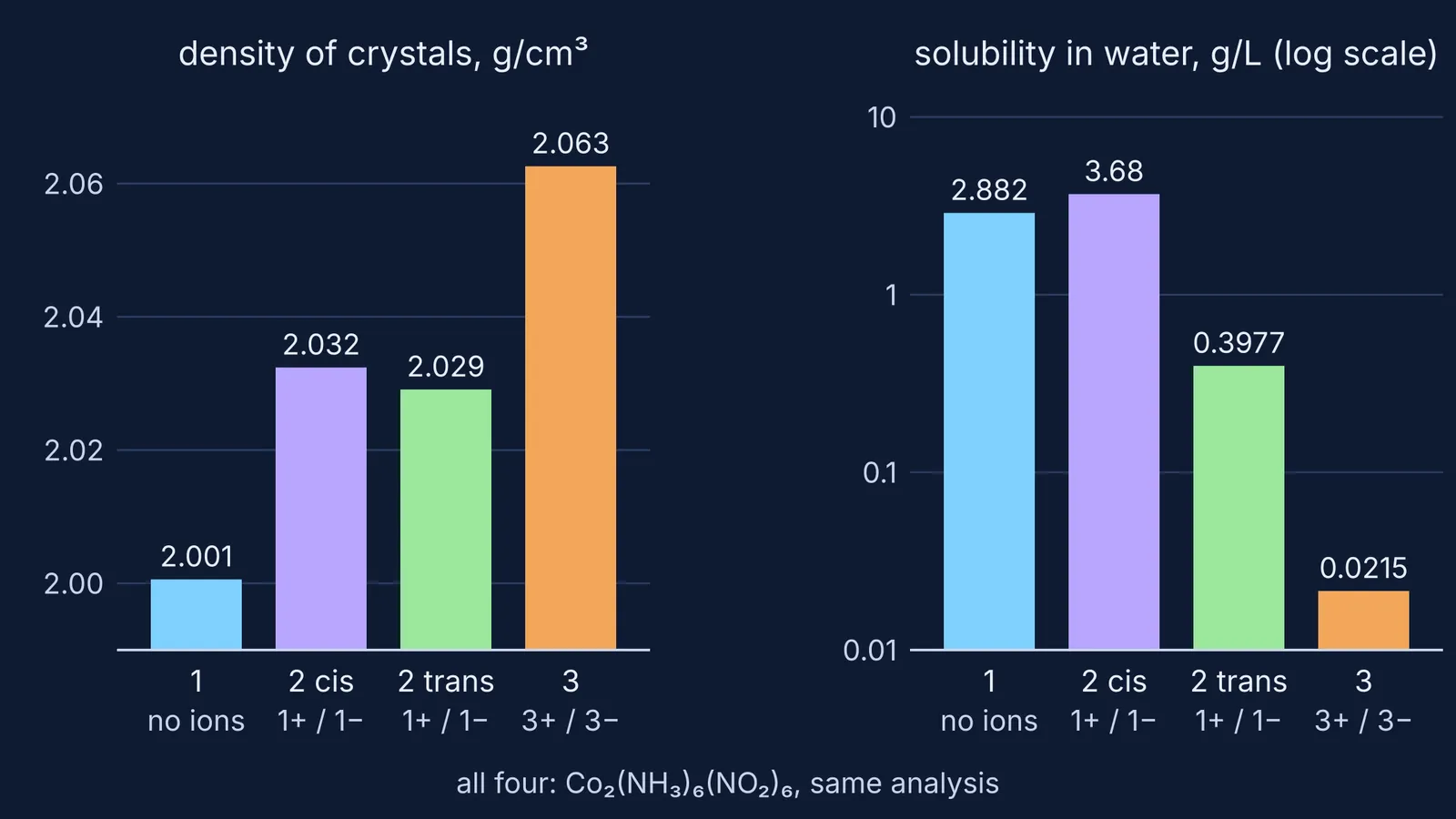
He measured densities at 32–33 °C, using xylene as the filling liquid. The page gives:
Compound 1 (no ions): mean density 2.0006, molar volume 248.0
Compound 2, 1,2 form: 2.0324, molar volume 244.2
Compound 2, 1,6 form: 2.0291, molar volume 244.5
Compound 3 (3+ and 3−): 2.0626, molar volume 240.5
Molar volume here is 496.08 ÷ density, for the doubled formula. Our python check reproduces his molar volumes to within 0.1. From no ions to 3+/3− ions, density rises by 3.1%. The same atoms pack a little tighter when the ions carry more charge.
De read this as electrical attraction compressing the molecule, following T. W. Richards's idea of "compressible atoms". Treat that mechanism as of its time. The measured trend is the reliable part.
How did solubility change with charge?
He could not measure such small amounts of cobalt reliably, so he measured the ammonia. He added NaOH to the saturated solution, distilled off the NH₃ into acid, estimated it by nesslerisation (and titration where possible) and reported it as grams of NH₄Cl. His results, in grams per litre:
Compound 1: 2.8820
Compound 2, 1,2 form: 3.6800
Compound 2, 1,6 form: 0.3977
Compound 3: 0.0215
He gives the ratios as 7·3 : 1 for compound 1 against the 1,6 form, and 18·5 : 1 for the 1,6 form against compound 3. (A text-only copy of the page drops the decimal point and reads "73:1"; the page image and the arithmetic, 2.8820 ÷ 0.3977 = 7.25, both give 7.3.) From the neutral compound to the 3+/3− salt, solubility falls about 134-fold.
The cis 1,2 form breaks the pattern. It is 9.3 times more soluble than its trans partner and even more soluble than compound 1. De called it "abnormal" and blamed the side-by-side NO₂ groups.
So treat "more charge, less soluble" as a tendency, not a rule. Higher charges make a stronger lattice, roughly in proportion to z₊ × z₋. That is the idea in how ion charge and size decide lattice energy. But hydration also grows with charge, and shape matters too, as the cis form shows.
Worked example: same analysis, different ions
1. Show that analysis cannot tell them apart. Molar mass of Co(NH₃)₃(NO₂)₃ = 58.933 + 3(17.031) + 3(46.005) = 248.04 g/mol. Doubled: 496.08.
Co = 58.933 ÷ 248.04 = 23.76%
N (six per Co) = 6 × 14.007 ÷ 248.04 = 33.88%
De printed 23.76% and 33.86%, and every compound gave about this. Composition alone gives Co(NH₃)₃(NO₂)₃ for all of them.
2. Count the ions per 496 g. Compound 1: two neutral molecules. Compound 2: two ions, 1+ and 1−. Compound 3: two ions, 3+ and 3−.
3. Which test separates them? Ideal colligative properties count particles, and every form gives two particles per 496 g. A freezing-point measurement cannot separate them. Conductivity can: compound 1 barely conducts, compound 2 conducts like a 1:1 salt, and compound 3 should conduct most, because its ions carry triple charges. A silver nitrate or barium chloride test is no help, since there is no free Cl⁻ or SO₄²⁻. Those precipitation tests are for ionisation isomers such as [Co(NH₃)₅Br]SO₄ and [Co(NH₃)₅SO₄]Br. For those, see counting ionisable chlorides with AgNO₃ and conductivity.
4. Check his solubility method. For compound 1 he found 1.8645 g of NH₄Cl per litre. NH₄Cl = 53.49 g/mol, so that is 0.03486 mol of NH₃. Each doubled formula contains 6 NH₃, so 0.005809 mol of compound dissolved. Multiply by 496.08 g/mol to get 2.882 g/L, which matches his 2.8820.
Where does this come up in JEE and NEET?
Class 12 Coordination Compounds: Werner's theory, counting ions from conductivity, coordination isomerism, and cis/trans in octahedral MA₄B₂.
Class 11 Some Basic Concepts: percentage composition, and why it gives only an empirical formula.
Class 12 Solutions: particle counting for the van 't Hoff factor.
If the idea of what sits inside and outside the bracket still feels hazy, the Concept Library covers every concept in chemistry with its own lesson. For exam practice, Fermi Test Prep covers JEE Main and Advanced preparation with an AI tutor.
Quick checklist
All three compounds have Co 23.76% and N 33.88%. Analysis cannot separate them.
[Co(NH₃)₃(NO₂)₃]: no ions. [Co(NH₃)₄(NO₂)₂][Co(NH₃)₂(NO₂)₄]: 1+/1−. [Co(NH₃)₆][Co(NO₂)₆]: 3+/3−.
Density rose 2.0006 → 2.029 → 2.0626 as the ionic charge rose.
Solubility fell 2.88 → 0.398 → 0.0215 g/L (ratios 7.3 : 1 and 18.5 : 1), except for the cis form.
Conductivity separates them; AgNO₃ does not.
The last two compounds are coordination isomers of each other.