On this page
In water, soap is not an ordinary salt. Its long anions cluster into micelles, and the solution behaves partly like a colloid. In 1918 Mary Evelyn Laing, working at Bristol, asked what soap does in dry alcohol instead. She measured how much potassium oleate raised the boiling point of ethanol, and how well the solution conducted. Both answers said the same thing: in alcohol, soap is a plain salt with close to its simple formula mass, only slightly ionised. An earlier claim that it formed double molecules was wrong.
Who was Mary Evelyn Laing and what did she publish in 1918?
The paper is M. E. Laing, "The state of potassium oleate and of oleic acid in solution in dry alcohol", J. Chem. Soc. Trans. 113 (1918) 435–444. We read it in the scanned 1918 volume and checked every number below against the page images. It is signed from the "Chemical Department, Bristol University" and was received on 14 March 1918. She thanks Dr. J. W. McBain, "at whose suggestion this work was carried out". We have not checked anything else about her life or career.
Why did anyone think soap formed double molecules in alcohol?
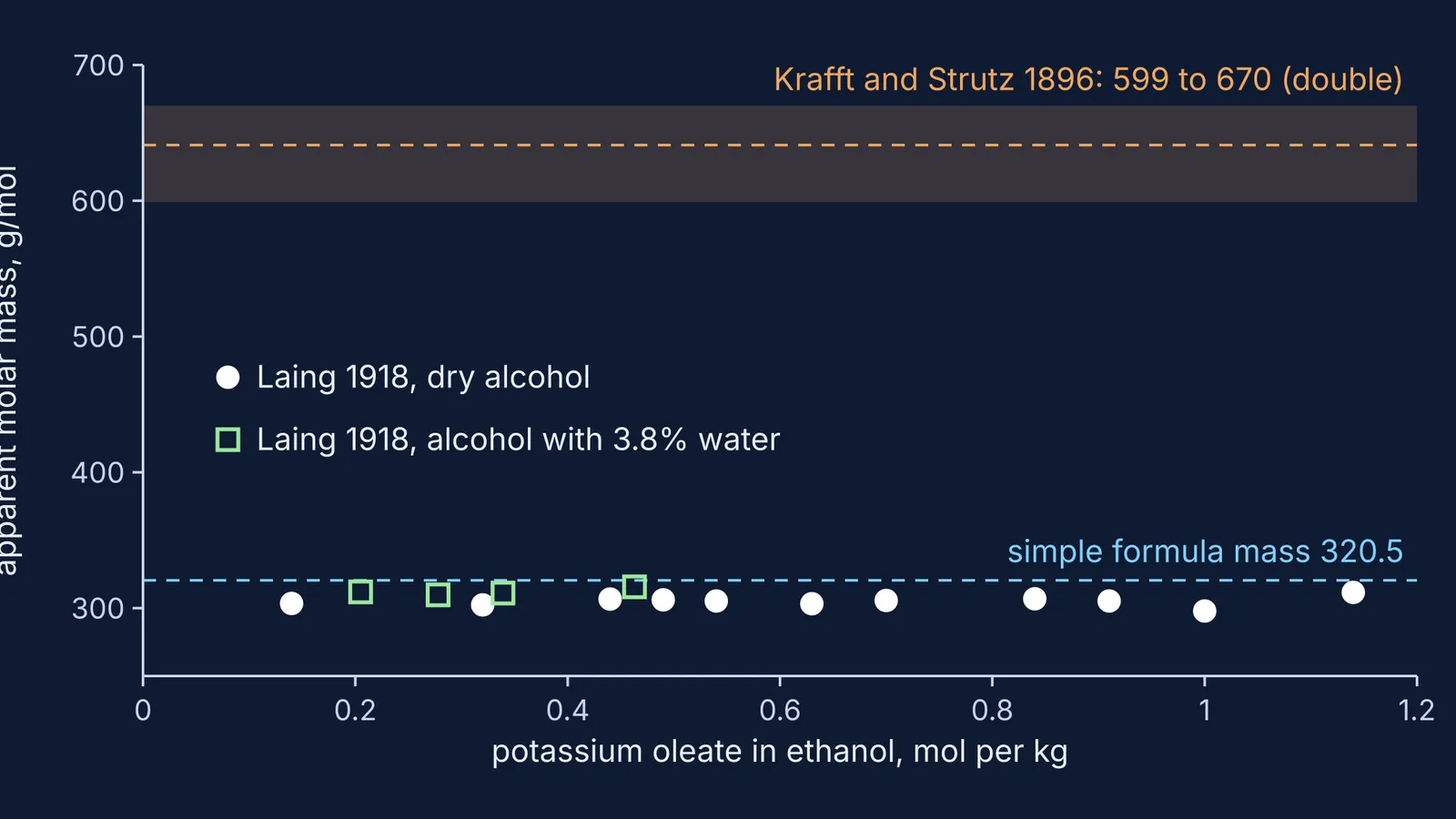
In 1896 Krafft and Strutz had measured molar masses of soap in alcohol of 599 to 670. The simple formula mass of potassium oleate is 320.5, so their numbers looked like double molecules. Krafft's second paper gave 347.
Meanwhile the Bristol laboratory where she worked had spent six years showing that soap in water is a "colloidal electrolyte". Laing quotes the definition: "Colloidal electrolytes are salts in which one ion has been replaced by a heavily hydrated micelle". So three pictures were possible in alcohol: single formula units, pairs, or colloid.
She took great care over dryness. Her ethanol had been kept over quicklime for three years, until it became "a soft, pale yellow jelly owing to the formation of calcium ethoxide". She made the soap without water at all: potassium metal into dry alcohol, then oleic acid.
2C₂H₅OH + 2K → 2C₂H₅OK + H₂
C₂H₅OK + C₁₇H₃₃COOH → C₁₇H₃₃COOK + C₂H₅OH
Both equations balance in atoms and charge.
What did her boiling-point measurements show?
She used Beckmann's boiling-point apparatus. Eleven solutions ran from 0.14 to 1.14 mol per kg of ethanol. Some of her rows:
4.518 g per 100 g alcohol: rise 0.173°, molar mass 303.4
10.21 g: rise 0.388°, molar mass 302.4
17.34 g: rise 0.654°, molar mass 305.2
36.80 g: rise 1.350°, molar mass 311.6
Her mean was 304.9, against a theory value of 320.5. In her words, the results "show no tendency for the molecular weight to alter with concentration". With 3.8% water added to the alcohol, the mean was 311.9.
She does not print the ebullioscopic constant she used. Working backwards from her rows gives about 1.15 K kg/mol. The NCERT Class 12 Solutions chapter lists 1.20 K kg/mol for ethanol in Table 1.3. Both are measured values of their time. In an exam, use whatever value the question gives.
How did conductivity confirm it?
At 60 °C her molar conductivity rose steadily on dilution, from 2.806 at 1.14 molal to 19.20 at 0.03 molal, "without exhibiting any irregularities". She judged the limiting value "probably lies between 50 and 60". From that she wrote that the dissociation "rises from a value of about 3 per cent in N-solution to about 30 per cent" in the most dilute solution. If you divide her table values by 50 to 60 yourself, you get about 5% and 32–38%. Either way, the salt is only a few per cent ionised when concentrated.
Her conclusion: potassium oleate in alcohol is "essentially a simple electrolyte dissociating to a very moderate extent into simple ions. Only quite small amounts of colloid can be present." She also printed a preliminary 18 °C result whose sample mass does not match its stated concentration on the page, so we leave it out.
How did she explain Krafft's water test?
Krafft had added 1.5 c.c. of water to a boiling soap solution and seen the boiling point fall by 0.09°. He took this as support for double molecules. Laing pointed out that alcohol with about 96% ethanol is "a minimum constant-boiling mixture". Adding 4% water to dry alcohol therefore lowers its boiling point "by about 0.126°", soap or no soap. The drop came from the solvent, not the solute. For the theory, see minimum and maximum boiling azeotropes; NCERT gives the ethanol–water azeotrope as about 95% ethanol by volume.
Oleic acid itself gave a mean molar mass of 287.1 against 282.3 calculated: also simple, and very weakly ionised.
Worked example: molar mass and the van 't Hoff factor from her data
Take her row with 10.21 g of potassium oleate in 100 g of ethanol and a rise of 0.388 K. Use NCERT's Kb = 1.20 K kg/mol.
Formula mass. C₁₇H₃₃COOK is C₁₈H₃₃KO₂: 18(12.011) + 33(1.008) + 39.098 + 2(15.999) = 320.56 g/mol.
Observed molar mass. M₂ = Kb × w₂ × 1000 ÷ (ΔTb × w₁) = 1.20 × 10.21 × 1000 ÷ (0.388 × 100) = 315.8 g/mol.
Van 't Hoff factor. i = normal ÷ observed = 320.56 ÷ 315.8 = 1.015.
Degree of ionisation. For KA ⇌ K⁺ + A⁻, i = 1 + α, so α ≈ 0.015, or 1.5%.
Same row with her Kb of about 1.15. M₂ = 302.6 g/mol, i = 1.059, α ≈ 6%.
Test the three pictures. Molality m = (10.21 ÷ 320.56) ÷ 0.100 = 0.3185 mol/kg. Predicted rise with Kb = 1.20: simple formula units 0.382 K; all paired into dimers (i = 0.5) 0.191 K; fully ionised (i = 2) 0.764 K. She measured 0.388 K. Only the simple picture fits.
The lesson: a 4% change in Kb moves α from 1.5% to 6%. What the data settle firmly is that i is close to 1, not 0.5. For the opposite case, where i really is near 0.5, see why acetic acid shows a molar mass of 120 in benzene.
Where does this come up in JEE and NEET?
Class 12 Solutions: ΔTb = Kb·m, the formula for M₂, abnormal molar mass and i. For the basic numerical, see elevation in boiling point numericals using Kb and molality.
Azeotropes: why 95–96% ethanol cannot be made drier by distillation.
Electrochemistry: α = Λm ÷ Λm°, and why Λm rises on dilution.
Class 10 soaps: micelles form in water. Laing's paper is the contrast case.
If molar-mass numericals keep slipping, the Fermi Problem Library has worked problems with a step-by-step solver that explains the reasoning. For exam practice, Fermi Test Prep covers JEE Main and Advanced preparation with an AI tutor.
Quick checklist
Potassium oleate, C₁₇H₃₃COOK, has a formula mass of 320.5.
Laing's 1918 mean molar mass in dry alcohol was 304.9, steady from 0.14 to 1.14 mol/kg.
Krafft and Strutz's 599–670 would mean double molecules; her data rule that out.
i = 320.5 ÷ observed, slightly above 1, so a few per cent ionised.
Her Kb was about 1.15; NCERT's is 1.20. Use the one the question gives.
Adding water to dry alcohol lowers its boiling point because of the azeotrope.