On this page
A liquid from coal tar is part benzene and part toluene and xylenes. How much of it is benzene? In 1919 Charles Edward Fawsitt, at the University of Sydney, answered with two freezing points. Dissolve the mixture in nitrobenzene and every component counts as a solute. Dissolve it in benzene and the benzene stops counting, because it simply joins the solvent. The difference between the two gives you the benzene.
Who was Fawsitt, and what did he publish?
The paper is C. E. Fawsitt, "The Use of Freezing-point Determinations in Quantitative Analysis", J. Chem. Soc. Trans. 115 (1919) 801–808. We read it in the scanned 1919 volume and checked the numbers below against the page images. It is signed "Chemical Department, University of Sydney" and was received on 14 April 1919. Fawsitt thanks C. H. Fischer "for carrying out the experimental work". We have not checked anything else about either man's life.
The idea was not his. Drapier had suggested it in 1915, but, Fawsitt writes, "has apparently not followed up this suggestion by publishing any experimental support". Fawsitt tested it.
Benzene and nitrobenzene are toxic. This post covers the idea and the arithmetic, not a procedure.
How can two freezing points measure one component?
Use ΔTf = Kf·m twice.
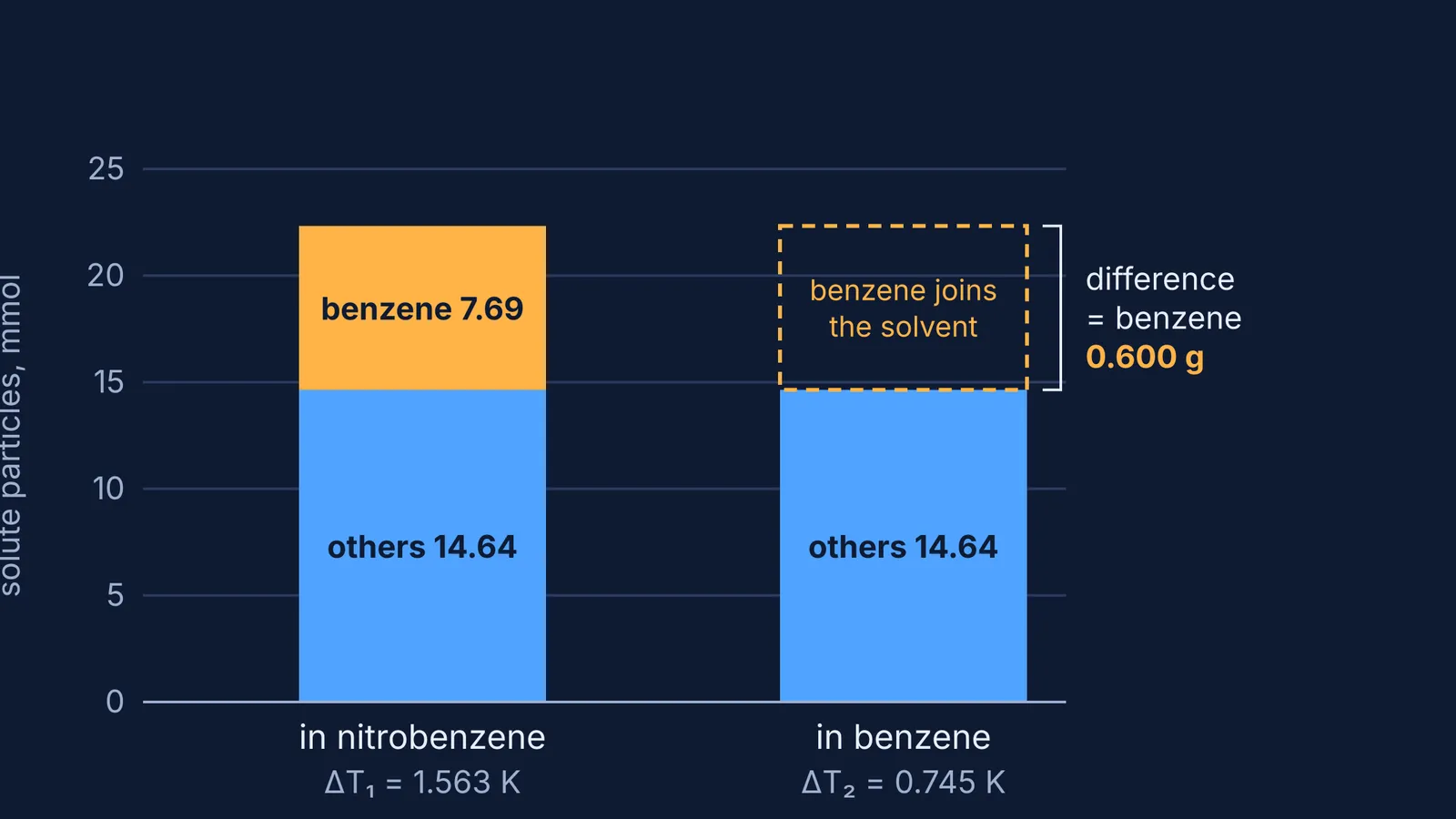
In nitrobenzene (a solvent that is not in the mixture): benzene, toluene and xylene are all solutes. ΔT₁ counts the moles of everything.
In benzene (a solvent that is one of the components): the sample's benzene joins the solvent, so the solvent gets slightly heavier. ΔT₂ counts only the moles of everything else.
Subtract: total moles minus other moles is the moles of benzene. Multiply by 78 g mol⁻¹.
The neat part: you never need to know what the other components are, or their molar masses. Only benzene's molar mass enters. Fawsitt states the assumptions plainly: depression proportional to concentration, inversely proportional to molar mass, and each solute acting "independently of the presence or absence of other solutes". He adds that the last one "certainly does not hold quite true even in dilute solution".
Worked example: find the benzene
Question. A 2.00 g sample contains benzene plus other hydrocarbons of unknown identity. Dissolved in 100 g of nitrobenzene (Kf = 7.0 K kg mol⁻¹, the value Fawsitt used) it lowers the freezing point by 1.563 K. A second 2.00 g portion, dissolved in 100 g of benzene (Kf = 5.12 K kg mol⁻¹), lowers it by 0.745 K. Find the mass of benzene in the sample.
Total moles, from nitrobenzene. ΔT₁ = Kf × n ÷ (mass of solvent in kg), so n = 1.563 × 0.100 ÷ 7.0 = 0.022329 mol.
Other moles, first pass. Pretend the benzene solvent is still 100 g: n(other) = 0.745 × 0.100 ÷ 5.12 = 0.014551 mol.
Benzene, first pass. 0.022329 − 0.014551 = 0.007778 mol, which is 0.607 g.
Correct the solvent. That benzene joined the solvent, which is now 100.607 g. Redo step 2: 0.745 × 0.100607 ÷ 5.12 = 0.014639 mol.
Benzene, second pass. 0.022329 − 0.014639 = 0.007690 mol = 0.600 g. One more round changes nothing at three figures.
Answer. 0.600 g of benzene, or 30.0% of the sample.
Bonus. The rest is 1.400 g in 0.014638 mol, an average molar mass of 95.7 g mol⁻¹: somewhere between toluene (92) and xylene (106).
We built this sample from 0.60 g benzene, 1.00 g toluene and 0.40 g xylene, and the method recovers the benzene exactly. Ideal equations in, ideal answer out. Real liquids are less tidy.
How close did Fawsitt get with real mixtures?
His Mixture B was benzene 15.3, toluene 62.4 and m-xylene 22.3 per cent, with Kf taken as 5.0 for benzene and 7.0 for nitrobenzene. His first readings:
1.383 per cent of the mixture in nitrobenzene: ΔT₁ = 1.040.
1.392 per cent in benzene: ΔT₂ = 0.642.
His tables say "percentage of solute". We read that as grams per 100 g of solvent, because with that reading his own formula returns his answer for this pair, 14.1, exactly. (For his other three pairs we get values 0.1 to 0.6 lower than he printed.)
The ideal equations predict 1.049 and 0.616. The nitrobenzene reading is close. The benzene reading is about 4% high, so the plain equations count too many "other" moles and give only 11.7% benzene. So Fawsitt added corrections:
A heavier solvent term. Each solvent mass gets an extra term proportional to the solute present, as pointed out in his preceding paper on freezing points.
Empirical factors. Correction factors, 1.018 and 1.008 for benzene mixtures, fitted to similar mixtures beforehand.
With them, Mixture B came out at 14.1, 13.4, 14.9 and 15.0 per cent, against 15.3 true. Mixture A (68.85% benzene) gave 69.6, 70.2 and 70.4. He used the same trick for cineole in eucalyptus oils, with benzene and cineole as the two solvents. There he took 146 for cineole's molar mass, found by experiment, not the formula value 154.
Why does he give the error in units, not per cent?
Because the answer is a small difference between two larger numbers. His Beckmann thermometer was graduated to 0.01°. In our python check on Mixture B, an error of 0.01° in ΔT₂ moves the answer by about 1.2 percentage units, and the same error in ΔT₁ by about 0.85. So he wrote that results were "within about 2 units of the true percentage", and that without earlier work on similar mixtures the error "was as high as 8 units". He recommended the method when there was earlier experience with the same class of substance, when other methods were less accurate, or when they needed more sample. His needs about 1 g, though 4–6 g is better.
Where does this come up in JEE and NEET?
Class 12 Solutions: ΔTf = Kf·m and molar mass from freezing point. For the single-solute version, see how to find molar mass from depression in freezing point. For a solvent picked for its large Kf, see the Rast method with camphor. A two-solvent problem like this one is good multi-step practice in JEE Advanced style.
To practise multi-step freezing-point problems, the Fermi Problem Library has a step-by-step solver that explains the reasoning. For exam practice, Fermi Test Prep covers JEE Main and Advanced preparation with an AI tutor.
Quick checklist
Fawsitt, University of Sydney, 1919; experiments by C. H. Fischer; idea from Drapier, 1915.
In nitrobenzene, ΔT₁ counts all solute moles. In benzene, ΔT₂ counts only non-benzene moles.
Benzene moles = total moles − other moles. Only benzene's molar mass is needed.
Add the sample's benzene to the solvent mass, and iterate once or twice.
Mixture B, 15.3% benzene: plain equations 11.7%, Fawsitt's corrected formula 14.1%.
A 0.01° reading error shifts the answer by about one unit.