

On this page
After an extraction, the organic layer can still carry dissolved water. Even dichloromethane, which we call immiscible with water, holds a little, and it has to go before you evaporate the solvent, as the Athabasca University extraction and drying-agents lab manual explains. The usual fix is an anhydrous salt that grabs water and becomes a solid hydrate, for example MgSO₄ + 7H₂O → MgSO₄·7H₂O. The salt you pick decides how fast and how safely that happens.
Which drying agent should you use for an organic liquid?
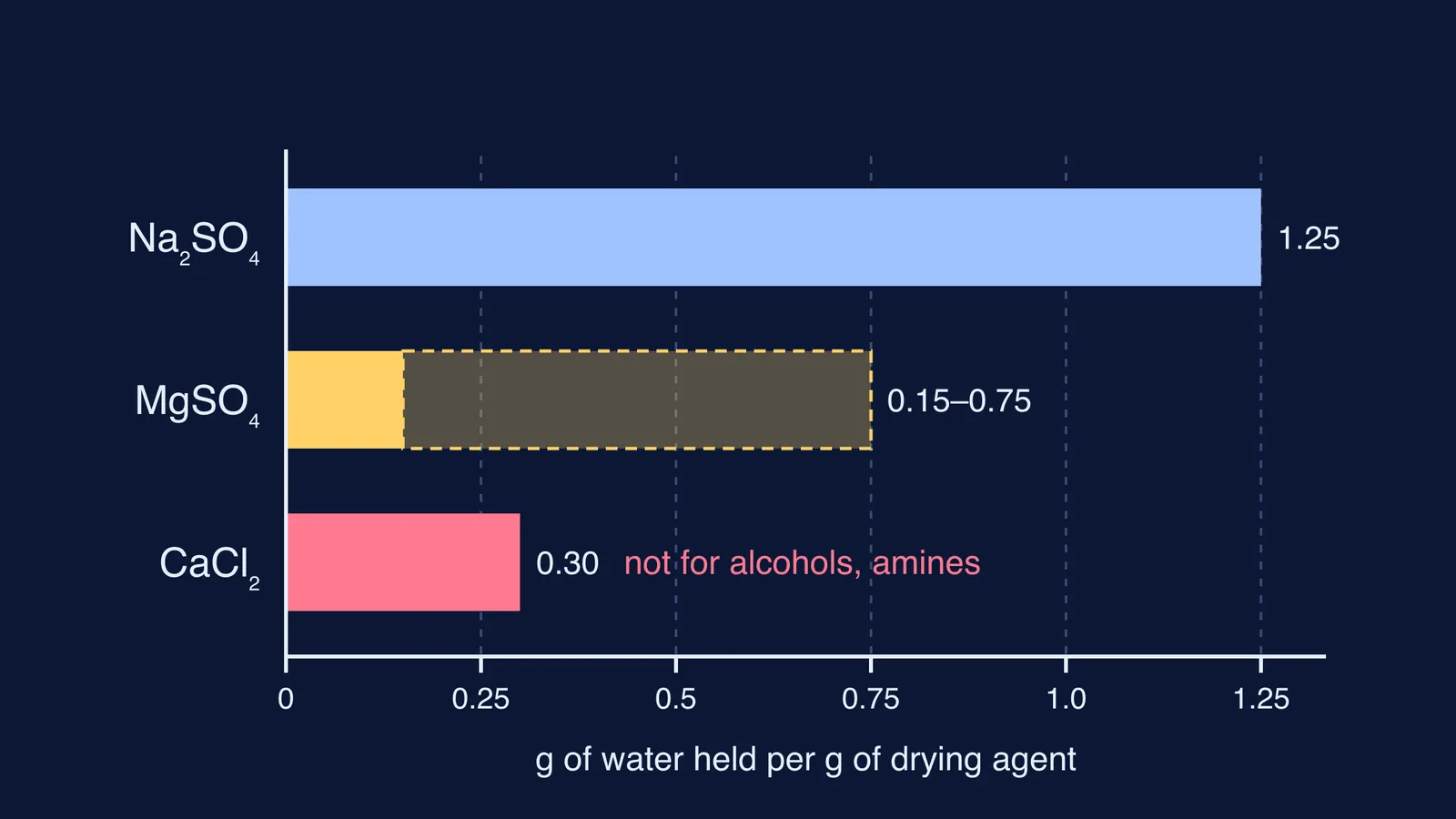
The survey table in the LibreTexts organic chemistry lab textbook by Lisa Nichols compares drying agents on how fast they work, how much water they hold per gram, and what they should not be used with. In that textbook:
Anhydrous magnesium sulfate (MgSO₄) removes most water quickly and holds 0.15–0.75 g of water per gram. It is a fine powder that adsorbs some of your compound, so you filter it off and rinse it. It is somewhat acidic, so avoid it for highly acid-sensitive compounds.
Anhydrous sodium sulfate (Na₂SO₄) holds 1.25 g of water per gram, the most of the three, but works at a moderate rate and may leave small amounts of water behind, so let the flask stand for a while. You can usually decant the liquid off it. It dries diethyl ether poorly unless you wash with brine (saturated salt solution) first.
Anhydrous calcium chloride (CaCl₂) removes water quickly but holds only 0.30 g per gram, so you need more of it. As pellets, it can be decanted after a few minutes. It also absorbs methanol and ethanol, which is the catch.
Why must CaCl₂ not be used for alcohols and amines?
The Athabasca manual's drying-agent table lists calcium chloride as "not good for alcohols, amines, phenols", while it rates sodium sulfate and magnesium sulfate as "good with organic solvents". A common way to picture why: the small, doubly charged Ca²⁺ ion holds water by attracting the lone pairs on its oxygen. An alcohol's oxygen and an amine's nitrogen carry lone pairs too, so they can be held in the solid as well.
A University of Minnesota paper reports that ammonia can be selectively absorbed by calcium chloride, while nitrogen and hydrogen are not. Amines keep ammonia's nitrogen lone pair, which fits the manual's warning. For alcohols, LibreTexts says it directly: CaCl₂ absorbs methanol and ethanol.
So your yield can drop, and some of the salt's capacity goes on your product instead of water.
Chemists study each compound class as its own drying problem: David Burfield and Roger Smithers's series on desiccant efficiency in The Journal of Organic Chemistry includes amines in 1981 (with Andrew Tan) and alcohols in 1983.
If the lone-pair idea feels shaky, our post on why alcohols act as both acids and bases walks through the oxygen in –OH, and the Fermi Concept Library covers every concept in chemistry, each with its own lesson.
How do you know the liquid is dry?
Watch the solid. Anhydrous MgSO₄ is a fine, loose powder, while its hydrate is clumpy and often clings to the glass, according to the LibreTexts drying-agents guide. Add a small portion, swirl, and keep adding until new powder stops clumping and fine particles move freely without clinging to each other or the glass. Sodium sulfate clumps the same way, but the guide says to let it sit for at least 5 minutes before you call the solution dry.
Two rules from the Athabasca manual:
Don't add far too much, as the desiccant can absorb your organic liquid along with the water. A layer covering the bottom of the flask is usually enough to start.
Filter or decant the drying agent off before you distil. Many hydrates give their water back when heated.
How much drying agent do you need?
Say your extract holds about 0.30 g of water (a practice figure, not a measurement). Divide by each capacity in the LibreTexts table of drying agents:
Na₂SO₄: 0.30 ÷ 1.25 = 0.24 g at the very least.
MgSO₄: 0.30 ÷ 0.75 = 0.4 g up to 0.30 ÷ 0.15 = 2.0 g, depending on how much of its range it reaches.
CaCl₂: 0.30 ÷ 0.30 = 1.0 g.
These are floors, not recipes: in practice you add more, wait, and judge by the clumping test. Then run the compound check:
Is your compound an alcohol, amine or phenol? Rule out CaCl₂. For an amine, the Athabasca table lists KOH as "good for amines".
Is it highly acid-sensitive? Prefer Na₂SO₄ over MgSO₄.
Is the solvent diethyl ether? Wash with brine first, then dry.
Short on time? Use MgSO₄, then filter and rinse.
Try it on separating benzoic acid, phenol, aniline and toluene by extraction: the phenol and aniline fractions rule out CaCl₂. So does aniline recovered after the dilute HCl wash that pulls amines into water.
To practise reagent choices like this, the Fermi Problem Library has worked problems with a step-by-step solver that explains the reasoning rather than printing an answer.


