

On this page
Drop a small piece of sodium into ethanol and it fizzes as hydrogen gas forms. Heat the same ethanol with concentrated sulphuric acid and its oxygen picks up a proton, the first step on the way to ethene. Once you see which part of the –OH group does each job, many Class 12 reactions start to make sense.
Why do alcohols act as both acids and bases?
The –OH group gives an alcohol two features. The O–H bond is polar, so a strong enough base can pull the hydrogen off as H⁺. The oxygen also carries two lone pairs, which can take a proton from a strong enough acid.
The NCERT Class 12 chemistry textbook (Unit 7, Alcohols, Phenols and Ethers) says the acidic character of alcohols "is due to the polar nature of O–H bond". The same chapter adds: "Alcohols act as Bronsted bases as well. It is due to the presence of unshared electron pairs on oxygen, which makes them proton acceptors."
A substance that can act as an acid or a base is called amphoteric. LibreTexts' organic chemistry text/17:_Alcohols_and_Phenols/17.02:_Properties_of_Alcohols_and_Phenols) describes alcohols as weak bases, similar in strength to water, and as weak acids that need a strong base such as sodium hydride or sodium metal to form alkoxide ions.
What happens when an alcohol reacts with sodium?
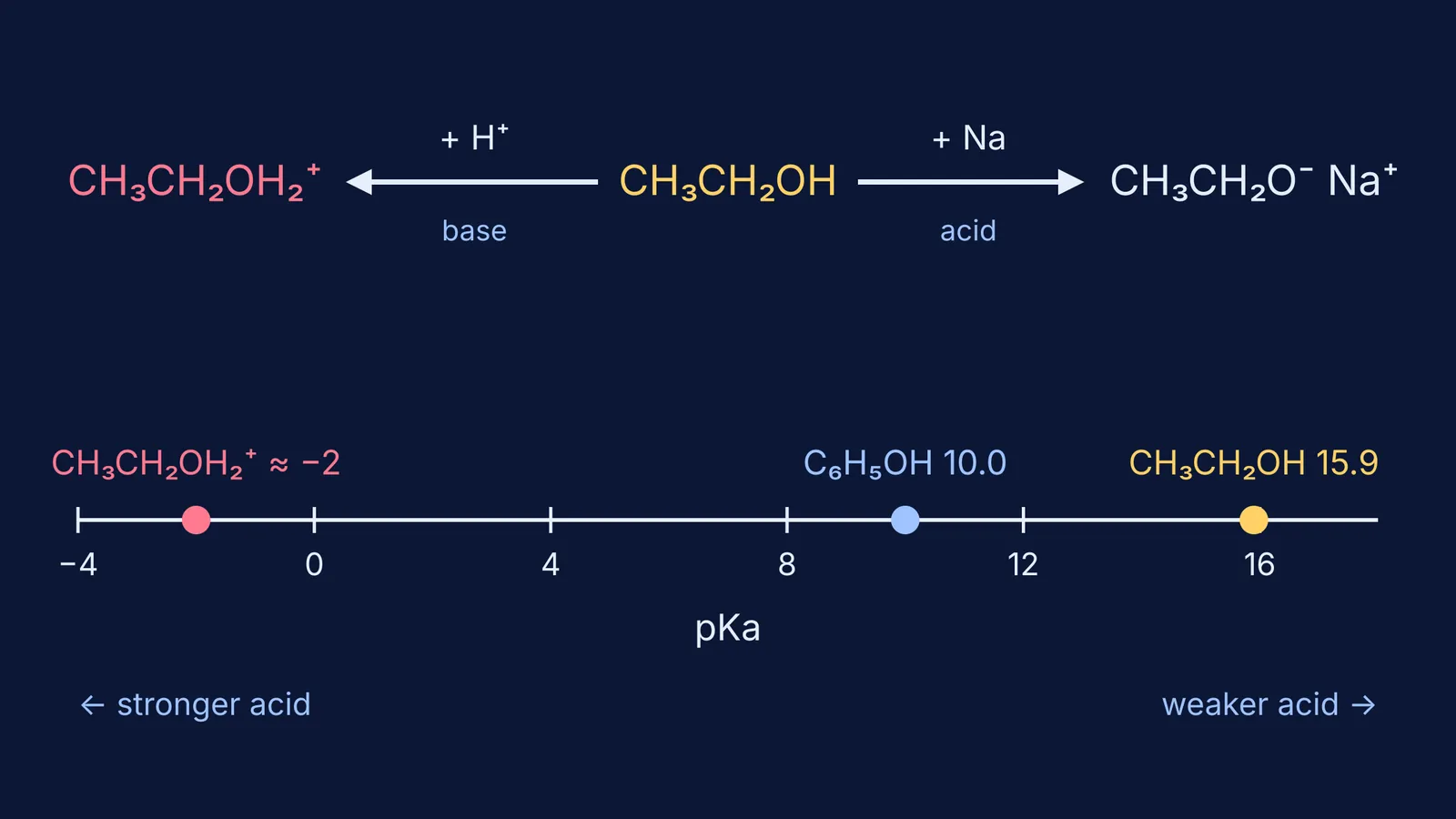
Here the alcohol is the acid. Sodium removes the O–H hydrogen, and you get a sodium alkoxide plus hydrogen gas, as shown in NCERT Unit 7:
2R–OH + 2Na → 2R–O–Na + H₂
Ethanol has a pKa of 15.9, according to Table 7.3 of the same NCERT chapter. Phenol's pKa is 10.0, and the textbook notes that phenol is about a million times more acidic than ethanol. A higher pKa means a weaker acid.
Alkyl groups matter too. NCERT explains that electron-releasing groups such as –CH₃ push electron density onto oxygen and make the O–H bond less polar. That gives the order of acid strength: primary > secondary > tertiary. For other places this metal turns up, see our guide to uses of sodium metal in organic chemistry.
What happens when an alcohol meets a strong acid?
Now the alcohol is the base. One lone pair on oxygen accepts H⁺, and the alcohol becomes a protonated alcohol, or oxonium ion, R–OH₂⁺. NCERT's mechanism for making ethene from ethanol with concentrated H₂SO₄ at 443 K starts at exactly this point: "Step 1: Formation of protonated alcohol" (NCERT Unit 7). In step 2, a neutral water molecule leaves and a carbocation forms.
That protonated alcohol is itself a strong acid. Master Organic Chemistry puts the pKa of oxonium ions at about −2, and that of typical alcohols such as ethanol, isopropanol and t-butanol at about 16 to 18. So only a strong acid can protonate an alcohol to any real extent.
That is why acid shows up when an alcohol's C–O bond breaks, as in dehydration and in the Lucas test for primary, secondary and tertiary alcohols, which uses concentrated HCl.
How do you tell which role an alcohol is playing?
Run this three-question check on any reaction in your paper.
What is the partner? If it is a reactive metal (Na, K, Al) or a very strong base, look at the O–H hydrogen. If it is a strong acid (concentrated H₂SO₄, H₃PO₄, HX), look at the oxygen lone pair.
Which bond changes? If O–H breaks and you get an alkoxide, the alcohol was the acid. If oxygen gains a new O–H bond and a + charge, the alcohol was the base.
Is the partner strong enough? Compare pKa values: the reaction favours the side with the weaker acid. NaOH with phenol works; NaOH with ethanol does not get you far.
Worked example (both reactions are in NCERT Unit 7): Ethanol is treated (a) with sodium metal and (b) with concentrated H₂SO₄ at 443 K. In each case, does ethanol act as an acid or a base, and what is the first species formed?
(a) Sodium takes the hydrogen from the O–H bond, so the O–H bond breaks. Ethanol is the acid. You get sodium ethoxide, CH₃CH₂O⁻ Na⁺, and hydrogen gas.
(b) The acid gives H⁺ to an oxygen lone pair. Ethanol is the base. The first species is the ethyl oxonium ion, CH₃CH₂OH₂⁺, which then loses water and a proton to give ethene.
To see how alcohols, water and stronger acids line up on one scale, read our pKa ladder for common organic acids. When you practise, the Fermi Problem Library has worked problems with a step-by-step solver that explains the reasoning rather than printing an answer, so you can check where the proton goes at each step. If conjugate acids and bases still feel shaky, revise them first in the Fermi Concept Library.


