On this page
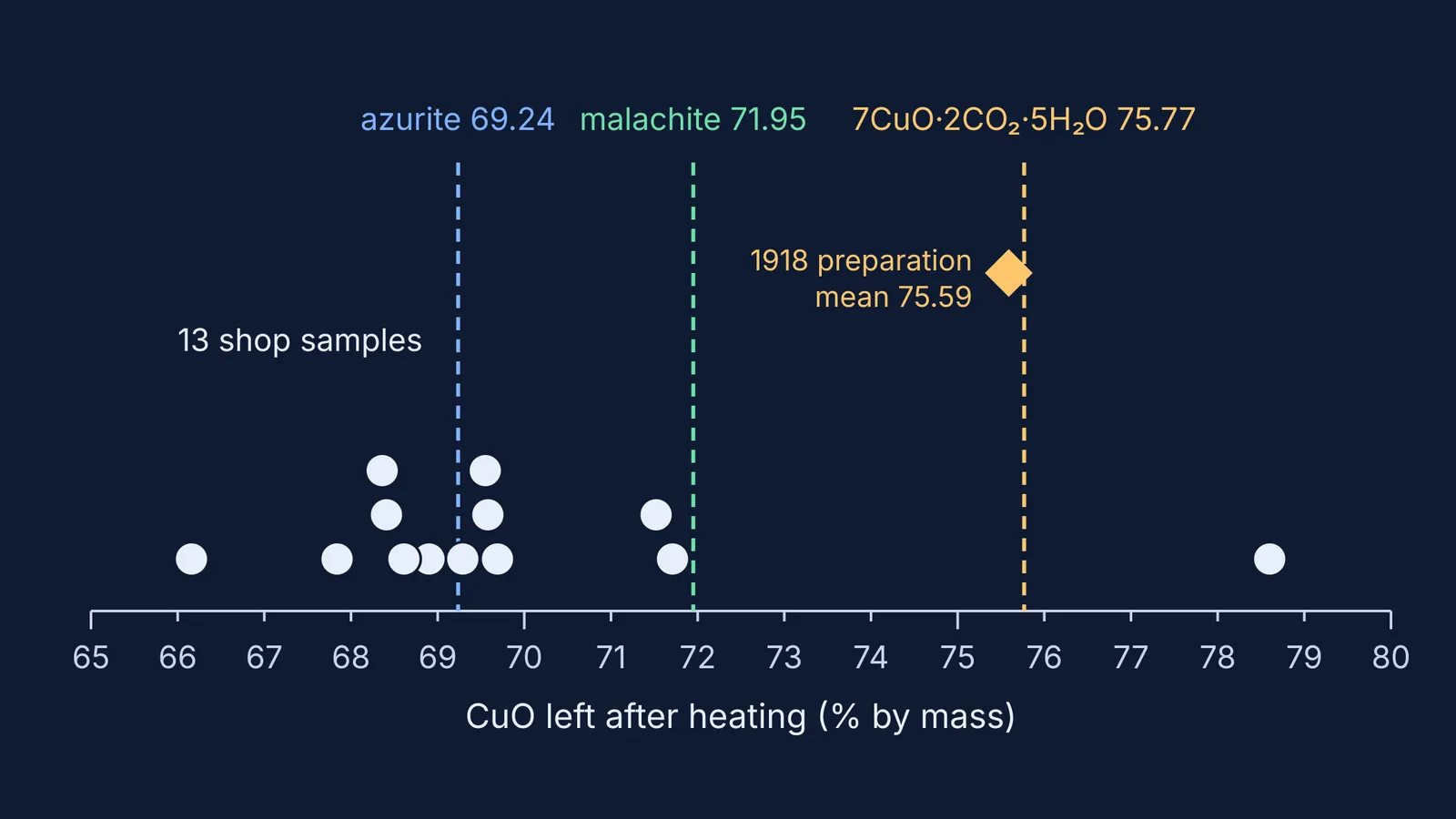
Buy a jar labelled "copper carbonate" and you might expect the green mineral malachite, CuCO₃·Cu(OH)₂. In 1918 two chemists at Government College, Lahore, heated thirteen commercial samples from European and Indian suppliers and weighed the copper oxide left behind. The numbers matched neither malachite nor any other single formula. They then set out to make a basic carbonate of steady composition, and their most consistent preparation analysed as 7CuO·2CO₂·5H₂O, which they wrote as 2CuCO₃·5Cu(OH)₂.
Who were Dunnicliff and Lal, and what were they testing?
The paper is Horace Barratt Dunnicliff and Sudarshan Lal, "The Basic Carbonates of Copper", Journal of the Chemical Society, Transactions, volume 113 (1918), pages 718–722 (DOI 10.1039/CT9181300718; scan on the Internet Archive). The address printed at the end is The Chemical Laboratories, Government College, Lahore, and it was received on 25 April 1918. We have not checked either author's biography, so this post sticks to what they printed. The numbers below were checked against the page images.
The work began with a cuprammonium solution of cellulose, made by dissolving cotton wool in commercial copper carbonate dissolved in ammonium hydroxide. To know what was in that solution, the authors needed to know what was in the jar. The chemist Pickering had written in 1909 (Transactions, volume 95) that ordinary commercial copper carbonate has the formula 2CuO,CO₂,H₂O, "identical with malachite". Dunnicliff and Lal's reply: "The present paper does not support that statement."
How did they show shop copper carbonate was not malachite?
Heat any basic copper carbonate strongly and only black copper(II) oxide is left:
CuCO₃·Cu(OH)₂ → 2CuO + CO₂ + H₂O
So the percentage of CuO left is a fingerprint of the formula. Their table of theory values, for comparison:
Malachite, CuCO₃·Cu(OH)₂: 71.94% CuO, 19.95% CO₂, 8.11% H₂O
Azurite, 2CuCO₃·Cu(OH)₂: 69.23% CuO, 25.54% CO₂, 5.22% H₂O
CuCO₃·Cu(OH)₂·H₂O: 66.53% CuO
Pickering's compound, 8CuO·3CO₂·6H₂O: 72.62% CuO
The thirteen samples gave 78.60, 71.71, 71.52, 69.69, 69.58, 69.55, 69.29, 68.90, 68.61, 68.41, 68.36, 67.84 and 66.16% CuO. Twelve of them fall between 66.16% and 71.71%, a spread of more than five percentage points. The first value is higher than any formula in their table, and the paper does not comment on it. Small amounts of impurity, usually iron, were present, but never enough to explain the spread.
Could damp air explain the low values? Dried samples left in laboratory air for three days gained at most 1.06%, too small to matter.
Then they measured carbon dioxide. Five samples holding 69.55% to 71.71% CuO contained only 17.35% to 18.1% CO₂, well below malachite (19.95%) and azurite (25.54%). Their conclusion: "in reality the substance is a mixture of very varying composition".
Why is precipitated copper carbonate always basic?
Carbonate ions in water partly react with water and make hydroxide ions:
CO₃²⁻ + H₂O ⇌ HCO₃⁻ + OH⁻
So when you add sodium carbonate solution to copper sulphate solution, the copper comes down with both carbonate and hydroxide. Written for malachite, a balanced version is:
2CuSO₄ + 2Na₂CO₃ + H₂O → CuCO₃·Cu(OH)₂ + 2Na₂SO₄ + CO₂
How much carbonate and how much hydroxide end up in the solid depends on how you mix. In Dunnicliff and Lal's Table II, five precipitation methods gave 71.82, 78.85, 77.09, 71.08 and 72.37% CuO. The hot copper sulphate run gave the highest. "These results yielded no valuable prospects," they wrote.
How did they make a basic carbonate of fixed composition?
They moved to a full analysis. A weighed sample was heated in a boat inside a short lead-glass tube in dry oxygen, and the water and carbon dioxide were caught in the same absorption tubes used for organic combustion analysis. The copper oxide left was "very dark brown, not black" and tested free of impurity.
Cold sodium carbonate (10%) added to copper sulphate at 14.5°. The mean analysis was 72.98% CuO, 15.46% CO₂ and 11.89% H₂O, which they wrote as 13.07CuO·5CO₂·9.40H₂O. That is close to Pickering's 8CuO·3CO₂·6H₂O.
A mixture of 5% sodium carbonate and 5% sodium hydrogen carbonate. Three separate preparations gave 7CuO·1.89CO₂·5.20H₂O, 7CuO·1.93CO₂·5.39H₂O and 7CuO·2.01CO₂·5.28H₂O. The mean was 75.59% CuO, 11.61% CO₂ and 12.95% H₂O, against 75.77%, 11.98% and 12.25% required for 2CuCO₃·5Cu(OH)₂.
They called it "a new basic copper carbonate". We have not checked whether later chemists accepted it as a distinct compound, and it is not in NCERT, so treat it as a 1918 result, not textbook fact.
How do you get a formula from oxide percentages?
Here is the calculation behind their mean result. Treat each oxide as one unit, with molar masses CuO = 79.545, CO₂ = 44.009 and H₂O = 18.015 g/mol.
Take 100 g. That gives 75.59 g CuO, 11.61 g CO₂ and 12.95 g H₂O.
Convert to moles. CuO: 75.59 ÷ 79.545 = 0.9503. CO₂: 11.61 ÷ 44.009 = 0.2638. H₂O: 12.95 ÷ 18.015 = 0.7188.
Divide by the smallest. 0.9503 ÷ 0.2638 = 3.60 and 0.7188 ÷ 0.2638 = 2.72, so CuO : CO₂ : H₂O = 3.60 : 1 : 2.72.
Clear the decimal. Multiply by 2: 7.20 : 2 : 5.45. Scaled to exactly 7 CuO, as the paper does, it is 7 : 1.94 : 5.30. The nearest simple ratio is 7 : 2 : 5.
Check by working back. 7CuO·2CO₂·5H₂O has a molar mass of 734.91 g/mol and requires 75.77% CuO, 11.98% CO₂ and 12.26% H₂O. Malachite would need 71.95%, 19.90% and 8.15%; azurite 69.24%, 25.54% and 5.23%. Only 7 : 2 : 5 is close. Water comes out about 0.7% high, and all three preparations ran slightly high in water.
Rewrite as carbonate and hydroxide. 2CuO + 2CO₂ make 2CuCO₃, and 5CuO + 5H₂O make 5Cu(OH)₂, so 7CuO·2CO₂·5H₂O = 2CuCO₃·5Cu(OH)₂. Atoms: Cu 7, C 2, O 16, H 10.
Write the decomposition. 2CuCO₃·5Cu(OH)₂ → 7CuO + 2CO₂ + 5H₂O. It is 60.53% copper and loses 24.23% of its mass on heating. Malachite (221.11 g/mol) is 57.48% copper and loses 28.05%.
If you want more formula problems with every step checked, the Fermi Problem Library has a step-by-step solver that explains the reasoning. For the general method with organic compounds, see our guide to empirical and molecular formulas from percentage data.
Where does this show up in JEE, NEET and board exams?
Class 11, Some Basic Concepts of Chemistry: empirical formula from percentage composition, and the law of definite proportions.
Class 10, Metals and Non-metals: NCERT calls the green coat on copper basic copper carbonate. That is a different question from this paper, which is about lab powders. Outdoors the coat is often mostly a basic sulphate; see why copper roofs turn green.
Heating salts: carbonates losing CO₂ on heating, covered in what happens when nitrates and carbonates are heated.
Quick checklist
Malachite is CuCO₃·Cu(OH)₂ and leaves 71.95% CuO on heating; azurite 2CuCO₃·Cu(OH)₂ leaves 69.24%.
Dunnicliff and Lal (Lahore, 1918) found commercial samples ranging from 66.16% to 71.71% CuO for twelve of thirteen, with too little CO₂ for either mineral.
Carbonate precipitates of copper are basic because carbonate solutions contain OH⁻.
With oxide data, divide by oxide molar masses, clear decimals, then check percentages.
7CuO·2CO₂·5H₂O = 2CuCO₃·5Cu(OH)₂; balance Cu 7, C 2, O 16, H 10.