On this page
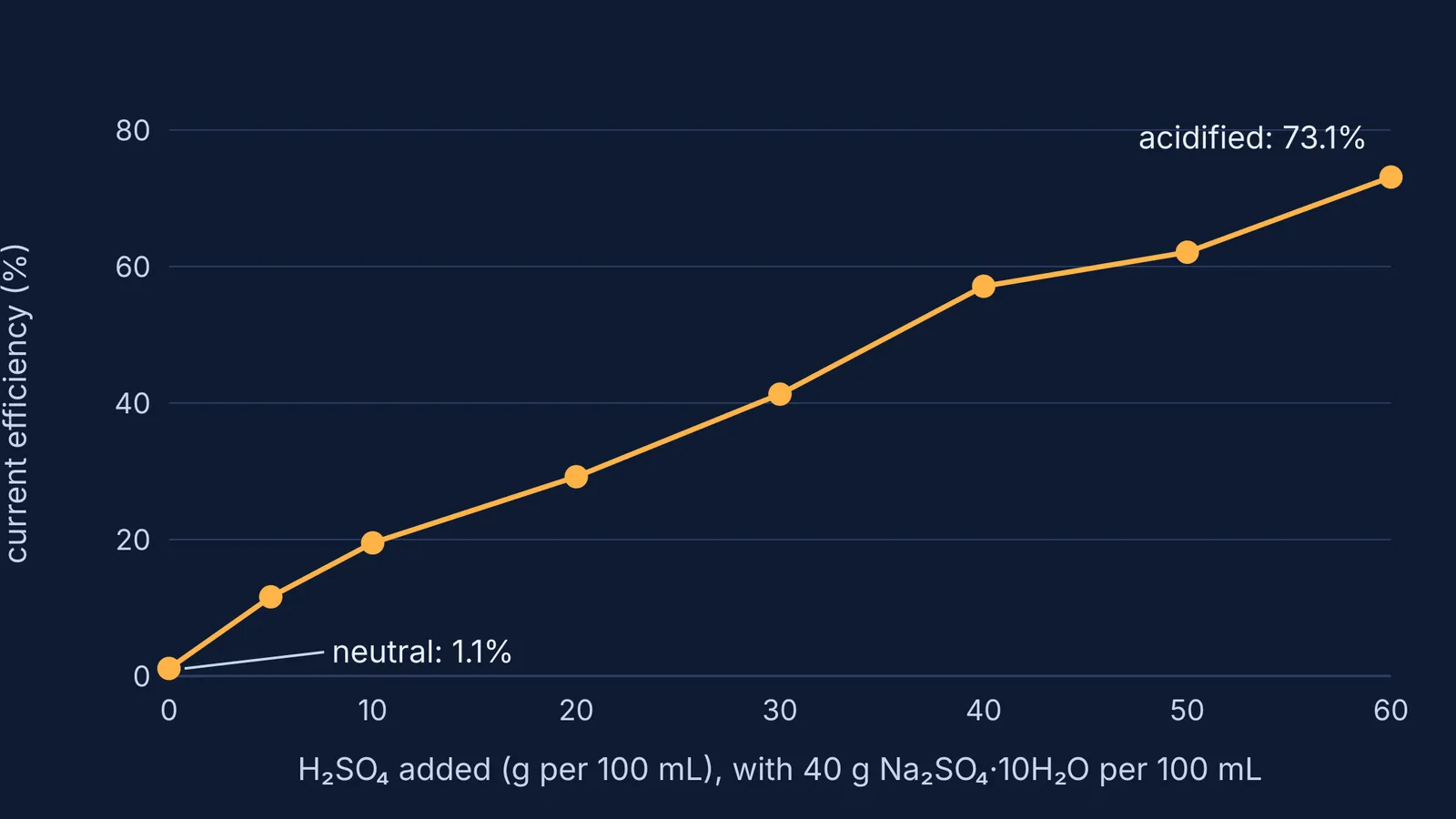
NCERT says one way to make hydrogen peroxide is to electrolyse an acidified sulphate solution at high current density, which gives peroxodisulphate, and then hydrolyse it. It does not say how much of the current actually ends up as peroxodisulphate. In 1946 two chemists at Benares Hindu University measured exactly that. With a neutral sodium sulphate solution, only about 1% of the charge made persulphate. Add sulphuric acid and the figure rose to 73%. They counted the product with a permanganate back-titration, and you can redo their arithmetic with Faraday's law.
Who were Solanki and Kamath and what did they measure?
Our source is the paper itself: "The electrolytic preparation of hydrogen peroxide. Part I. The intermediate production of sodium persulphate" by Dr. D. N. Solanki and I. S. K. Kamath, Chemistry Department, Benares Hindu University. It was communicated by Professor S. S. Joshi, who suggested the problem, and printed in the Proceedings of the Indian Academy of Sciences, Section A, vol. 24, pp. 305–314 (1946), doi:10.1007/BF03171065. The full text is on the Academy's site. We could not verify anything about the authors beyond these printed affiliations.
Their aim was practical. Persulphuric acid, H₂S₂O₈, is unstable, so they tried aqueous sodium sulphate as the starting material, because the sodium salt is more stable. In each run they passed a known charge between platinum electrodes in a cooled cell, then measured the "total active oxygen" in the electrolyte. Current efficiency (C.E.) is the share of the charge that went into that active oxygen.
This post describes their measurements. It is not a recipe: concentrated acid, persulphates and hydrogen peroxide are hazardous.
Why did neutral sodium sulphate give only about 1%?
Their Table I used neutral Na₂SO₄·10H₂O solutions of 10 to 40 g per 100 mL, at 1 A for 30 minutes. The current efficiency was only 0.5 to 1.1%. They wrote that the net result was "apparently the decomposition of water into its elements": hydrogen and oxygen came off in about a 2 : 1 ratio.
When they acidified the bath, less oxygen appeared at the anode, "less than half of the cathodic hydrogen", and the solution became strongly oxidising. With 40 g of the sulphate per 100 mL, adding sulphuric acid raised the efficiency step by step, from 11.6% (5 g per 100 mL) to 73.1% (60 g per 100 mL), as the hero chart shows.
Their explanation follows Richarz: persulphate forms when discharged HSO₄⁻ ions pair up at the anode. In ionic form:
2HSO₄⁻ → S₂O₈²⁻ + 2H⁺ + 2e⁻
A neutral sulphate solution is almost all Na⁺ and SO₄²⁻, so the HSO₄⁻ needed is missing. Adding sulphuric acid supplies it. They also noted one exception the theory could not explain: neutral ammonium sulphate gives high yields, which others had explained by writing the reaction directly from sulphate, 2SO₄²⁻ → S₂O₈²⁻ + 2e⁻.
Why water oxidation competes at all, and why concentration and overpotential decide which product wins, is covered in our post on the anode product in sulphuric acid electrolysis. This paper adds the measured numbers.
How did temperature, time and additives change the result?
The acidified bath was sensitive to several conditions. All figures below are as printed in their tables.
Temperature (Table VII): 63.8% at 10 °C, falling to 51.2% at 30 °C and 21.9% at 50 °C. Cold cells matter.
Time (Table VIII): 84.0% for 15 minutes, 63.3% for 30 minutes and 46.3% for 240 minutes. As HSO₄⁻ is used up and the product builds up, more charge is wasted. Solid sodium persulphate began to separate after about 2 ampere-hours.
Anode current density (Table IV): efficiency rose to about 72% at 55–83 A dm⁻², then fell to 67.2% at 165.5 A dm⁻², which they put down to heating.
Additives (Table X): 1 g per 100 mL of K₂Cr₂O₇ lowered it to 45.1%; KClO₄ gave 74.1% and HF gave 81.4%. With a porous diaphragm and HF they reached 92.7%.
A note on the HF row: the machine-readable text layer of the Academy's PDF reads "31.4", but the printed scan clearly shows 81.4. Our check agrees: 303 mL of N/20 active oxygen after 0.5 A h works out to 81.2% with today's Faraday constant (81.4% with their 26.86).
"Active oxygen" counts every oxidant that the iron(II) reduces, so any Caro's acid (H₂SO₅) or H₂O₂ formed in the cell is included with the persulphate.
How did they count the persulphate with a back-titration?
Permanganate is itself an oxidant, so it cannot titrate persulphate directly. They added a measured excess of FeSO₄ to 5 mL of electrolyte, then titrated the leftover Fe²⁺ with N/20 KMnO₄. Both reactions balance in atoms and charge:
S₂O₈²⁻ + 2Fe²⁺ → 2SO₄²⁻ + 2Fe³⁺
MnO₄⁻ + 5Fe²⁺ + 8H⁺ → Mn²⁺ + 5Fe³⁺ + 4H₂O
The blank (FeSO₄ alone) minus the back-titre gives the KMnO₄ volume equivalent to the oxidant. The general method is in our guide to back titration calculations.
Worked example: the paper's Expt. 1, step by step
Conditions: 1 A for 15 minutes, 50 mL of electrolyte, 5 mL taken for analysis.
Step 1. Back-titration. The blank for 10 mL FeSO₄ took 21.1 mL of N/20 KMnO₄. After adding 5 mL of electrolyte, it took 5.4 mL. Oxidant in 5 mL = 21.1 − 5.4 = 15.7 mL of N/20.
Step 2. Scale up. The whole 50 mL holds 15.7 × 10 = 157 mL of N/20, or 157 × 0.05 = 7.85 milliequivalents.
Step 3. Charge passed. Q = I × t = 1 × 900 = 900 C, which is 0.25 A h. Moles of electrons = 900 ÷ 96485 = 9.33 × 10⁻³ mol = 9.33 meq.
Step 4. Current efficiency. C.E. = 7.85 ÷ 9.33 × 100 = 84.2%. The paper prints 84.0%. It used 26.86 A h per faraday, which gives 84.3% by the same formula; today's value is 26.80 A h.
Step 5. As hydrogen peroxide. S₂O₈²⁻ + 2H₂O → 2HSO₄⁻ + H₂O₂ (balanced in S, O, H and charge). Each mole of H₂O₂ is 2 equivalents, so 7.85 meq corresponds to 7.85 × 17.01 = 134 mg of H₂O₂ in the 50 mL, if every bit of active oxygen ended up as H₂O₂.
Fermi Test Prep offers JEE Main and Advanced preparation with an AI tutor, where you can practise Faraday's-law numericals like this one. For more practice chaining titres into moles, the Fermi Problem Library has a step-by-step solver that explains the reasoning.
Where does this appear in the syllabus?
Class 12 Electrochemistry: Faraday's laws, products of electrolysis, and current efficiency in electrolysis.
Class 11 Hydrogen: H₂O₂ from peroxodisulphate by electrolysis and hydrolysis.
Redox titrations: permanganate, iron(II) and back-titration arithmetic.
Checklist
Neutral Na₂SO₄: about 1% current efficiency, mostly H₂ and O₂.
Acidified with H₂SO₄: up to 73%, because HSO₄⁻ is present.
Cold cells and short runs give higher efficiency.
Anode: 2HSO₄⁻ → S₂O₈²⁻ + 2H⁺ + 2e⁻.
Back-titration: oxidant = blank − back-titre.
C.E. = equivalents of product ÷ (Q ÷ 96485) × 100.