On this page
Most salt-analysis tests have a floor: below some amount of the ion, you see nothing. The lanthanum nitrate test for acetate also has a ceiling. Chemists at Andhra University, Waltair, proposed it for routine analysis in 1941, then found it sometimes failed because there was too much acetate. Here is the test, their limits, and how to turn mg per mL into mol/L.
What is the lanthanum nitrate test for acetate?
K. Neelakantam and L. Ramachandra Row, of the Department of Chemistry, Andhra University, described the method in the Proceedings of the Indian Academy of Sciences, Section A, volume 13, pages 194–198 (DOI 10.1007/BF03049266; full text at ias.ac.in). They credit Damour (1857) with finding that lanthanum salts, iodine and ammonia give "a dark blue precipitate or a blue solution" with acetates, and Krüger and Tschirch (from 1929) with making it an acetate test.
Their procedure:
Distil 2–3 g of the mixture with excess dilute (4 N) sulphuric acid for 5–10 minutes, collecting the vapour under a little water.
If sulphite or thiosulphate is present, first add excess saturated KMnO₄ to the acidified mixture, so no SO₂ distils over (sulphate formed from it interferes).
To the cooled distillate add 1 mL of 5% lanthanum nitrate, a slight excess of 0.02 N iodine (made in potassium iodide) and a few drops of dilute ammonia.
If no blue appears within a minute, heat gradually to boiling. With acetate the liquid turns dark blue, often in the cold, and a deep blue gelatinous precipitate settles on standing. Without acetate there is only a greyish gelatinous precipitate.
Why did they want a new acetate test?
The usual tests did not satisfy them. They wrote that the ferric chloride test "is not satisfactory" (citing Curtman and Harris, 1917), that success with the ethyl acetate test "is largely dependant on personal factors", and that "a visual test would be far superior to the olefactory ones". You can compare this with the standard school tests in our post on the acetate ion test with vinegar smell and neutral ferric chloride.
Distillation was their way round interference. Phosphate, fluoride, oxalate and tartrate precipitate lanthanum, and sulphate interferes in small amounts. The sodium carbonate extract was no good here: it "leaves the interfering acid radicles in solution". Volatile acetic acid distils away from them.
What did the 1948 follow-up find about too much acetate?
Neelakantam, now F.A.Sc., and N. Viswanadham published Part II in volume 27, pages 138–140, received December 1947 (DOI 10.1007/BF03170886; full text at ias.ac.in). They wrote that "the test failed to detect acetate" in some cases, and that "an upper limit of identification existed".
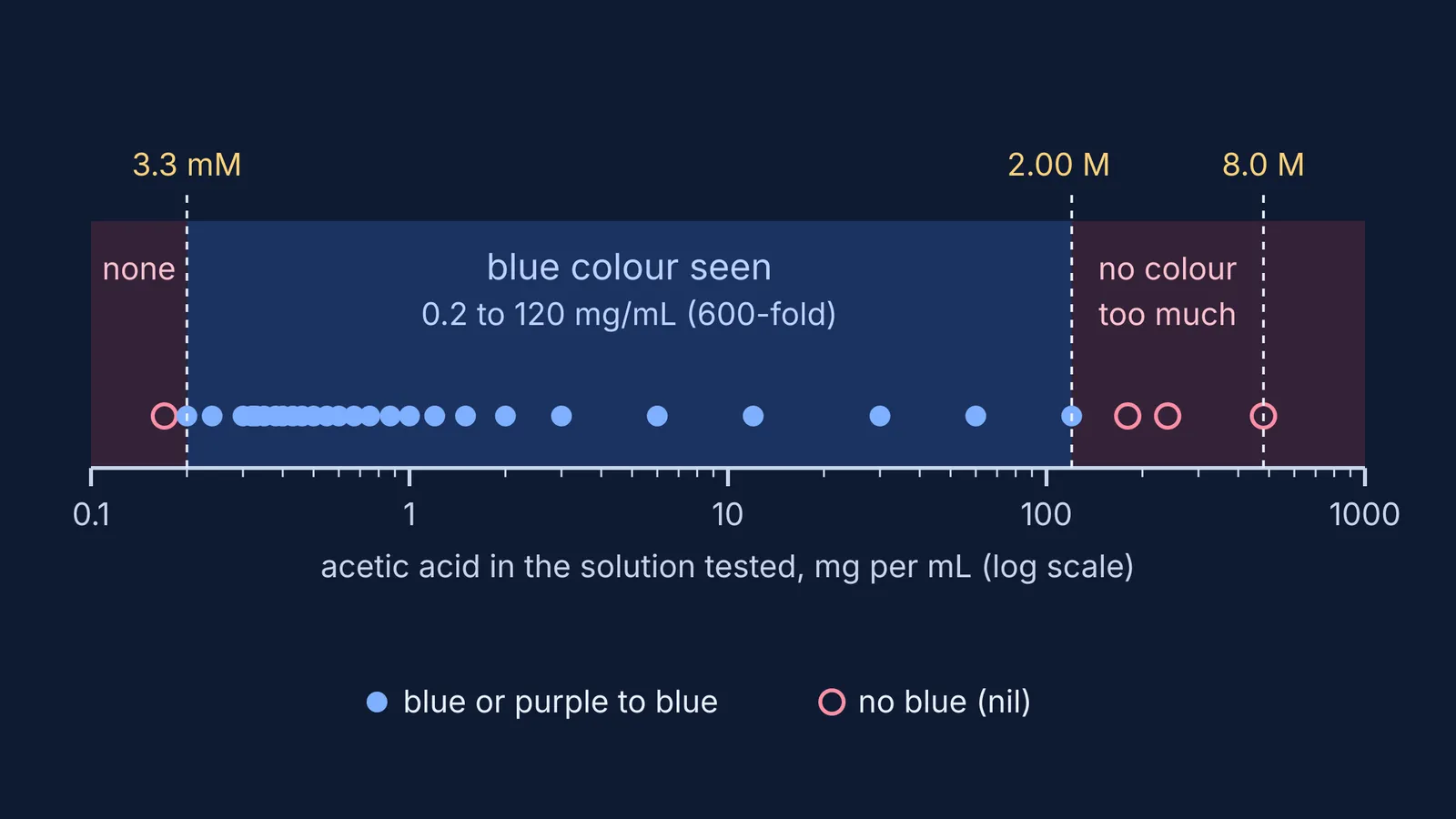
They mixed 1.0 mL of acetic acid (8 N down to 0.005 N) with 1.0 mL of 5% lanthanum nitrate, added iodine until distinctly yellow, then 2 N ammonia until the yellow was "nearly but not completely discharged". Their table, in mg acetic acid per mL:
480: no colour, cold or hot, even with more ammonia.
240 and 180: no colour; extra ammonia gave only a light purple tinge.
120: light purple at once, turning blue in about five minutes.
60 down to 1.2: purple (once brownish purple) turning dark or deep blue, quickly, in the cold.
1.0 to 0.67: blue or greenish blue, developing slowly; at 0.75 and 0.67 a dirty grey precipitate turned deep blue on heating.
0.60 to 0.20: nothing in the cold; a purple or bluish colour developed slowly on heating, fading to "light bluish grey" at 0.20.
0.17: nothing, just a cream precipitate.
Their stated limits are 120 mg per mL (upper) and 0.2 mg per mL (lower), the second being "1 in 5,000". Feigl's spot-test book had given 1 in 2,000. They also found that "a drop or two of ammonia" beyond the usual end point "frequently secured a positive result", and that the failures were "primarily due to a high acetate ion concentration" and "to some extent" to the amount of ammonia added.
Why does the blue colour appear, and why does it disappear?
Neither paper explains the blue. The explanation you will meet elsewhere is that iodine is taken up by a precipitate of basic lanthanum acetate, much as starch holds iodine. Treat that as the usual explanation, not something these papers showed; we have not checked it against a primary source.
They do not explain the upper limit either, beyond pointing at acetate concentration and ammonia. You can work out how much ammonia the acid uses up (step 5 below). That fits their remark about ammonia, but they did not test it as the cause, so it is a hint, not an answer.
Worked example: the detection window in mol/L
Molar mass. CH₃COOH = 2(12.011) + 4(1.008) + 2(15.999) = 60.05 g/mol. Since 1 mg/mL = 1 g/L, divide by this to get mol/L.
Upper limit. 120 ÷ 60.05 = 2.00 mol/L.
Lower limit. 0.2 ÷ 60.05 = 0.00333 mol/L, or 3.3 mmol/L. Check "1 in 5,000": 1 g in 5,000 mL is 0.2 mg/mL. Feigl's 1 in 2,000 is 0.5 mg/mL.
Top of the series. 480 ÷ 60.05 = 7.99 mol/L. Acetic acid gives one H⁺, so this is the paper's "8 N".
Ammonia used up. 1.0 mL of 2.00 M acid holds 2.0 mmol, which needs 1.0 mL of 2 N NH₃ just to neutralise it. 1.0 mL of the 480 mg/mL solution holds 8.0 mmol and needs 4.0 mL.
Width of the window. 120 ÷ 0.2 = 600-fold.
These limits are for the acid before the lanthanum nitrate went in; in the tube it was roughly half.
Try it. A mixture holds 1.0 g of anhydrous sodium acetate (M = 82.03 g/mol). Assume all of its acetic acid distils into 3.0 mL of water.
Moles: 1.0 ÷ 82.03 = 12.19 mmol, which is 12.19 × 60.05 = 732 mg of acetic acid.
Concentration: 732 ÷ 3.0 = 244 mg/mL, about 4.06 mol/L.
This is above 120 mg/mL. In the 1948 table, 240 mg/mL gave no colour.
Fix: dilute at least 244 ÷ 120 = 2.03-fold. Mixing 1 mL of distillate with 2 mL of water gives 81 mg/mL, safely inside the window.
The 3.0 mL assumption is ours, for the arithmetic. Nothing in the tube tells you that you are above the limit.
What does this teach you about salt analysis?
A negative result means "not seen under these conditions", not "absent". Concentration and the amount of acid or base can hide an ion that is there. Keep that in mind across the whole systematic approach to salt analysis.
If unit conversions slow you down, the Fermi Problem Library has a step-by-step solver that explains the reasoning. For practical and viva revision, Fermi Test Prep offers JEE Main and Advanced preparation with an AI tutor.
Quick checklist
Reagents: lanthanum nitrate, iodine in KI, then dilute ammonia; blue means acetate.
Distil acetic acid out first to leave phosphate, fluoride, oxalate, tartrate and sulphate behind.
Working range (1948): 120 down to 0.2 mg acetic acid per mL, about 2.0 M to 3.3 mM.
No colour with a strong distillate? Add a drop more ammonia, or dilute and repeat.
The blue is usually explained as iodine taken up by basic lanthanum acetate; the papers do not say.