On this page
Mix very dilute silver nitrate with a salt of α-bromopropionic acid and, for hours, almost nothing happens. In 1935 A. N. Kappanna, working at the College of Science, Nagpur, showed why. The reaction does not run in the solution at all. It runs on the surface of the silver bromide it makes. It is autocatalysis by a solid product, and he proved it by adding the solid at the start.
Who was A. N. Kappanna, and where is the paper?
The paper is "Kinetics of the reaction between a brompropionate and silver ions: a heterogeneous reaction taking place on the surface of silver bromide", received on 15 October 1935 and printed in the Proceedings of the Indian Academy of Sciences, Section A, vol. 2, pp. 512–524 (doi:10.1007/BF03046894). The full text is open on the Academy's site.
The paper gives his name and "College of Science, Nagpur", and nothing more. We have not checked the rest of his career, so we leave it out.
What reaction did Kappanna study?
Halogen-substituted propionic acids react with silver nitrate to give lactic acid and silver halide. With the sodium salt, the ionic equation is:
CH₃CHBrCOO⁻ + Ag⁺ + H₂O → CH₃CH(OH)COO⁻ + AgBr + H⁺
It balances: C 3, H 6, O 3, Br 1 and Ag 1 on each side, and zero net charge on both sides. Without silver, Kappanna notes, the bromo salt hydrolyses only very slowly, even when heated.
George Senter (J.C.S., 1910) had found that the second-order rate constant "gradually increased as the reaction progressed" and blamed the silver halide. Kappanna set out to test that.
He worked at 27 °C in bottles painted black to keep light off the silver bromide. To follow the reaction he pipetted out a sample, added excess KI (which removes Ag⁺ as AgI and stops the reaction), then KIO₃. The acid formed releases iodine, which he titrated with thiosulphate:
IO₃⁻ + 5I⁻ + 6H⁺ → 3I₂ + 3H₂O
I₂ + 2S₂O₃²⁻ → 2I⁻ + S₄O₆²⁻
Both balance in atoms and charge.
How did he prove the precipitate was the catalyst?
The constant drifts up. In 0.03 N bromopropionate with 0.02 N AgNO₃, his second-order constant rose from 1.104 at 5 minutes to 1.638 at 20 minutes.
Coagulation stops it. After about 20 minutes the AgBr clumped and the reaction slowed sharply. He put this down to "the large diminution in the surface area of the particles on coagulation".
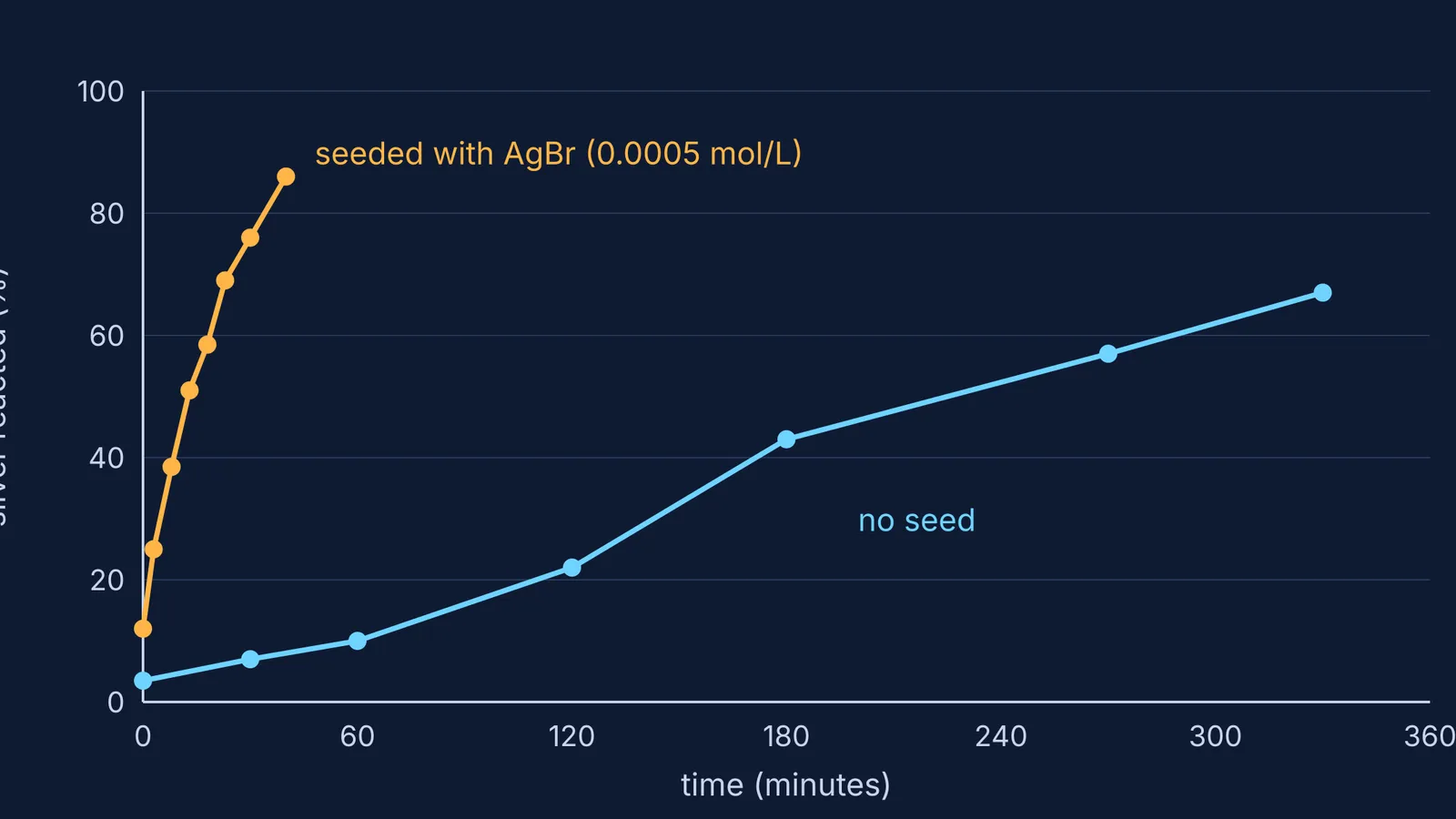
No solid, no reaction. Below 0.001 N, he wrote, the reaction "does not start at all for quite a long time". In the first five or six hours, less than ten per cent of the silver reacted.
AgBr alone is not enough. Colloidal AgBr added to the bromo salt without silver nitrate caused no more than 2–3% hydrolysis in about 24 hours. So the active agent is "silver ions absorbed on the surface of silver bromide particles".
Seeding works. Without a seed, "six to seven hours are required to enable two-thirds of the silver nitrate to react". With 0.0005 mol of AgBr per litre at the start, the reaction went "to completion in less than an hour". His table shows 86% of the silver used up by 40 minutes.
He then wrote the rate as k₃(a − x)(b − x)(c + x), where a and b are the silver and bromopropionate concentrations, and c + x is the amount of AgBr present. He called the assumption behind the (c + x) term, that surface is proportional to the amount of solid, "very arbitrary". Yet with seeds from 0.0005 to 0.0015 mol per litre, k₃ came out between 4.1 and 4.6 × 10⁴. The unit is L² mol⁻² min⁻¹; our recalculation from his Table VIII gives 4.3 to 4.9 × 10⁴ after the first reading. Because the rate is first order in each ion, he concluded that both are only "sparsely adsorbed" on the surface.
Why does an autocatalytic reaction have a maximum rate?
Worked example. In his unseeded run (Table VII), the units make a = 10 for silver and b = 15 for bromopropionate.
Simplest model. If rate = kx(a − x), the rate is zero at the start (no product) and zero at the end (no reactant). Setting d/dx of x(a − x) to zero gives a − 2x = 0, so the maximum is at x = a/2, half-way.
His rate law, no seed. Put c = 0, so rate ∝ x(10 − x)(15 − x) = x³ − 25x² + 150x. The derivative is zero when 3x² − 50x + 150 = 0, giving x = 3.92. By our calculation, the fastest point comes at about 39% of the silver used. It is earlier than half-way because the excess bromopropionate keeps the (b − x) term large.
Compare with what he saw. In Table VII the fastest stretch was 120 to 180 minutes, while the silver reacted went from 22% to 43%. The prediction falls inside that window (37% if you use the small c = 0.35 he measured at the start).
With a heavy seed (c = 5), the peak moves to x = 0.66, so the reaction is fastest almost from the start. The rate law predicts a starting rate about 15 times the unseeded one (our calculation).
If problems like finding where a rate is largest still feel slippery, the Fermi Problem Library has a step-by-step solver that explains the reasoning.
How is this different from Mn²⁺ in the permanganate titration?
In the KMnO₄–oxalic acid titration, Mn²⁺ speeds up the reaction that makes it. That catalyst is dissolved, so it is homogeneous catalysis. Kappanna's catalyst is a solid in contact with a solution, which is heterogeneous catalysis, sorted out in homogeneous vs heterogeneous catalysis examples. Here surface area matters: fine particles work, clumped ones barely do.
For another silver reaction with an accelerating product, see Donnan and Potts, 1910 on how such a product can hide the true order.
Kappanna also explained the long wait. Bromide has to form by slow hydrolysis "before the solubility product of silver bromide is reached". A quick check of our own: with Ksp(AgBr) about 5 × 10⁻¹³ and [Ag⁺] = 0.001 M, AgBr is saturated once [Br⁻] reaches only about 5 × 10⁻¹⁰ M. So reaching Ksp is probably not the slow step; building up enough solid surface is the likelier bottleneck. That is our inference, not his.
Where does this show up in JEE and NEET?
Chemical Kinetics (Class 12): autocatalysis, S-shaped curves, and finding the maximum of a rate expression.
Surface Chemistry: heterogeneous catalysis, adsorption on a solid, and why coagulation cuts the active surface.
Ionic Equilibrium: a precipitate forms only when the ionic product exceeds Ksp.
Redox titrations: iodate and iodide releasing iodine in proportion to the acid present.
For structured JEE practice on these chapters, Fermi Test Prep covers JEE Main and Advanced preparation with an AI tutor.
Quick checklist
The reaction runs on the AgBr surface, through Ag⁺ adsorbed there.
Seeding with 0.0005 mol/L AgBr cut 6–7 hours to under one hour.
For rate = kx(a − x), the maximum rate is at x = a/2.
His rate law with a 1.5-fold excess of bromopropionate puts the maximum near 39% (our calculation).
Mn²⁺ in permanganate titrations is homogeneous autocatalysis; AgBr here is heterogeneous.