On this page
The brown ring test for nitrate comes with a warning: rule out nitrite first. But what if your sample has both? In a paper received in October 1937, G. V. L. Narasimha Murty, at the Department of Chemistry, Andhra University, Waltair, compared two ways of getting nitrite out of the way before measuring nitrate. One looks neat on paper and drifts high. The other uses urea, and it held steady.
Why does nitrite interfere with nitrate tests?
In the brown ring test, iron(II) reduces nitrate to nitric oxide in concentrated acid:
3Fe²⁺ + NO₃⁻ + 4H⁺ → 3Fe³⁺ + NO + 2H₂O
Nitrite does the same job more easily. It needs only dilute acid and one Fe²⁺:
NO₂⁻ + Fe²⁺ + 2H⁺ → Fe³⁺ + NO + H₂O
Check it: charge on the left is −1 + 2 + 2 = +3, on the right +3. Oxygen is 2 on each side. Either way you get NO, and NO with spare Fe²⁺ gives the brown [Fe(H₂O)₅(NO)]²⁺. The colour cannot tell you which ion made the NO.
Murty met the same problem in quantitative work. His paper, "Colourimetric estimation of nitrate in the presence of nitrite", appeared in the Proceedings of the Indian Academy of Sciences, Section A, volume 7, pages 108–112 (received 30 October 1937, published 1938, communicated by T. R. Seshadri; DOI 10.1007/BF03045675; full text at ias.ac.in). It opens with the problem: "more than one part per million of nitrite is found to give too high a value for the nitrate content" in the phenol sulphonic acid colour method.
What were the two ways to remove nitrite?
Route 1: oxidise it with H₂O₂. Tatlock and Thomson (1904) had shown that hydrogen peroxide converts nitrite to nitrate quantitatively:
NO₂⁻ + H₂O₂ → NO₃⁻ + H₂O
Nitrogen goes from +3 to +5, and each peroxide oxygen goes from −1 to −2, so two electrons move each way. You then measure nitrite separately, measure the total nitrate after oxidation, and subtract. Murty added 0.1 N H₂O₂ in small portions at 40–50 °C, at least five times, then evaporated to dryness. A few drops of very dilute ferric sulphate (about 0.002 M) let the oxidation finish during evaporation. Adding all the peroxide at once "gave widely varying results".
Route 2: destroy it with urea. He added excess 1% urea and four or five drops of 0.002 N sulphuric acid. Nitrous acid and urea give only gases:
CO(NH₂)₂ + 2HNO₂ → CO₂ + 2N₂ + 3H₂O
Atoms: C 1 and 1; H 4 + 2 = 6 and 6; N 2 + 2 = 4 and 4; O 1 + 4 = 5 and 2 + 3 = 5. In electron terms, each urea nitrogen (−3) gives up three electrons and each nitrite nitrogen (+3) takes three, and all four end up at 0 in N₂. Two cautions from the paper: "excess of sulphuric acid should be scrupulously avoided" because it concentrates on evaporation "and destroys some of the nitrate", while varying the amount of urea "over a very wide range" made no difference.
Which method gave the right nitrate value?
Each test used the same nitrate, with nitrite raised step by step. The tables give nitrogen in mg × 10². The text layer of the scan garbles this label, but the printed page reads "mg. × 10²", and it fits his sentence that the error becomes considerable once nitrite nitrogen "exceeds 0.1 mg". So "20" in the table means 0.20 mg of nitrate nitrogen.
With the α-naphthol sulphonic acid reagent, which he recommended, nitrate found was:
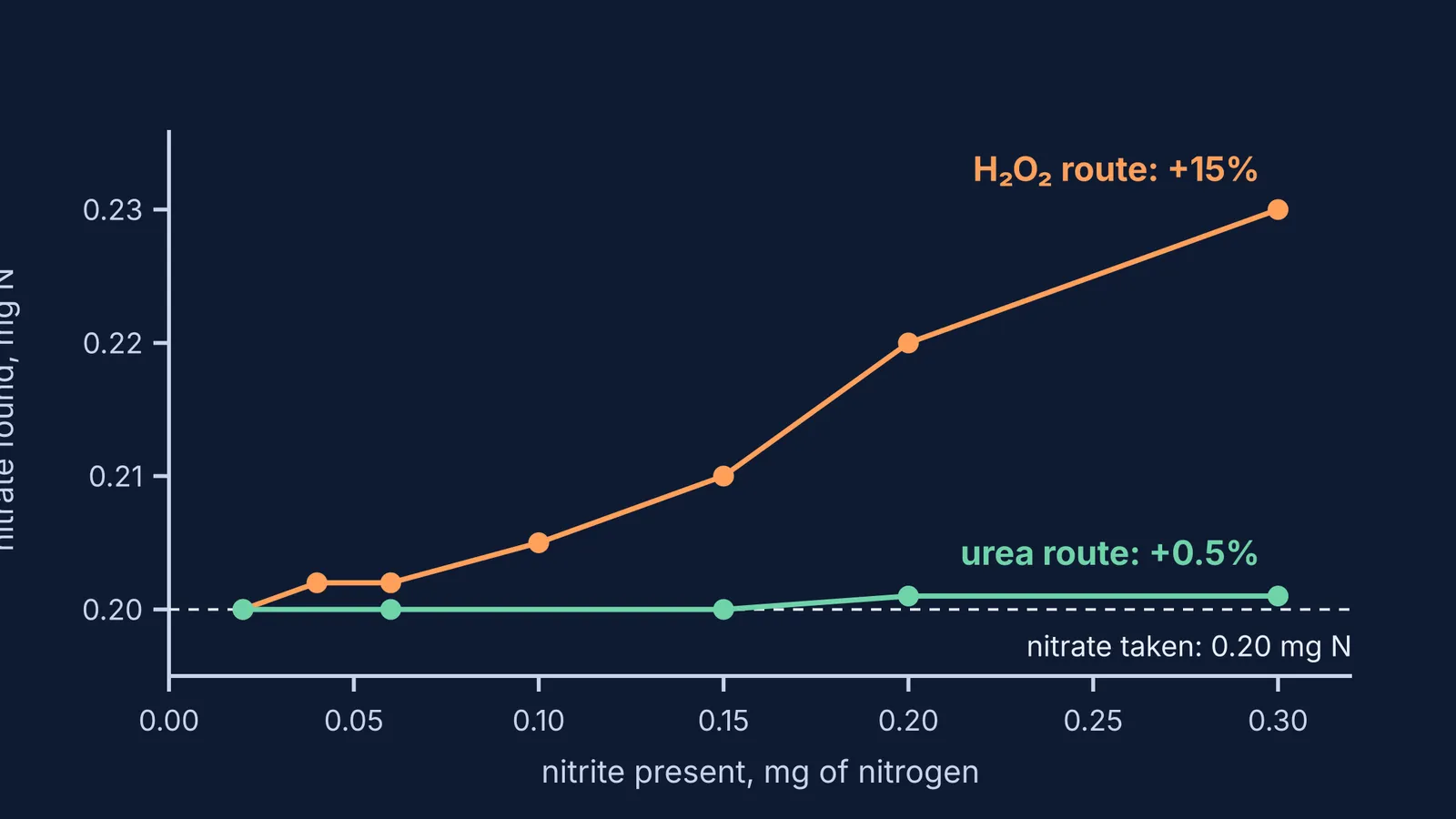
H₂O₂ route: 0.200 mg with 0.02 mg nitrite-N, 0.205 with 0.10, 0.21 with 0.15, 0.22 with 0.20, and 0.23 with 0.30.
Urea route: 0.200 to 0.201 mg across the whole range, 0.02 to 0.30 mg nitrite-N.
With the phenol sulphonic acid reagent the urea results were 0.202 to 0.205 mg. He put this down to excess urea slightly strengthening that reagent's colour. A blank with nitrite only (0.30 mg N) and urea gave a "very faint colour" with one reagent and none with the other. His verdict: the urea method is "much more accurate", "quite suitable even for high concentrations of nitrites", quicker, and has a wider range. He does not say why the peroxide totals run high, so we will not guess.
Worked example: the stock solution and the percentage error
Nitrite stock. Murty dissolved 0.1100 g of AgNO₂ (M = 153.87 g/mol) and added 0.0650 g of KCl to remove silver: AgNO₂ + KCl → AgCl↓ + KNO₂. Moles AgNO₂ = 0.1100 ÷ 153.87 = 0.7149 mmol. Nitrogen = 0.7149 × 14.007 = 10.01 mg in 1 L, so 0.0100 mg per mL. That matches his "0.01 mg of nitrite nitrogen" per mL.
Is the KCl enough? 0.0650 ÷ 74.55 = 0.872 mmol, about 22% more than the silver.
Error, H₂O₂ route, at 0.30 mg nitrite-N. (0.23 − 0.20) ÷ 0.20 × 100 = +15%. At 0.10 mg it is +2.5%; at 0.20 mg, +10%.
Why subtraction makes it worse. The total should be 0.20 + 0.30 = 0.50 mg N; the table gives 0.53. That is 6% high on the total. Subtracting 0.30 leaves 0.23, so the whole 0.03 mg lands on the smaller number, and the error becomes 15%.
Error, urea route. (0.201 − 0.200) ÷ 0.200 × 100 = +0.5%.
How much urea is needed? 0.30 mg nitrite-N is 0.30 ÷ 14.007 = 0.0214 mmol HNO₂. Urea needed is half that, 0.0107 mmol, or 0.64 mg (M = 60.06 g/mol). That is about 0.06 mL of 1% urea, so an "excess" is easy.
At test-tube scale the same reaction is larger. 0.10 g of NaNO₂ (1.45 mmol) needs 43.5 mg of urea and gives 1.45 mmol N₂ plus 0.72 mmol CO₂, about 54 mL of gas at 25 °C and 1 bar. Murty worked with dilute solutions and a colorimeter, not the brown ring, so follow your lab manual before changing a practical procedure.
How can this come up in JEE, NEET and the practical?
Salt analysis: telling nitrite from nitrate. Nitrite reacts with dilute acid and with the starch-iodide test; nitrate does not.
Amines and nitrous acid: urea, like a primary amine, releases N₂ with HNO₂. Thiourea does something different, as Coade and Werner's 1913 nitrite gas measurements show.
Redox: oxidation states of N in NO₂⁻ (+3) and NO₃⁻ (+5), and O in H₂O₂ (−1).
Percentage error: a small absolute error becomes a large relative one when you subtract.
For more redox-balancing and percentage-error problems, the Fermi Problem Library has a step-by-step solver that explains the reasoning. For practical-exam revision, Fermi's AI tutor for JEE prep can work through salt-analysis questions with you.
Quick checklist
Nitrite gives NO in dilute acid, so it fakes a positive brown ring.
H₂O₂ turns nitrite into nitrate: useless for a qualitative nitrate test, and 15% high in Murty's quantitative work at 0.30 mg nitrite-N.
Urea in slightly acid solution: CO(NH₂)₂ + 2HNO₂ → CO₂ + 2N₂ + 3H₂O.
Avoid excess strong acid when you evaporate; Murty found it destroys some nitrate.
Subtracting two measurements magnifies the error in the smaller result.