

On this page
The brown ring test is a confirmatory test for the nitrate ion in the Class 12 salt analysis practical. You layer freshly prepared iron(II) sulphate over an acidified salt solution, and if nitrate is present a dark brown band appears where the two liquids meet. Here is what that band is and how to get it on your first attempt.
How do you do the brown ring test for nitrate?
The NCERT Class 12 lab manual, Unit 7 gives the procedure in four steps:
Take 1 mL of an aqueous solution of the salt and add 2 mL of concentrated sulphuric acid slowly.
Mix thoroughly and cool the test tube under the tap.
Add freshly prepared iron(II) sulphate solution dropwise along the side of the tube, so it forms a layer on top.
Look for a dark brown ring at the junction of the two solutions.
The manual notes you can also add the iron(II) sulphate first and then the concentrated acid.
What happens chemically in the brown ring test?
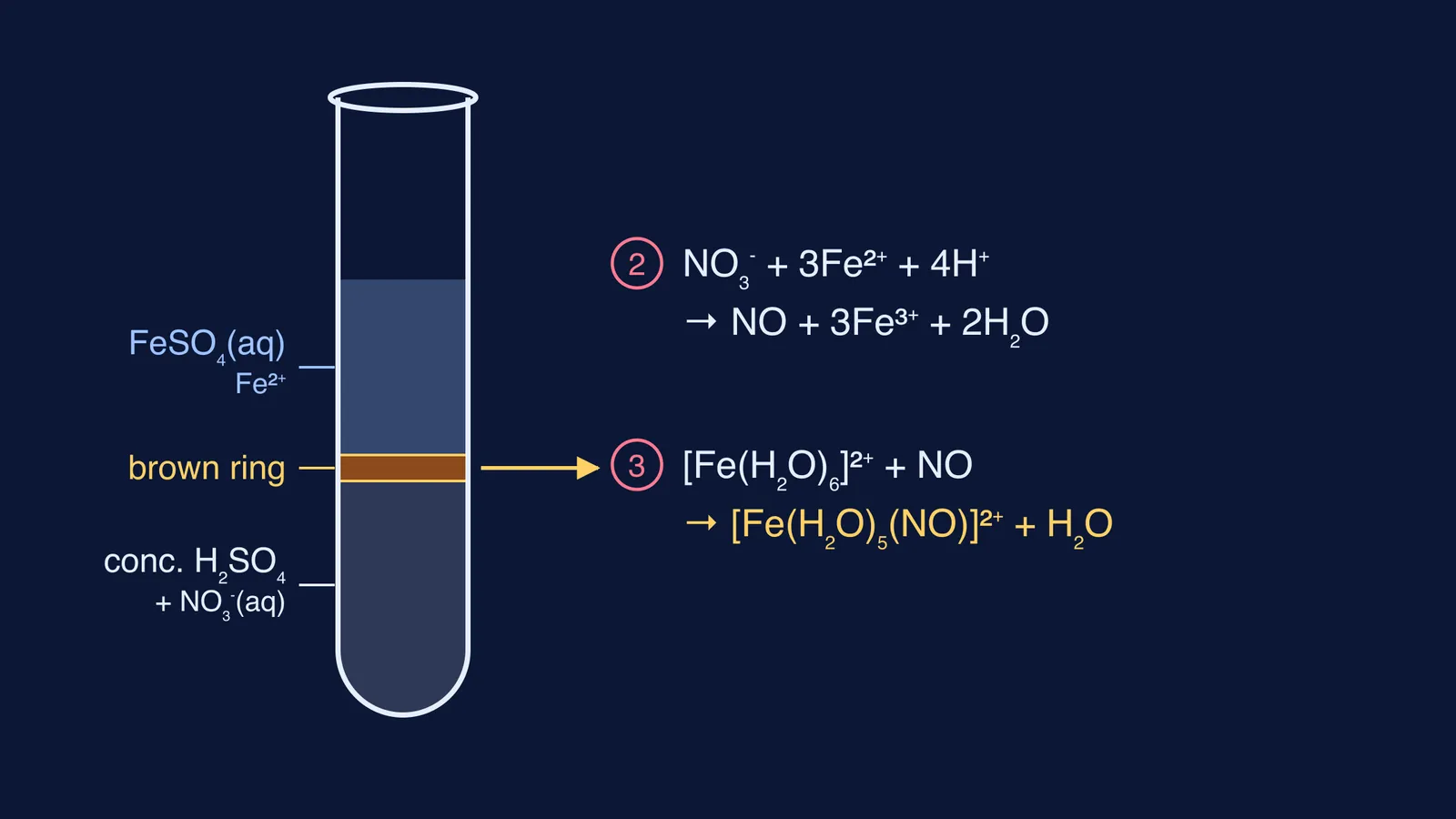
NCERT writes the test as three reactions. We have rewritten the second and third as ionic equations below.
The acid releases nitric acid from the nitrate: NaNO3 + H2SO4 gives NaHSO4 + HNO3.
Iron(II) reduces the nitrate to nitric oxide and is itself oxidised to iron(III): 3Fe2+ + NO3- + 4H+ gives 3Fe3+ + NO + 2H2O.
The NO binds to an iron(II) ion that has not been used up: [Fe(H2O)6]2+ + NO gives [Fe(H2O)5(NO)]2+ + H2O.
The brown species is the pentaaquanitrosyliron ion, [Fe(H2O)5(NO)]2+, according to Monsch and Klüfers in Angewandte Chemie (2019). NCERT's manual writes the same product more simply as [Fe(NO)]SO4, "nitroso ferrous sulphate".
Worked example: how much iron(II) does one nitrate need?
Check equation 2 before you trust it. Charge on the left is 3(+2) + (-1) + 4(+1) = +9. Charge on the right is 3(+3) = +9. Oxygen: 3 on the left, 1 + 2 = 3 on the right. It balances.
Now count the iron. Each nitrate uses three Fe2+ ions to become one NO, and that NO needs one more Fe2+ to make the brown ion. So every nitrate ion that ends up in the ring uses four Fe2+ ions. This is one reason the iron(II) sulphate solution should be freshly prepared: if some of it has already turned to iron(III), there is less Fe2+ to spare and the ring may come out faint.
Why does the brown ring form only at the junction?
The reduction in step 2 needs strong acid, and the Fe2+ is in the upper layer. The two meet along the boundary, so that is where NO is made and caught. The brown ion is also fragile: the 2019 paper describes it as a "poorly stable species" that had been a research target for more than a century but had never been isolated (Monsch and Klüfers). This is why the manual asks you to cool the tube and add the iron(II) sulphate without shaking: shaking mixes the layers, so there is no sharp boundary for the ring to form at.
What is the oxidation state of iron in the brown ring complex?
Chemists still argue about this. It was formerly thought that the complex contains iron(+1) and NO+, as the Wikipedia article on the nitrate test records. Monsch and Klüfers found that the Fe-NO bond is held by two "stretched, spin-polarised" π-interactions that "challenge the concept of oxidation state" (Angewandte Chemie, 2019). A 2025 review by Das and colleagues in Dalton Transactions calls the electronic structure "a matter of debate" among both theoretical and experimental chemists.
For your exam, give the oxidation state your textbook uses, and know that the question is still open.
If ligands, coordination numbers or oxidation states still feel shaky, the Fermi Concept Library covers every concept in chemistry, each with its own lesson and its place in the map.
Brown ring test checklist for your practical
Make the iron(II) sulphate solution fresh, as NCERT specifies.
Add the concentrated acid slowly and cool the tube before layering.
Pour down the inside wall, drop by drop, and do not shake.
Rule out nitrite first, because nitrite interferes with this test (Wikipedia, nitrate test). In the NCERT scheme, a nitrite gives reddish brown fumes on warming with dilute sulphuric acid; nitrate needs the concentrated acid. See the starch-iodide test for nitrite for the confirmatory step.
Back up the ring with the copper turnings test for nitrate, which gives dense brown fumes and a blue solution.
If you are unsure whether your reagent is still iron(II), see how to tell Fe2+ from Fe3+ in salt analysis.
To practise balancing redox equations like step 2, the Fermi Problem Library has worked problems with a step-by-step solver that explains the reasoning rather than printing an answer.


