

On this page
In qualitative analysis, detecting the nitrate ion (NO₃⁻) relies on tests that break it down into visible products. While the brown ring test is the most famous, the copper turnings test is a reliable confirmatory alternative.
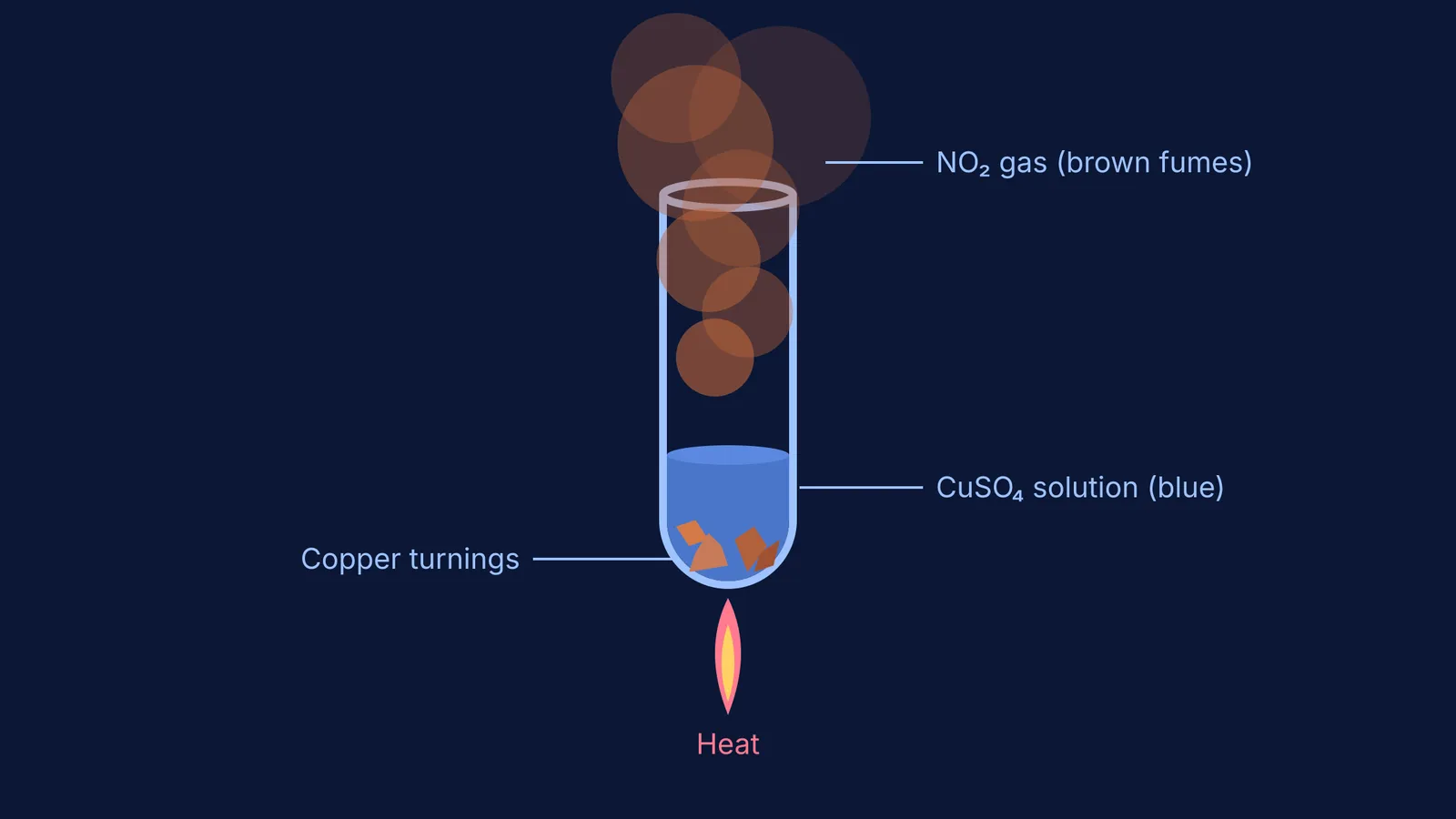
When you heat a nitrate salt with copper turnings and concentrated sulphuric acid, the mixture evolves dense reddish-brown fumes, and the liquid turns blue or blue-green.
Here is exactly what happens in the test tube, the chemical reactions behind it, and how it compares to the brown ring test. If you are mapping out inorganic reactions in the Fermi Concept Library, understanding the stepwise mechanism of these tests is more reliable than memorising the final equations.
What happens when nitrate is heated with copper turnings and concentrated sulphuric acid?
The procedure for the copper turnings test is very straightforward and primarily requires careful heating in a fume hood. According to the NCERT Class 12 Chemistry Laboratory Manual, the test is performed in these steps:
Take a small quantity (about 0.1 g) of the dry salt in a clean test tube.
Add 3 to 4 drops of concentrated sulphuric acid (H₂SO₄) and warm the mixture gently.
If light brown fumes are evolved, add a few copper turnings to the reaction mixture.
Heat the test tube again over a Bunsen burner.
If the nitrate ion is present in the original sample, you will see two distinct observations that confirm its identity:
Reddish-brown fumes: A large volume of pungent, brown gas escapes the tube. This is nitrogen dioxide (NO₂).
Blue solution: The remaining liquid in the test tube turns a distinct blue or blue-green colour.
If you struggle to remember which gases have which colours, Fermi's AI tutor can work out what you already know and build a plan for your study session to review qualitative analysis.
What are the chemical reactions for the copper turnings test?
The chemical reaction in the test tube does not happen in a single, simple step. Instead, it relies on the concentrated sulphuric acid acting first as a strong acid, and then the newly formed nitric acid acting as a powerful oxidising agent.
The mechanism breaks down into three stages:
1. Formation of nitric acid Concentrated sulphuric acid reacts with the nitrate salt (such as sodium nitrate) to form nitric acid (HNO₃).
NaNO₃ + H₂SO₄ → NaHSO₄ + HNO₃
2. Reduction by copper Copper is a transition metal that reacts with nitric acid. In the presence of excess concentrated sulphuric acid, copper reduces the nitric acid to colourless nitric oxide (NO) gas. The copper itself is oxidised, forming copper(II) sulphate (CuSO₄), which gives the solution its blue colour.
2NaNO₃ + 4H₂SO₄ + 3Cu → 3CuSO₄ + Na₂SO₄ + 4H₂O + 2NO
3. Oxidation to nitrogen dioxide As the colourless nitric oxide (NO) travels up the test tube and meets the air, it reacts with atmospheric oxygen to form nitrogen dioxide (NO₂). This is the reddish-brown gas you actually see.
2NO + O₂ → 2NO₂
You can find the step-by-step balancing for these redox reactions, along with the average bond order from resonance in the nitrate ion itself.
Why does the solution turn blue in the copper turnings test?
The distinct blue colour observed in the test tube is the classic visual signature of aqueous Cu²⁺ ions.
When copper metal reacts in the acidic mixture, it loses two electrons to form Cu²⁺. Because concentrated sulphuric acid provides an abundance of sulphate ions (SO₄²⁻), the resulting dissolved salt is copper(II) sulphate.
This is the same blue compound you see during the electrolytic refining of copper or when making standard solutions of CuSO₄. The intensity of the blue colour depends on how much copper reacts; warming the tube accelerates the reaction and deepens the colour.
How does the copper turnings test compare to the brown ring test?
Both the copper turnings test and the brown ring test are commonly used to confirm the presence of the nitrate ion, but they rely on entirely different chemistry and laboratory techniques.
State of the salt: The copper test uses the solid salt directly, while the brown ring test requires a clear aqueous solution.
Heating: You must heat the copper turnings test to drive the reaction. The brown ring test must be kept completely cold, as heat destroys the brown complex.
Reagents: The copper test relies on elemental copper chips. The brown ring test requires freshly prepared iron(II) sulphate; old solutions will fail because the iron oxidises to iron(III) over time.
Positive result: The copper test yields a test tube full of brown gas and a blue liquid. The brown ring test creates a thin, fragile brown layer exactly at the junction of the acid and the aqueous solution.
If you are investigating other uses of concentrated H₂SO₄, such as the contact process for sulphuric acid, you will see its role shifts between acting as a strong acid, a dehydrating agent, and an oxidising agent depending on the temperature and reagents.


