

On this page
In 1913 May Emily Coade and Emil Alphonse Werner, of the University Chemical Laboratory at Trinity College, Dublin, showed how to count nitrite by the gas it gives off with thiourea, which they called thiocarbamide. The odd part: the gas changed with the acid. Acetic acid gave mostly nitrogen. Hydrochloric acid gave mostly nitric oxide. Yet the volume came out the same, because each molecule of nitrous acid gives one molecule of gas either way. Their silver nitrite check is a clean Class 11 gas-over-water problem.
The paper is "The Estimation of Nitrites by means of Thiocarbamide, and the Interaction of Nitrous Acid and Thiocarbamide in the Presence of Acids of Different Strength", Journal of the Chemical Society, Transactions, volume 103, pages 1221 to 1228. The scanned 1913 volume is on the Internet Archive. The paper gives only the authors' names and laboratory; this Werner is not Alfred Werner of coordination chemistry. Nitrites and nitric oxide are toxic, so this post is history and arithmetic only, not a procedure.
What two reactions did Werner find for nitrous acid and thiourea?
The paper opens with two equations. We write thiourea as CS(NH₂)₂; the paper writes CSN₂H₄.
(a) With a weak acid such as acetic acid: CS(NH₂)₂ + HNO₂ → HSCN + N₂ + 2H₂O
(b) With hydrochloric acid: 2CS(NH₂)₂ + 2HNO₂ → C₂S₂N₄H₆ + 2NO + 2H₂O
Both balance: (a) has C 1, S 1, N 3, H 5, O 2 per side, and (b) has C 2, S 2, N 6, H 10, O 4. C₂S₂N₄H₆ is the paper's formula for two thiourea units joined by an S–S bond. Each sulphur goes from −2 to −1, so two electrons are lost; each nitrogen in HNO₂ goes from +3 to +2 in NO, so two are gained. The electrons balance.
Reaction (a) is the same idea as the nitrous acid test for primary amines: an –NH₂ nitrogen and the nitrite nitrogen leave together as N₂. See how nitrous acid tells primary, secondary and tertiary amines apart.
Now count gas: one N₂ per HNO₂ in (a), one NO per HNO₂ in (b). In the paper's words, "the total volume of gas evolved is the same in both cases". A mixture of the two routes changes the gas, not the count.
Why does the acid decide which gas comes off?
Werner's explanation was that a strong acid turns thiourea into a salt at once. Nitrous acid then oxidises it at sulphur and joins two molecules by an S–S bond, giving NO. A weak acid leaves thiourea as it is, and nitrous acid attacks the nitrogen, giving N₂.
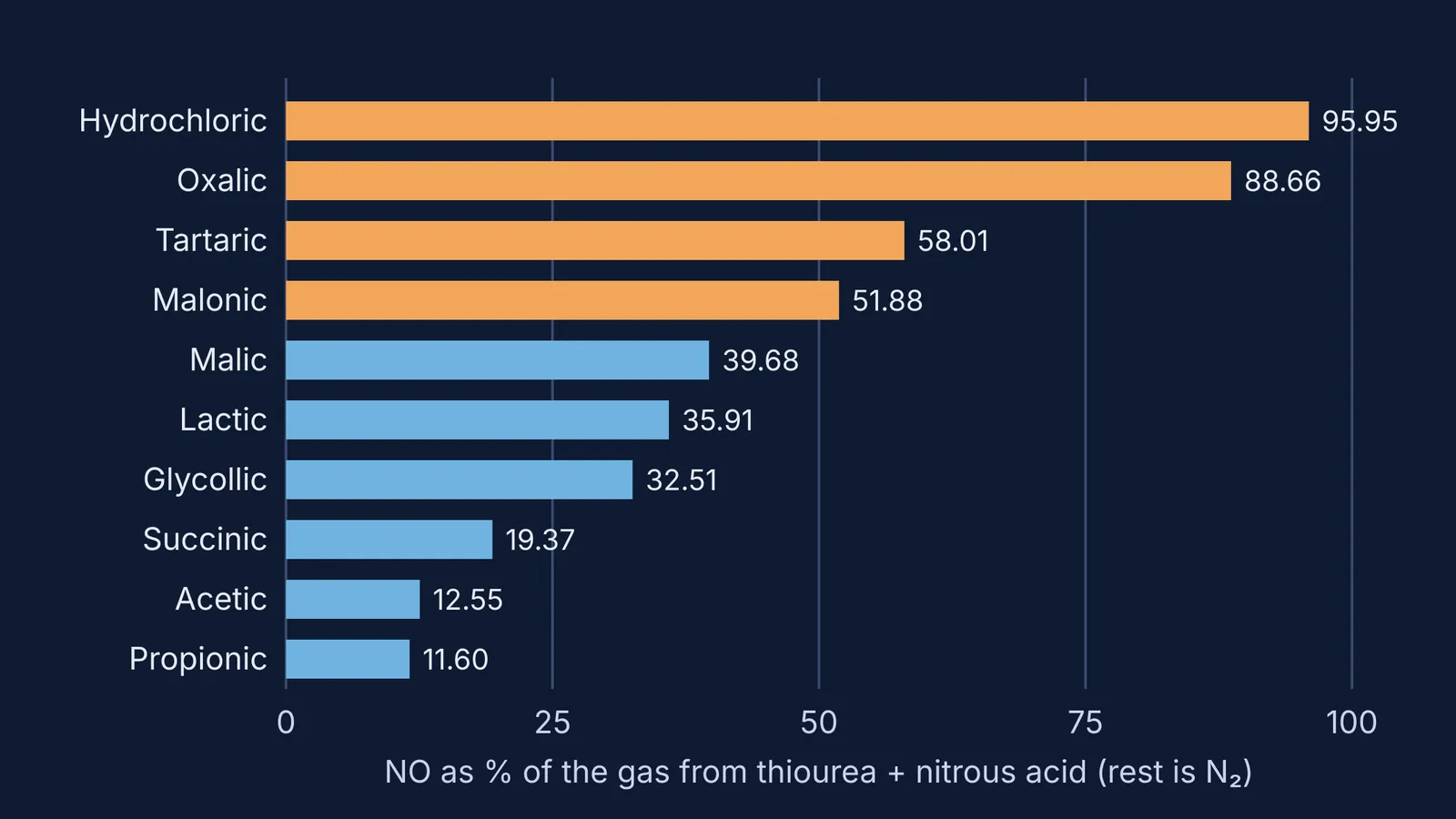
They mixed equal moles of thiourea and nitrite with two moles of each acid and analysed the gas. Their Table I gives the share of NO as:
hydrochloric acid 95.95%
oxalic acid 88.66%
tartaric acid 58.01%
malonic acid 51.88%
malic acid 39.68%
acetic acid 12.55%
propionic acid 11.60%
Their printed "K" is Ostwald's constant, 100 times the modern Ka: acetic acid's K = 0.0018 is Ka = 1.8 × 10⁻⁵. The trend is clear: stronger acid, more NO. But they claimed the NO share was "directly proportional" to the constant, and their own numbers do not show that. Malonic acid (K = 0.163) is stronger than tartaric (K = 0.108) yet gave less NO. They admitted the runs were "not strictly comparable". Read it as an ordering, not a law.
Why was thiourea better than urea for counting nitrite?
Urea also destroys nitrous acid: CO(NH₂)₂ + 2HNO₂ → CO₂ + 2N₂ + 3H₂O. That is still one N₂ per HNO₂, but the CO₂ must be absorbed in potassium hydroxide before reading the volume. Coade and Werner listed these advantages for thiourea:
Nitrate does not interfere, even in large excess (0.6 g of NaNO₃ with 0.069 g of nitrite).
The reaction was over in about 45 seconds with sulphuric acid and 2 minutes with acetic acid. Urea took 28 minutes.
The mercury in the nitrometer stayed clean, unlike with the potassium iodide method.
On one sample of commercial sodium nitrite, seven thiourea runs gave a mean of 96.76% NaNO₂. Three urea runs averaged only 92.89%. A permanganate titration by Rupp's method gave 96.5% and 97%, which backed the thiourea figure.
How do you correct a gas volume collected over water?
The gas sat over a little water, so it was saturated with vapour. By Dalton's law, the gas's own pressure is the barometer reading minus water's vapour pressure. For the general method, see how to subtract water vapour from a gas collected over water.
The paper's "N.T.P." is 0 °C and 760 mm. It also fixes "one gram of hydrogen, at N.T.P. = 11·18 litres", which makes the molar volume 22.36 L mol⁻¹, a little below the modern 22.414 L mol⁻¹. We use their value so we can check their numbers.
Worked example: their silver nitrite test.
Moles of nitrite. They used 0.07695 g of AgNO₂ with M = 153.9 g mol⁻¹. Moles = 0.07695 ÷ 153.9 = 0.0005000 mol = 0.5000 mmol. Expected gas = 0.5000 mmol (one gas molecule per HNO₂).
Expected volume. 0.5000 mmol × 22.36 mL mmol⁻¹ = 11.18 mL at N.T.P., their theoretical figure.
What they measured. 12 mL of gas at 16.7 °C and 769.8 mm.
Vapour pressure of water at 16.7 °C. The NIST Chemistry WebBook gives 1.9018 kPa, which is 14.26 mmHg. The paper does not print the value it used.
Dry gas pressure. P = 769.8 − 14.26 = 755.54 mm.
Combined gas law to 0 °C and 760 mm. V₀ = 12 × (755.54 ÷ 760) × (273.15 ÷ 289.85) = 12 × 0.9941 × 0.9424 = 11.24 mL.
Compare. The paper prints 11.24 mL dry, so our correction reproduces it. That is 0.5% above the 11.18 mL expected, and 11.24 ÷ 22.36 = 0.503 mmol of gas from 0.500 mmol of nitrite: one to one.
Skip step 5 and you get 11.45 mL, 2.4% too high: the water correction is bigger than the method's own error.
The sodium nitrite runs work the same way. Run 1 gave 23.5 mL at 17.4 °C and 758.82 mm; with p(H₂O) = 14.91 mm the dry volume is 21.62 mL (paper: 21.64). Pure 0.069 g NaNO₂ would give 22.36 mL, so purity ≈ 96.8%.
For more gas-law and mole-concept problems worked step by step, the Fermi Problem Library has a solver that explains the reasoning at each line.
Where does this show up in JEE and NEET?
Class 11, States of matter: gas collected over water. Dalton's law, then the combined gas law.
Class 11, Some basic concepts: moles of gas per mole of reactant. Here it is 1 mol of gas per mol of HNO₂, whichever product forms.
Class 12, Amines: RNH₂ + HNO₂ → ROH + N₂ + H₂O, and urea used to destroy excess nitrous acid.
If you are working through these chapters for JEE Main and Advanced, Fermi Test Prep pairs practice with an AI tutor.
Quick checklist
Each HNO₂ gives one gas molecule: N₂ in weak acid, NO in strong acid.
Gas over water: P(gas) = P(barometer) − p(H₂O).
Their silver nitrite: 12 mL wet becomes 11.24 mL dry at 0 °C and 760 mm.
Stronger acid gave more NO, as a trend, not a proportion.


