

On this page
Because nitrous acid (HNO₂) decomposes rapidly at ambient temperatures, chemists prepare it in situ by mixing sodium nitrite (NaNO₂) with cold dilute hydrochloric acid (HCl). The generated nitrosonium ion (NO⁺) attacks amine nitrogens along distinct pathways depending on their degree of substitution and whether attached substituents are aliphatic or aromatic. For students analyzing functional groups, recognizing the visible differences produced by each class turns confusing qualitative analysis problems into systematic deductions.
How does nitrous acid react with primary amines?
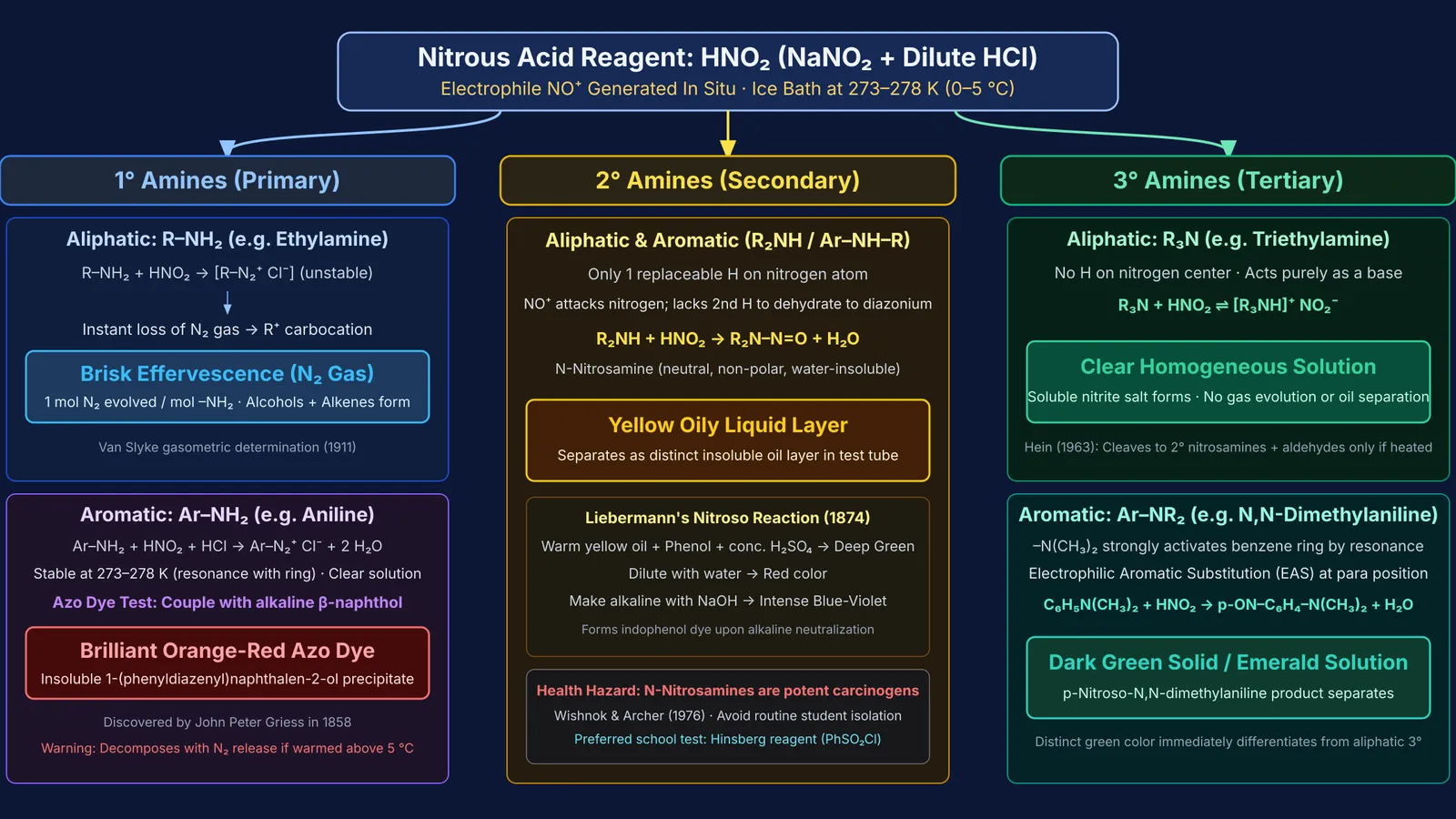
Primary aliphatic amines (R–NH₂) react with cold nitrous acid to form unstable aliphatic diazonium intermediates ([R–N₂⁺ Cl⁻]) that decompose almost instantaneously. They expel nitrogen gas as brisk effervescence while generating an aliphatic carbocation. This carbocation reacts with water, counterions, or undergoes proton elimination to yield a mixture of alcohols, alkenes, and alkyl halides. The gas evolution is quantitative, releasing exactly one mole of nitrogen gas per mole of aliphatic amino group. In 1911, biochemist Donald D. Van Slyke published this gasometric principle in the Journal of Biological Chemistry91459-6) to determine amino acid concentrations during protein digestion.
Primary aromatic amines behave fundamentally differently. In 1858, chemist John Peter Griess reported in the Proceedings of the Royal Society of London that aromatic amines form arenediazonium salts in the cold. At 273–278 K (0–5 °C), the benzenediazonium ion (C₆H₅N₂⁺) is stabilized by resonance with the benzene ring, so the cold reaction mixture remains clear without gas evolution. When poured into an alkaline solution of β-naphthol, the diazonium salt couples to produce an insoluble, brilliant orange-red azo dye. While the carbylamine test for primary amines detects both aliphatic and aromatic primary amines by their foul isocyanide odour, cold nitrous acid cleanly distinguishes between the two.
Why do secondary amines form yellow oily nitrosamines?
Secondary amines (R₂NH), whether aliphatic or aromatic, carry only one replaceable hydrogen atom on nitrogen. Because they lack the second proton required to eliminate water and complete diazonium formation, electrophilic attack by the nitrosonium ion halts at the N-nitrosation stage:
R₂NH + HNO₂ → R₂N–N=O + H₂O
Because N-nitrosamines are neutral, non-polar molecules, they cannot form strong hydrogen bonds with water and separate from the aqueous reaction mixture as an insoluble yellow oily liquid layer. In 1874, Carl Liebermann described a confirmatory colour test in Berichte der deutschen chemischen Gesellschaft: warming the yellow oil with phenol and concentrated sulfuric acid produces a deep green solution that turns red upon dilution with water and intense blue-violet when made alkaline with sodium hydroxide. However, as John S. Wishnok and Michael C. Archer highlighted in the Journal of Chemical Education, N-nitrosamines are potent carcinogens. Consequently, school and college laboratories avoid handling isolated nitrosamines and rely instead on the Hinsberg reagent test for separating amine classes.
How do tertiary amines react with cold nitrous acid?
Tertiary amines have three organic groups bonded to nitrogen and no directly attached hydrogen atoms. Their reaction pathway depends entirely on their aliphatic or aromatic nature:
Aliphatic tertiary amines (such as triethylamine) function purely as Brønsted-Lowry bases. In cold aqueous nitrous acid, they dissolve by forming soluble trialkylammonium nitrite salts:
R₃N + HNO₂ ⇌ [R₃NH]⁺ NO₂⁻
The solution remains clear, homogeneous, and colourless, showing neither gas evolution nor phase separation. Although George E. Hein showed in the Journal of Chemical Education that heating tertiary amines with nitrous acid causes nitrosative cleavage into secondary nitrosamines and aldehydes, maintaining temperatures at 273–278 K yields only the clear salt solution.
Aromatic tertiary amines (such as N,N-dimethylaniline) react along an entirely different path. Because the dialkylamino group strongly activates the aromatic ring through resonance, the nitrosonium electrophile attacks the electron-rich para position in an electrophilic aromatic substitution:
C₆H₅N(CH₃)₂ + HNO₂ → p-ON–C₆H₄–N(CH₃)₂ + H₂O
The product, p-nitroso-N,N-dimethylaniline, separates as a dark green solid or colours the solution emerald-green, providing an immediate visual contrast to aliphatic tertiary amines.
How do you distinguish amines step by step in the lab?
To identify an unknown amine using cold nitrous acid, maintain the reaction mixture between 273 K and 278 K in an ice bath:
Mix cold aqueous sodium nitrite with dilute hydrochloric acid, then add a small sample of the unknown amine slowly.
Observe gas evolution: brisk effervescence of colourless nitrogen gas confirms a primary aliphatic amine.
If no gas evolves, inspect the phase and colour:
A separate yellow oily layer confirms a secondary amine.
A clear solution that yields an orange-red precipitate upon addition to cold alkaline β-naphthol confirms a primary aromatic amine.
A dark green solid or deep emerald solution confirms an aromatic tertiary amine.
A clear, colourless solution with no gas or oil confirms an aliphatic tertiary amine.
The Fermi Concept Library covers every concept in chemistry, each with its own lesson and its place in the map, showing how amine reactions and carbocation stabilities connect across organic families.
What are the most common exam pitfalls with nitrous acid?
A frequent error in competitive examinations involves carbocation rearrangements. When propan-1-amine reacts with nitrous acid, the initially formed 1-propyldiazonium ion loses nitrogen to generate a primary propyl carbocation. A swift 1,2-hydride shift yields the more stable secondary isopropyl carbocation, making propan-2-ol the predominant alcohol product rather than propan-1-ol, along with propene and 1-chloropropane.
Another common misconception is confusing benzylamine with aniline. Aniline forms a stable benzenediazonium chloride at 0–5 °C, creating the versatile synthetic intermediate used in Sandmeyer and Gattermann reactions. In contrast, benzylamine (C₆H₅CH₂NH₂) contains an amino group bonded to an aliphatic carbon; it behaves as an aliphatic primary amine, liberating nitrogen gas immediately to form benzyl alcohol.
The Fermi Problem Library has worked problems with a step-by-step solver that explains the reasoning rather than printing an answer, helping you identify carbocation rearrangements and predict multi-step synthetic pathways accurately. When revising organic roadmaps, Fermi's AI tutor works out what you already know and notices where you get stuck across multi-step reaction roadmaps, deciding whether to explain the underlying carbocation rearrangement, ask a guiding question, or show the mechanism step by step.


