On this page
In 1941 a short paper from St. John's College, Agra, reported a cleaner way to make cinnamic acids. Miss Rashmi Bala Pandya and Kantilal C. Pandya heated benzaldehyde with malonic acid and only a few drops of pyridine. They got cinnamic acid in 94.6% yield. The classic Perkin reaction, run under standard conditions by other chemists, gave 49%. When they put a chlorine or bromine atom on the ring, the reaction ran even faster. Leave the pyridine out, and a different acid forms, one you can identify with a single titration.
Who was Rashmi Bala Pandya and what did she publish?
What we know comes from the paper. It is Part XIII of "The condensation of aldehydes with malonic acid", by Kantilal C. Pandya and Miss Rashmi Bala Pandya of the Chemistry Laboratory, St. John's College, Agra. It was received on 24 April 1941 and printed in the Proceedings of the Indian Academy of Sciences, Section A, vol. 14, pp. 112–122 (doi:10.1007/BF03046555). The full text is on the Academy's site.
Crossref's records list her as co-author on later parts of the same series, in 1943 and, with Ram Labhaya Sethi, in 1948. We found nothing reliable about her life or about how the two authors were related, so we say nothing more.
The paper opens with a history of the reaction:
Perkin (1868) heated an aldehyde with acetic anhydride and sodium acetate.
Stuart, in Fittig's laboratory (1883), found that malonic acid worked in place of the acetate.
Knoevenagel (1898) brought in amine bases.
Doebner (from 1900) used pyridine.
By 1941 the standard recipe used about 3.5 mol of pyridine per mol of aldehyde, as solvent and base. The Agra lab's point was that pyridine is also a catalyst, so a trace is enough.
What did a few drops of pyridine do?
Their benzaldehyde run used 1.06 g of benzaldehyde, 1.04 g of malonic acid and 0.13 g of pyridine. That is about 1 : 1 : 0.16 by our arithmetic; the paper writes 1 : 1 : 0.15. The mixture was heated on a water bath (about 100 °C). It became a homogeneous liquid and, in their words, "effervescence commenced within ten minutes of the heating and continued for about an hour."
The fizzing is carbon dioxide. The overall change has two steps, and both balance:
C₆H₅CHO + CH₂(COOH)₂ → C₆H₅CH=C(COOH)₂ + H₂O (condensation)
C₆H₅CH=C(COOH)₂ → C₆H₅CH=CHCOOH + CO₂ (decarboxylation)
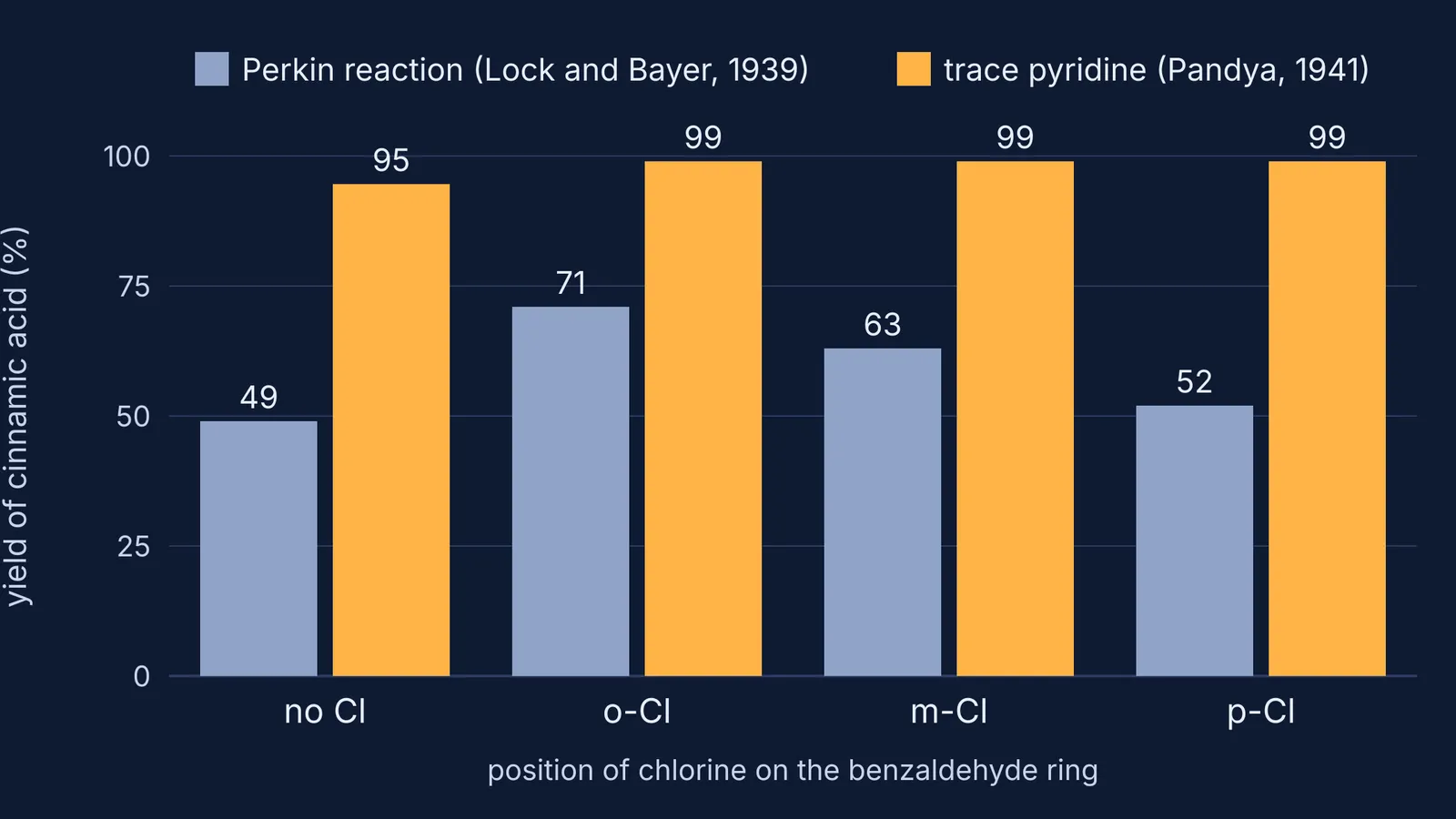
After 4 hours they collected 1.4 g of cinnamic acid (94.6%); after 2 hours, 1.3 g (87.8%). For comparison they quoted Lock and Bayer (1939), who got 49% of cinnamic acid from benzaldehyde by a standardised Perkin reaction. The mechanism of the base-catalysed condensation is in our post on the Knoevenagel condensation and the Doebner modification. The paper itself gives no mechanism.
Why did chlorine on the ring speed the reaction up?
With o-, m- or p-chlorobenzaldehyde, or m-bromobenzaldehyde, "the reaction was very obviously quickened." It was often complete in one hour, and the yields were 97–99%. The p-chloro case started fastest: it melted to a clear liquid and began to fizz within two minutes. The m-isomer took about ten minutes to liquefy.
The usual Class 12 reason fits. Chlorine pulls electron density out of the ring by its inductive effect. That makes the carbonyl carbon of the aldehyde more positive, so the nucleophile from malonic acid adds to it faster. The same logic explains why p-nitrobenzaldehyde is more reactive than benzaldehyde in nucleophilic addition.
The rule only takes you so far. Chlorine also donates electrons back by resonance at the ortho and para positions, so the simple argument does not tell you which isomer should win. The paper made the same point about Perkin's reaction. Lock and Bayer's yields were 71% for o-Cl, 63% for m-Cl and 52% for p-Cl, all above 49%. The Pandyas wrote that "no other generalisation regarding the influence of number and position would be safe as the figures are so irregular". They also noted that p-chlorine, the most helpful in their pyridine reaction, seemed the least helpful in Perkin's.
What forms when there is no pyridine at all?
They heated the same mixtures with no base at all. The mixture did not fizz, even over eight hours. The product was the undecarboxylated diacid, the benzalmalonic acid in the first equation above. From benzaldehyde they got 1.5 g (78%) after 4 or 6 hours.
The diacids can lose CO₂, but only when melted. The paper records the p-chloro diacid melting "with effervescence" at 197–198 °C, and the m-bromo diacid at 192 °C. So on the water bath, pyridine is what lets decarboxylation happen at about 100 °C. For why a carboxyl group two carbons away from another carbonyl falls off so readily, see why beta-keto acids decarboxylate on heating.
Worked example: percentage yield and equivalent weight
Molar masses: benzaldehyde C₇H₆O 106.12, cinnamic acid C₉H₈O₂ 148.16, benzalmalonic acid C₁₀H₈O₄ 192.17, p-chlorocinnamic acid C₉H₇ClO₂ 182.60, chlorobenzylidenemalonic acid C₁₀H₇ClO₄ 226.61, CO₂ 44.01 g mol⁻¹.
Step 1. Moles of aldehyde. 1.06 ÷ 106.12 = 0.009988 mol. Malonic acid is 1.04 ÷ 104.06 = 0.009994 mol, so the aldehyde is limiting by a hair.
Step 2. Theoretical yield. One mol of aldehyde gives one mol of cinnamic acid: 0.009988 × 148.16 = 1.480 g.
Step 3. Percentage yield. 1.4 ÷ 1.480 × 100 = 94.6%, exactly the paper's figure. The 2-hour run: 1.3 ÷ 1.480 × 100 = 87.8%.
Step 4. The no-pyridine product. The theoretical diacid is 0.009988 × 192.17 = 1.919 g, so 1.5 g is 78%. The extra 0.44 g compared with cinnamic acid is the CO₂ that stayed on.
Step 5. Monoacid or diacid? Equivalent weight = molar mass ÷ number of acidic H replaced by NaOH.
Chlorobenzylidenemalonic acid is dibasic: 226.61 ÷ 2 = 113.3. They found 113.6 for the m-isomer and 113.2 for the p-isomer.
p-Chlorocinnamic acid is monobasic: 182.6 ÷ 1 = 182.6.
So 0.2266 g of the diacid needs 20.0 mL of 0.1 N NaOH; the same mass of the cinnamic acid would need only 12.4 mL. Chlorine content tells them apart too: 15.64% Cl in the diacid against 19.41% in the cinnamic acid.
To see how inductive and resonance effects add up for each ring position, the Fermi Concept Library covers both, and the Fermi Problem Library has a step-by-step solver for yield and equivalent-weight numericals that explains the reasoning.
Where does this fit in JEE and NEET chemistry?
Aldehydes, Class 12: electron-withdrawing groups make aromatic aldehydes more reactive to nucleophilic addition.
Named reactions: Perkin uses an anhydride and its sodium salt; Knoevenagel–Doebner uses malonic acid and a base, with CO₂ lost. Compare the two in our Perkin reaction mechanism.
Physical chemistry numericals: percentage yield, limiting reagent, equivalent weight from titration.
Checklist
Benzaldehyde + malonic acid + a trace of pyridine gives cinnamic acid and CO₂ (94.6% in 1941).
No base, no fizzing: the diacid stays intact.
Electron-withdrawing Cl or Br speeds addition to the C=O.
Position effects are irregular; don't over-generalise.
Equivalent weight = M ÷ basicity: 113.3 for the diacid, 182.6 for the monoacid.
Percentage yield = actual ÷ theoretical × 100, from moles of the limiting reagent.