On this page
Why is the methylene carbon between two carbonyls so acidic?
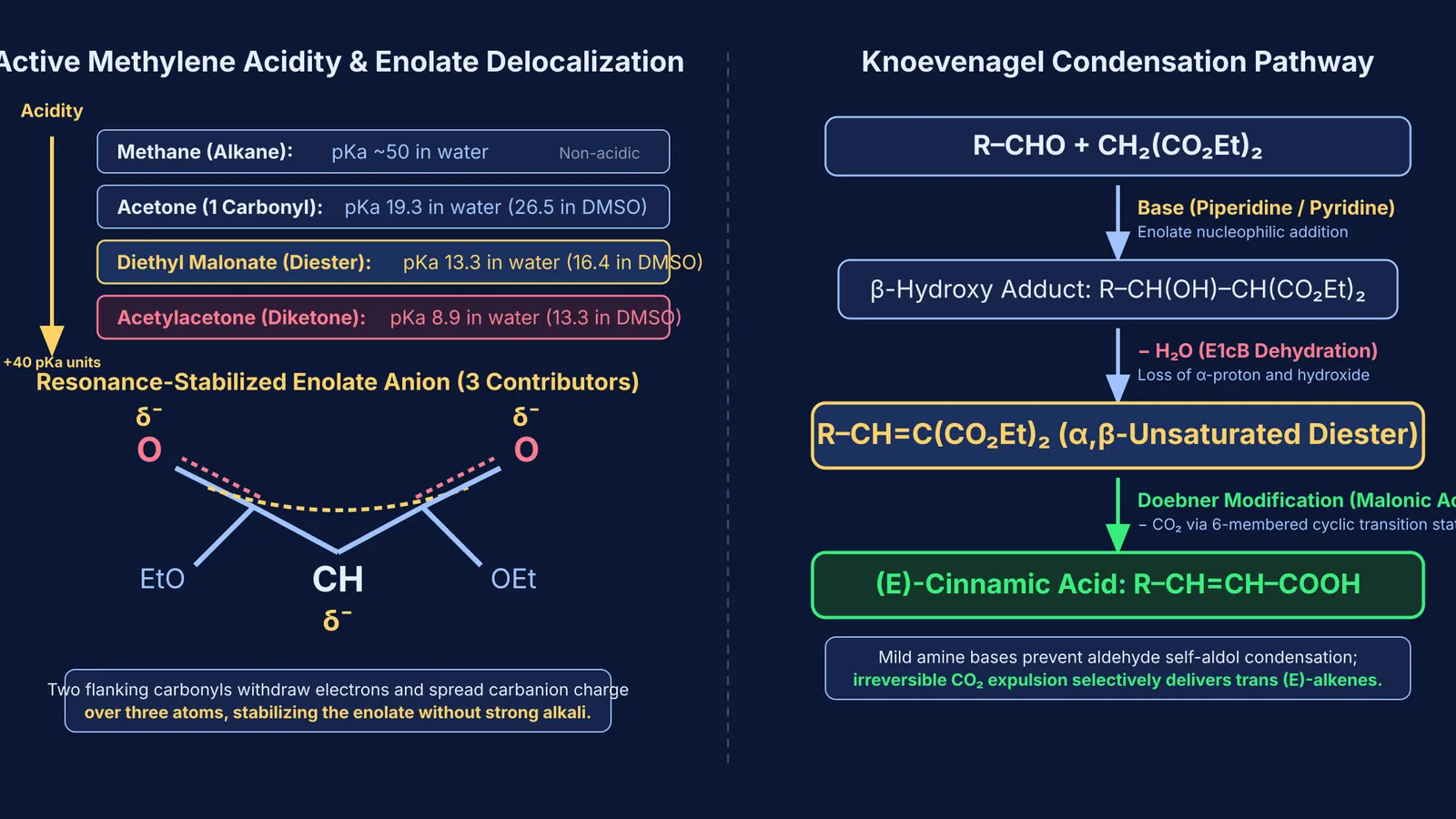
In simple alkanes like methane, carbon-hydrogen bonds are notoriously non-acidic, with a pKa around 50. Introducing a single adjacent carbonyl group, as in acetone, pulls electron density away and drops the α-proton pKa to roughly 19.3 in water (and 26.5 in dimethyl sulfoxide), as benchmarked in physical organic acidity scales by Frederick G. Bordwell in Accounts of Chemical Research. When a methylene (CH₂) carbon is flanked by two carbonyl groups, its acidity increases dramatically.
For diethyl malonate, Bordwell reported an equilibrium pKa of 16.4 in dimethyl sulfoxide (approximately 13.3 in water). In acetylacetone, where two ketone groups flank the CH₂ unit, the pKa drops further to 13.3 in dimethyl sulfoxide (8.9 in water).
This acidity stems from two cooperative effects:
Inductive withdrawal: Electronegative carbonyl oxygens pull electron density through σ-bonds, leaving the methylene carbon partially positive.
Resonance delocalization: Deprotonation creates a carbanion whose negative charge is delocalized over three contributors—the central carbon and two enolate oxygens.
Esters are less acidic than ketones because ester alkoxy oxygen lone pairs donate into the carbonyl π-system via cross-conjugation, competing with enolate stabilization. This hierarchy defines the acidity ladder for organic functional groups tested in competitive exams.
How does the Knoevenagel condensation create an alkene?
The Knoevenagel condensation was first reported by Emil Knoevenagel in Berichte der deutschen chemischen Gesellschaft in 1898. The reaction couples an aldehyde or ketone with an active methylene compound using an amine base to form an α,β-unsaturated compound.
The mechanism follows three steps:
Enolate generation: A mild base abstracts an acidic methylene proton to form a resonance-stabilized enolate.
Nucleophilic addition: The enolate attacks the electrophilic aldehyde carbonyl carbon, creating a β-hydroxy dicarbonyl intermediate.
Dehydration via E1cB: Base removes the remaining acidic α-proton to form a conjugated enolate, which expels hydroxide or water to forge the new carbon-carbon double bond.
Evaluating this pathway in The Journal of Physical Chemistry B, Ellen V. Dalessandro and co-workers measured an observed free energy activation barrier of 20.0 kcal mol⁻¹ (and 21.8 kcal mol⁻¹ theoretically) for the piperidine-catalyzed reaction of benzaldehyde with acetylacetone.
When students struggle to trace electron flows across multi-step organic additions, the Fermi Problem Library provides worked problems with a step-by-step solver that explains the reasoning rather than printing an answer.
Why do Knoevenagel reactions require weak amine bases instead of strong alkali?
In Angewandte Chemie International Edition, Benjamin List highlighted that Knoevenagel's amine-mediated additions formed the historical foundation of organocatalysis by exploiting base selectivity over harsh mineral bases. If you treat an aldehyde with strong alkali like sodium hydroxide (NaOH) or sodium ethoxide (NaOEt), the base deprotonates the aldehyde itself (acetaldehyde α-protons have a pKa near 17 in water), causing uncontrolled self-aldol condensation. Strong bases can also hydrolyze ester groups in malonic ester or trigger Cannizzaro dismutation in non-enolizable aromatic aldehydes.
A secondary amine like piperidine (conjugate acid pKa around 11.1) or pyridine acts with precision. Because active methylene protons (pKa 9 to 13 in water) are far more acidic than aldehyde α-protons, the weak amine base selectively deprotonates only the active methylene substrate.
Furthermore, secondary amines condense reversibly with aldehydes to form reactive iminium ion intermediates, lowering the LUMO of the electrophile and accelerating attack by the active methylene enolate. Students can practice writing organic mechanisms to master these subtle catalytic pathways.
What is the Doebner modification of malonic acid?
In 1900, Oskar Doebner reported in Berichte der deutschen chemischen Gesellschaft that using malonic acid in boiling pyridine delivers an α,β-unsaturated monocarboxylic acid directly. Benzaldehyde reacting with malonic acid in pyridine yields trans-cinnamic acid.
The reaction initially forms benzylidenemalonic acid (PhCH=C(COOH)₂). Because this intermediate contains a β-dicarboxylic acid unit, heating triggers concerted decarboxylation (loss of CO₂) through a cyclic six-membered transition state. The release of CO₂ gas drives the equilibrium irreversibly forward, selectively forming the (E)-alkene to minimize steric hindrance. This transformation represents the depth required for JEE Advanced chemistry.
How do you solve Knoevenagel condensation problems step by step?
To predict Knoevenagel condensation products systematically, apply this four-step checklist:
Identify the nucleophile: Locate the CH₂ carbon between the two electron-withdrawing groups (–COOR, –COR, –CN).
Spot the catalyst: Weak amine bases (piperidine, pyridine) ensure selective enolization of the active methylene carbon.
Construct the double bond: Formally remove two hydrogens from the methylene carbon and oxygen from the aldehyde to form the C=C bond.
Check for decarboxylation: If malonic acid is used under heating, eliminate one –COOH as CO₂ to yield the mono-acid.
For example, heating benzaldehyde (Ph–CHO) with malonic acid (HOOC–CH₂–COOH) in pyridine yields benzylidenemalonic acid, which decarboxylates to give (E)-cinnamic acid (Ph–CH=CH–COOH).
When students face questions on carbonyl acidity trends and addition pathways, the Fermi Concept Library offers dedicated lessons for every concept in chemistry, placing each topic in its syllabus map.