On this page
K. Sunanda Bai found a way to see carboxylic acid molecules pairing up. Your NCERT book says carboxylic acids exist as hydrogen-bonded dimers in the vapour and in aprotic solvents, and that this is why they boil so high. In 1940, working in the Department of Physics at the Indian Institute of Science, Bangalore, she recorded the Raman spectra of several acids. The C=O line of the acids sat about 70 cm⁻¹ below where it sits in esters and ketones. When she heated isobutyric acid close to its boiling point, a second, weak C=O line appeared where an unpaired molecule should absorb.
Who was K. Sunanda Bai, and where is the paper?
The paper is "Raman spectra of some carboxylic acids", received on 26 February 1940 and communicated by Sir C. V. Raman. It was printed in the Proceedings of the Indian Academy of Sciences, Section A, vol. 11, pp. 212–228 (doi:10.1007/BF03046550), and the full text is open on the Academy's site. Her affiliation is printed as the Department of Physics, Indian Institute of Science, Bangalore. She thanks Raman for his interest and Dr. Venkateswaran for his guidance.
The same journal carries later papers under her name on light scattering in liquids, the ultraviolet absorption and luminescence of diamond, and the Raman spectrum of hexamethylenetetramine. We have not verified her biography beyond that, so we leave it out.
How did she record the spectra?
In the Raman effect, a small fraction of scattered light comes out with less energy. The energy lost equals one vibration of the molecule, so each line's shift, in cm⁻¹, gives a vibration frequency.
She used a Hilger Littrow spectrograph with two large glass prisms, resolving about 3 cm⁻¹.
Exposures took three to four days on photographic plates.
The light came from two mercury lamps.
Liquids were distilled repeatedly, and solid benzoic and cinnamic acids were sublimed in vacuum.
She studied isobutyric, benzoic, cinnamic and lactic acids, and ethyl lactate.
Why is the C=O frequency lower in carboxylic acids?
She gives the typical C=O values as about 1730 cm⁻¹ for esters, 1720 for aldehydes and 1710 for ketones. In the acids it falls below about 1670. For liquid isobutyric acid, (CH₃)₂CHCOOH, she measured 1654 cm⁻¹.
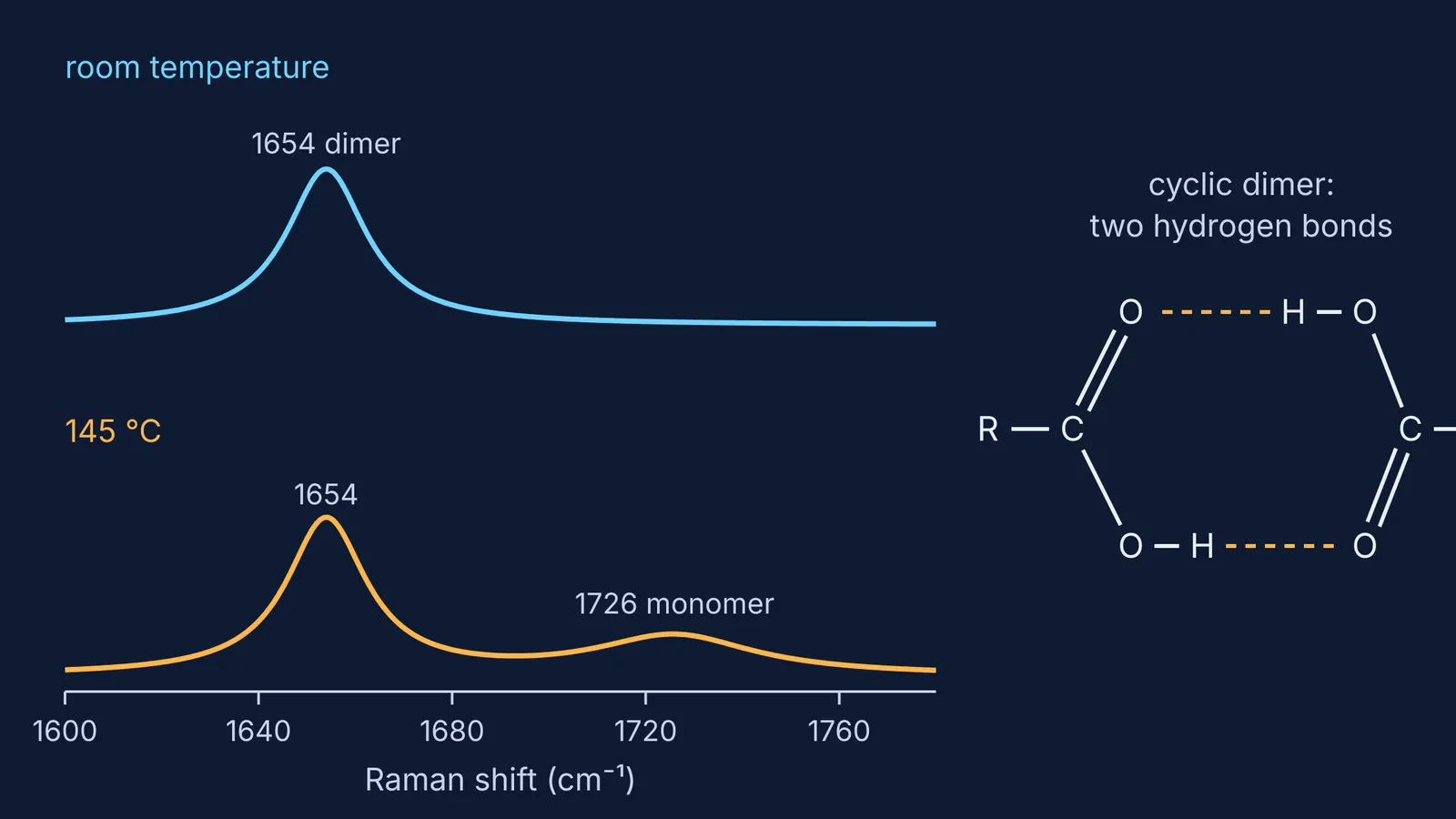
Her explanation used Pauling and Brockway's 1934 electron-diffraction work. It showed formic and acetic acids exist mostly as double molecules: a ring in which each O–H points at the other molecule's C=O. In her words, "The effect of this inter-molecular binding is to weaken the C = O and the O — H linkages, and consequently, to lower the carbonyl and the hydroxyl frequencies".
The hydrogen bond pulls on the carbonyl oxygen, the C=O bond loosens a little, and a looser bond vibrates more slowly.
What happened when she heated isobutyric acid?
Isobutyric acid boils at 154 °C. She compared its spectrum at room temperature with its spectrum at 145 °C:
The 1654 line stayed at the same position and width, "though probably it is slightly lowered in intensity".
A new, weak, diffuse line appeared near 1718 cm⁻¹ (her text says 1718; her Table I lists 1726). She assigned it to unassociated molecules.
A low-frequency line at 133 cm⁻¹ became weak and diffuse. She called it an "association band", a vibration of the dimer ring itself.
Her reading was that heating breaks some dimers into monomers without changing the strength of the hydrogen bonds that survive. That is why the dimer line did not move.
Two other results fit the picture. Lactic acid showed its C=O near 1715 cm⁻¹, close to ethyl lactate's 1730, and no line near 1650. She concluded it "behaves as if it consists mostly of single molecules". Benzoic acid's C=O sat at 1642 in the solid and 1662 in the melt, where a weak 1710 line also appeared.
She also corrected an earlier assignment of cinnamic acid's 1628 line to C=O, placing C=O near 1650. She went on to propose that cinnamic acid changes from trans to cis on melting. We could not confirm that later work supports this, so treat it as her 1940 interpretation, not a fact.
Worked example: what does a 70 cm⁻¹ shift mean?
Use her dimer line (1654 cm⁻¹) and monomer line (1718–1726 cm⁻¹).
Wavenumber to wavelength. λ = 1/ν̃. For 1654 cm⁻¹, λ = 1/1654 cm = 6.05 × 10⁻⁴ cm = 6.05 μm. For 1726 cm⁻¹, λ = 5.79 μm. Both are infrared wavelengths. Practice the units in wavelength, frequency and wavenumber sums.
Wavenumber to energy. E = hcν̃ = 6.626 × 10⁻³⁴ × 2.998 × 10¹⁰ cm s⁻¹ × 1654 cm⁻¹ = 3.29 × 10⁻²⁰ J per molecule. Multiply by 6.022 × 10²³ to get 19.8 kJ/mol. The 72 cm⁻¹ gap between 1654 and 1726 is only 0.86 kJ/mol. This is a change in a vibrational energy step, not the energy of the hydrogen bond.
Where the lines land. Excite with the 435.8 nm mercury line, which is 22,945 cm⁻¹. The dimer line appears at 1/(22,945 − 1654) cm = 469.7 nm and the monomer line at 471.3 nm. They are only about 1.6 nm apart, which is why a high-dispersion spectrograph mattered.
How much weaker is the bond? For a spring with the same atoms, ν̃ ∝ √k, so k ∝ ν̃². (1654/1726)² = 0.918 and (1654/1718)² = 0.927. Treating C=O as a simple spring, the bond's stiffness drops by about 7–8% in the dimer.
Why do acids boil higher, and where else does the dimer show up?
Isobutyric acid and ethyl acetate share the formula C₄H₈O₂ (M = 88.1 g/mol). Isobutyric acid boils at 154 °C, the value in her table, while ethyl acetate boils at about 77 °C. The general argument is in why carboxylic acids boil higher than alcohols, and the idea of the hydrogen bond goes back to Latimer and Rodebush in 1920.
The dimer also shows up in Class 12 Solutions. Take an NCERT-style problem: 2 g of benzoic acid in 25 g of benzene lowers the freezing point by 1.62 K, with Kf = 4.9 K kg mol⁻¹.
Apparent M = (1000 × Kf × w) / (ΔTf × W) = (1000 × 4.9 × 2) / (1.62 × 25) = 242 g/mol.
True M of C₆H₅COOH = 122.1 g/mol, so i = 122.1/242 = 0.505.
For 2A ⇌ A₂, i = 1 − x/2, so x = 2(1 − 0.505) = 0.99. About 99% of the acid is dimerised.
A spectrum and a freezing-point measurement point to the same pair of molecules. To see how hydrogen bonding links to boiling points, solubility and colligative properties, the Concept Library gives each concept its own lesson and its place in the map. For JEE practice on these chapters, Fermi's AI tutor for JEE prep is part of Fermi Test Prep for JEE Main and Advanced.
Quick checklist
C=O in carboxylic acid dimers: about 1654 cm⁻¹ in her isobutyric acid; esters, aldehydes and ketones: about 1710–1730.
Heating isobutyric acid to 145 °C added a weak monomer line near 1718–1726 cm⁻¹.
Lower frequency means a weaker bond; k ∝ ν̃² gives about 7–8% weaker C=O.
Benzoic acid in benzene: i ≈ 0.5, about 99% dimerised.
Her trans-to-cis claim for cinnamic acid is her interpretation, not settled fact.