

On this page
In a systematic salt analysis workflow, identifying anions begins by treating a pinch of dry salt with dilute sulphuric acid. As a member of the dilute acid group, the acetate anion (CH₃COO⁻) undergoes acid-base displacement:
2CH₃COONa + H₂SO₄ → Na₂SO₄ + 2CH₃COOH
Because acetic acid boils at 118 °C, gentle warming evolves pungent vapours with a characteristic vinegar smell. The official CBSE Senior Secondary Chemistry curriculum lists this vinegar odour as the preliminary indication for acetate.
When the odour is faint, rubbing equal pinches of salt and solid oxalic acid ((COOH)₂) with a drop of water on a watch glass serves as a sensitive test. Oxalic acid (pKₐ₁ ≈ 1.25) is far stronger than acetic acid (pKₐ ≈ 4.76), displacing acetate to release vinegar vapours at room temperature without heating. How dissociation constants govern displacement equilibria is mapped across the Fermi Concept Library.
How does the neutral ferric chloride test produce a deep red colour?
While a vinegar smell provides a preliminary clue, confirming the acetate radical requires the neutral ferric chloride test.
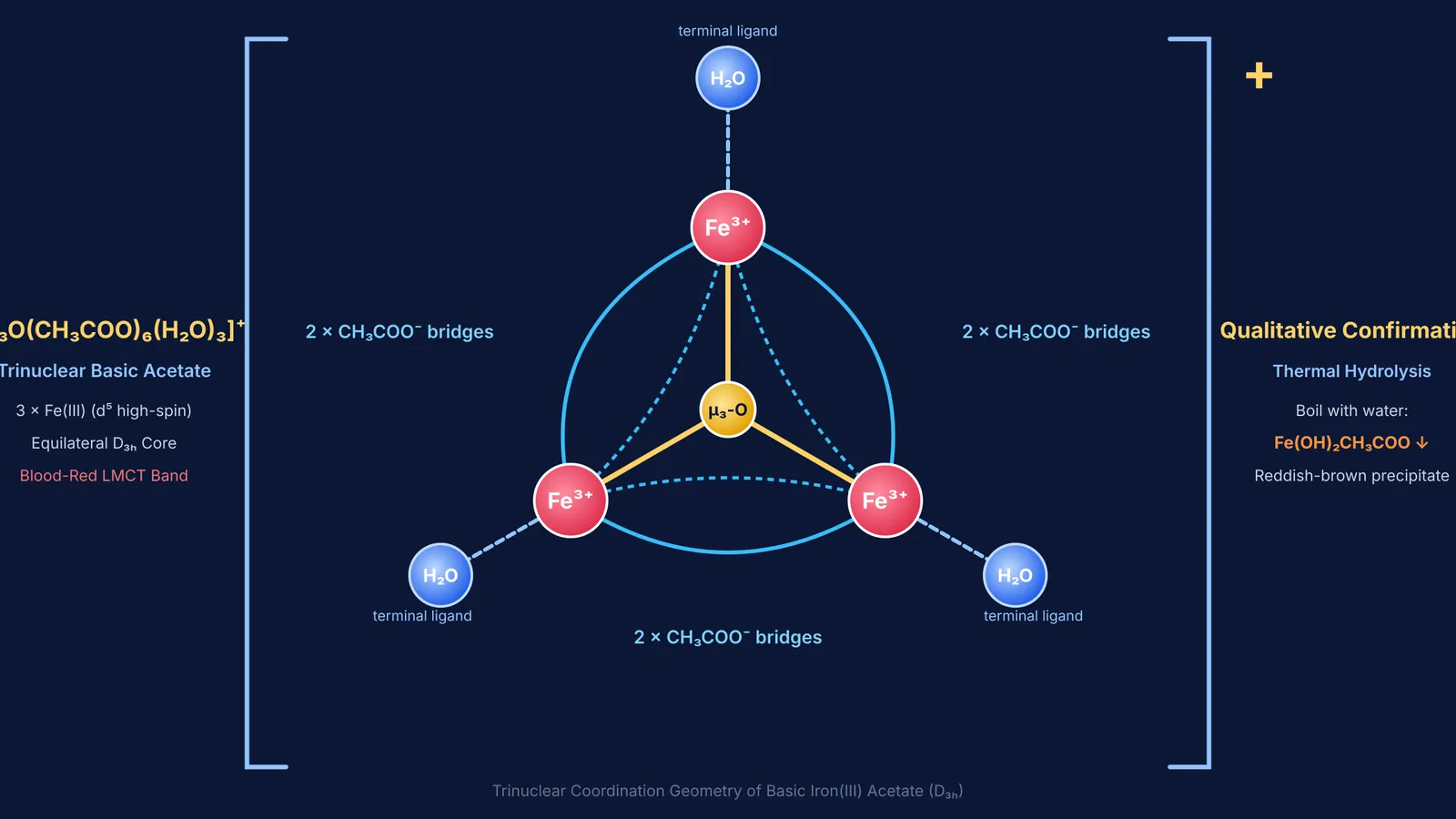
Adding neutral ferric chloride (FeCl₃) to an aqueous acetate solution turns the liquid blood-red. Rather than forming simple Fe(CH₃COO)₃, iron(III) and acetate assemble into an oxo-centred trinuclear coordination cluster:
6CH₃COO⁻ + 3Fe³⁺ + 2H₂O → [Fe₃O(CH₃COO)₆(H₂O)₃]⁺ + 2H⁺
The crystal structure of this basic carboxylate cation was solved by K. Anzenhofer and J. J. de Boer in Recueil des Travaux Chimiques des Pays-Bas. Three iron(III) centres form an equilateral triangle around a central, triply bridging oxo ligand (μ₃-O). Six acetate groups span the Fe–Fe edges as bidentate bridging ligands, while terminal water molecules complete octahedral coordination at each metal apex.
As reviewed by Roderick D. Cannon and Ross P. White in Progress in Inorganic Chemistry, intense ligand-to-metal charge transfer (LMCT) within this oxo-bridged core produces the vivid red coloration. For students tackling coordination chemistry questions, the Fermi Problem Library provides worked problems with a step-by-step solver that explains the chemical reasoning rather than printing an answer.
Why must ferric chloride be neutralised before testing?
Stock ferric chloride solutions fail this test because hydrated iron(III) undergoes cationic hydrolysis:
FeCl₃ + 3H₂O ⇌ Fe(OH)₃ + 3HCl
As reviewed by Rochelle M. Cornell and colleagues in the Journal of Chemical Technology & Biotechnology, unbuffered ferric solutions produce free hydrochloric acid. This high acidity protonates acetate into neutral acetic acid molecules (CH₃COOH), which cannot coordinate efficiently to Fe³⁺, preventing cluster assembly and destroying the red complex.
To prepare active neutral ferric chloride:
Take a small portion of commercial FeCl₃ solution in a clean test tube.
Add dilute ammonium hydroxide (NH₄OH) dropwise with shaking until a slight precipitate of ferric hydroxide persists.
Filter the mixture to collect the clear, neutral filtrate.
The pale yellow filtrate has excess mineral acid neutralised while retaining active iron(III) ions ready to coordinate acetate.
What happens when the red ferric acetate solution is boiled?
In salt analysis, you must confirm that the red color arises from acetate rather than interfering ions like thiocyanate (SCN⁻), which forms blood-red [Fe(SCN)]²⁺.
Diluting the red solution with water and boiling it gently over a burner decomposes the trinuclear complex via thermal hydrolysis:
[Fe₃O(CH₃COO)₆(H₂O)₃]⁺ + 4H₂O → 3Fe(OH)₂CH₃COO ↓ + 3CH₃COOH + H⁺
On boiling:
The deep red colour discharges completely as the soluble complex breaks down.
A flocculent, reddish-brown precipitate of basic iron(III) acetate forms at the bottom.
Adding dilute hydrochloric acid redissolves the precipitate, confirming its basic character.
Unlike acetate, red ferric thiocyanate does not precipitate upon boiling. Comparing how functional groups react across varied pH and temperature is explored in our guide to carboxylic acid acidity and reactions.
How does the ester test confirm the acetate radical?
Curriculum guidelines specify the ester test as an independent confirmatory method for the acetate ion.
In a dry test tube, treat a pinch of salt with a small volume of ethanol (C₂H₅OH) and several drops of concentrated sulphuric acid. Warming the mixture gently in a water bath before pouring into cold water induces esterification:
CH₃COONa + H₂SO₄ → CH₃COOH + NaHSO₄
CH₃COOH + C₂H₅OH ⇌ CH₃COOC₂H₅ + H₂O
Concentrated sulphuric acid acts as both catalyst and dehydrating agent, driving equilibrium toward ethyl acetate. Pouring the mixture into water releases a pleasant, distinctly fruity fragrance confirming the acetate radical. The step-by-step proton transfers and intermediates are detailed in our guide to the Fischer esterification mechanism.


