

On this page
In 1913 Rhoda Marianne Johnson, with John Theodore Hewitt and Frank George Pope at East London College, ran a simple comparison. Sodium phenoxide, warmed with ethyl chloroacetate in absolute alcohol on a water-bath, reacted within an hour. Sodium m-nitrophenoxide did too. Sodium o- and p-nitrophenoxide, under the same mild conditions, gave none. That result is chemical evidence for the resonance argument you learn for nitrophenol acidity: in the ortho and para salts, much of the negative charge sits on the nitro group, not on the phenoxide oxygen.
What were Johnson, Hewitt and Pope trying to test?
The paper is J. T. Hewitt, R. M. Johnson and F. G. Pope, "The Structure of the Salts of Nitrophenols", J. Chem. Soc. Trans. 103 (1913) 1626–1632. We read it in the scanned 1913 volume and checked the numbers below against the page images. The paper prints only the three names and "East London College"; we have not checked other biographical details. Hewitt also appears in Hewitt and Mann's 1913 kinetics puzzle.
Armstrong had argued that nitrophenol salts are "quinonoid", with a different structure from the parent phenol. The authors noted that "the evidence is based chiefly on the marked change" in light absorption, that is, colour. They wanted a chemical test. A footnote explains why they wrote "nitrophenolate": "nitrophenoxide" "definitely commits one to a certain constitution of the salt".
This is history only. Dinitro- and trinitrophenols are explosive, and no procedure is given here.
Which phenoxides made the ether, and which did not?
The test is a Williamson-type reaction, covered in our post on choosing the halide and alkoxide in Williamson synthesis. The phenoxide oxygen attacks the CH₂ carbon and chloride leaves:
ArO⁻Na⁺ + ClCH₂COOC₂H₅ → ArOCH₂COOC₂H₅ + NaCl
Atoms and charge balance on both sides. Their results, each with sodium in absolute alcohol on the water-bath:
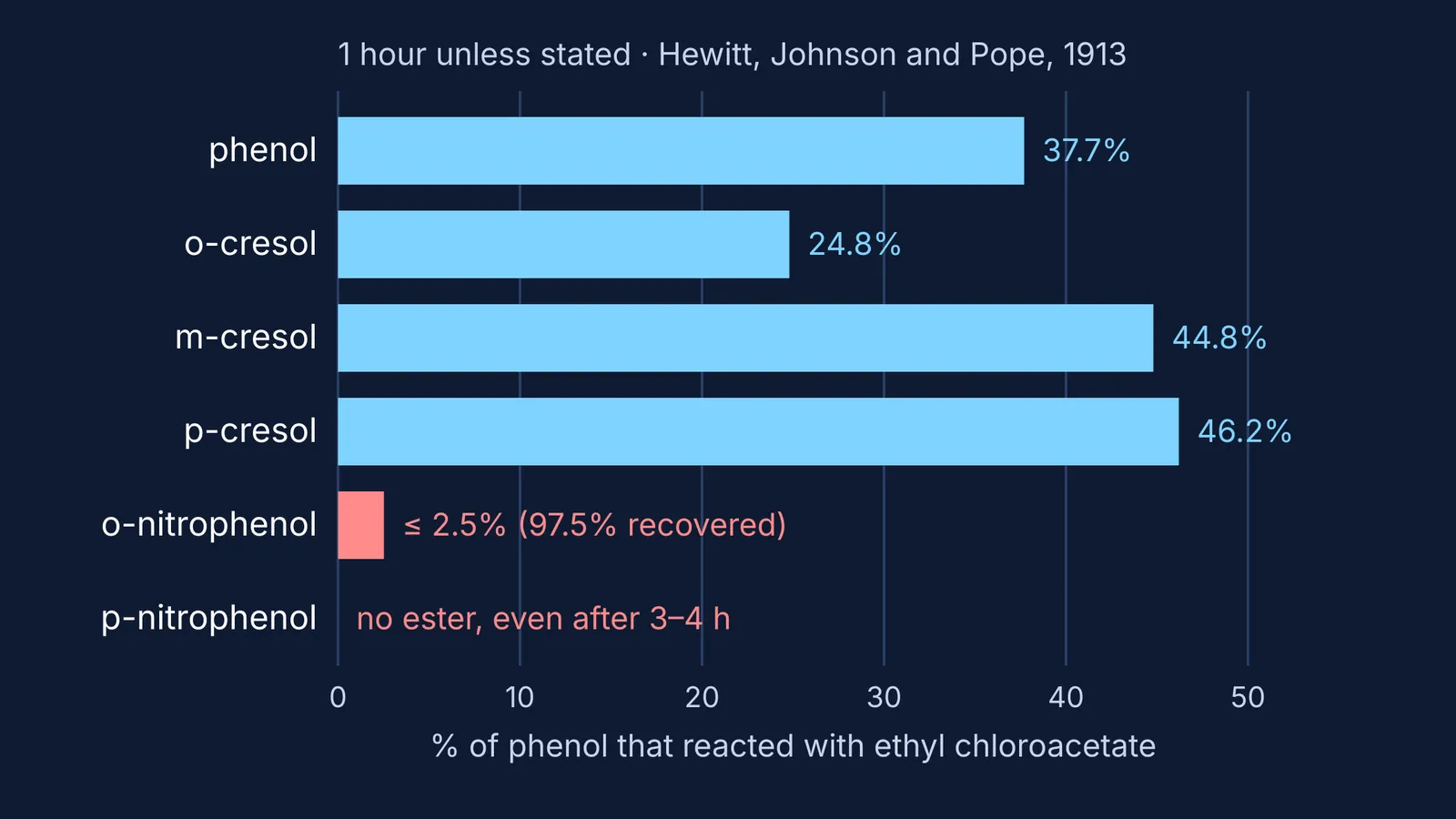
Phenol and the three cresols: with phenol, NaCl separated "almost immediately"; in one hour 37.7% of phenol and 24.8–46.2% of the cresols reacted.
2,4,6-Tribromophenol: reacted "quite well".
m-Nitrophenol: converted "with fair yield".
o- and p-Nitrophenol: no ester could be isolated.
4-Bromo-2-nitrophenol: 4.30 g of 4.36 g recovered unchanged. 2,4- and 2,6-Dinitrophenol: no reaction detected.
Their conclusion for the o- and p-salts: "we must conclude that the grouping :C·ONa is wanting."
Worked example 1: how much reacted?
Phenol. They used 0.92 g Na, 3.76 g phenol and 4.9 g ethyl chloroacetate. Moles: 0.92 ÷ 22.99 = 0.0400; 3.76 ÷ 94.11 = 0.0400; 4.9 ÷ 122.55 = 0.0400. So 1 : 1 : 1.
After one hour, a 10 mL portion of the 200 mL diluted mixture held 0.1171 g of phenol. Unreacted = 0.1171 × 20 = 2.342 g.
Converted = (3.76 − 2.342) ÷ 3.76 × 100 = 37.7%, the paper's figure.
o-Nitrophenol. They took 5.56 g, which is 5.56 ÷ 139.11 = 0.0400 mol, with the same Na and ester. After an hour under reflux they got back 5.42 g unchanged: 5.42 ÷ 5.56 × 100 = 97.5% recovered.
Why does a nitro group at ortho or para change the phenoxide?
Draw p-nitrophenoxide. The oxygen's negative charge can move into the ring by resonance and land on the ring carbons ortho and para to it. In the para isomer, one of those carbons carries the NO₂ group. So the charge can move on, onto the nitro oxygens. That contributor has C=O at the top, a quinone-like ring, and N(O⁻)O at the bottom. It is close to the "quinonoid structure" Armstrong had proposed. The same happens from the ortho position.
At meta, the ring charge lands on C-2, C-4 and C-6, never on C-3, where the NO₂ sits. The nitro group can only pull by its −I effect, which fades with distance. The charge stays mostly on the phenoxide oxygen.
This is the same reasoning behind the order o-, p-nitrophenol > m-nitrophenol > phenol in acidity, explained with measured pKa values in our post on the acidity order of substituted phenols. Today we would not call the quinonoid form a separate compound, as the 1913 authors did. It is one resonance contributor of a single ion.
Why would a stabilised anion be a poor nucleophile?
A more stable conjugate base is a weaker base. When the charge is spread over the ring and the nitro oxygens, the phenoxide oxygen has less charge to give to the carbon of ethyl chloroacetate. So it reacts more slowly. Nucleophilicity is not basicity, but for the same attacking atom (here oxygen) the weaker base is usually the slower nucleophile.
Two things the paper rules out:
It is not steric hindrance. They point out that o-bromophenol gives "a good yield" of its ester, and tribromophenol, with two ortho bromines, reacted.
It is not "never". Kym in 1897 got the o-nitro ester "in quantitative yield" by heating the dry salt with ethyl chloroacetate at 180 °C. The claim is only that the reaction fails under mild conditions.
A second test pointed the same way. Nitro compounds usually give azoxy compounds with sodium methoxide, but nitrophenols do not. The authors concluded "the :C·OH group does not become :C·ONa, whilst the nitro-group does not remain unchanged."
How did they confirm the m-nitro ester?
Worked example 2: yield. They used 1.84 g Na (0.0800 mol) and 9.8 g ethyl chloroacetate (0.0800 mol) with 11–12 g of m-nitrophenol, under reflux for three hours.
Ester obtained: 6.7579 g of C₁₀H₁₁NO₅, M = 225.20 g/mol. Moles = 0.0300.
Yield on sodium = 0.0300 ÷ 0.0800 × 100 = 37.5%.
Unreacted m-nitrophenol recovered: 4.2455 g, or 0.0305 mol.
So the meta salt reacted, more slowly than phenoxide; the ortho salt gave nothing.
Worked example 3: Dumas nitrogen. 0.2033 g of ester gave 11.1 mL of N₂ at 20 °C and 766 mm.
n(N₂) = pV/RT = (766/760 atm × 0.0111 L) ÷ (0.082057 × 293.15) = 4.651 × 10⁻⁴ mol.
Mass of N = 4.651 × 10⁻⁴ × 28.014 = 0.01303 g.
%N = 0.01303 ÷ 0.2033 × 100 = 6.41%, exactly the paper's figure. C₁₀H₁₁NO₅ requires 6.22%.
This uses 766 mm as the gas pressure. In the NCERT Dumas method the N₂ is collected over KOH solution, and you subtract aqueous tension. With water's 17.5 mm at 20 °C the answer would be 6.26%. The paper does not say what the gas was collected over. See our post on Dumas and Kjeldahl nitrogen estimation.
The carbon figure checks too. 0.1414 g CO₂ from 0.0720 g gives 0.1414 × 12.011/44.009 ÷ 0.0720 × 100 = 53.6% C, against 53.33% required (the paper prints 53.54). Their printed hydrogen, 4.79%, does not follow from the printed 0.0291 g of water, which gives 4.52%, so one of those figures is probably a misprint.
Where does this come up in JEE and NEET?
Class 12, Alcohols, Phenols and Ethers: acidity of nitrophenols, resonance, and the Williamson synthesis.
Class 11, Organic Chemistry: Some Basic Principles: Dumas nitrogen and C, H estimation.
Fermi's AI tutor for JEE prep is part of Fermi Test Prep for JEE Main and Advanced. To revise −I and −R effects themselves, the Concept Library gives each concept its own lesson.
Quick checklist
Phenoxide, cresoxides and m-nitrophenoxide made the ether; o- and p-nitrophenoxide did not, on the water-bath.
o/p-NO₂ takes the charge by resonance; m-NO₂ acts by −I only.
More delocalised anion: stronger parent acid, weaker nucleophile.
Not steric (o-bromophenol reacts) and not impossible (dry salt at 180 °C works).
Dumas: 11.1 mL N₂ at 20 °C, 766 mm from 0.2033 g gives 6.41% N.


