

On this page
In 1913 John Theodore Hewitt and Gladys Ruby Mann, of East London College, University of London, timed how fast iron(III) is reduced by thiosulphate. Their rate data fitted a fourth-order law, and they concluded that "four molecules or ions react simultaneously". NCERT says almost the opposite: four particles colliding at once is so unlikely that reactions with molecularity above three are very rare. Their own experiments also showed that the speed depended strongly on what was bound to the iron.
The paper is J. T. Hewitt and G. R. Mann, "The Reaction between Ferric Salts and Thiosulphates", J. Chem. Soc. Trans. 103 (1913) 324–329 (DOI 10.1039/CT9130300324; scan on the Internet Archive). Numbers below were checked against the page images. The paper gives only their names and college. For the algebra of third-order kinetics, see Arthur Noyes and the first third-order reaction.
What reaction did Hewitt and Mann measure?
2Fe³⁺ + 2S₂O₃²⁻ → 2Fe²⁺ + S₄O₆²⁻
The charge is +2 on each side (+6 − 4, then +4 − 2), and two electrons pass from two thiosulphate ions to two iron ions. The same tetrathionate forms when thiosulphate meets iodine, as in the thiosulphate–iodine reaction.
They came to it from analysis: using thiosulphate to reduce iron(III) in solutions full of organic matter (1912), they noticed that some iron compounds reacted slowly. Ferric chloride reacted too fast to time. Ferric alum, NH₄Fe(SO₄)₂·12H₂O, was slow enough, so they worked with it at 0 °C.
Both reagents were N/80 in the reaction mixture. Every 2 minutes or so they took a 10 c.c. sample and ran it into disodium phosphate and sodium acetate, which precipitated the iron and stopped the reaction. The leftover thiosulphate was titrated with N/80 iodine.
Why did they call it fourth order?
With both reagents at the same concentration and used up 1 : 1, a rate law of rate = k[Fe³⁺]²[S₂O₃²⁻]² becomes −dc/dt = kc⁴. Integrating gives their working formula:
k = (1/3t) × [1/(a − x)³ − 1/a³]
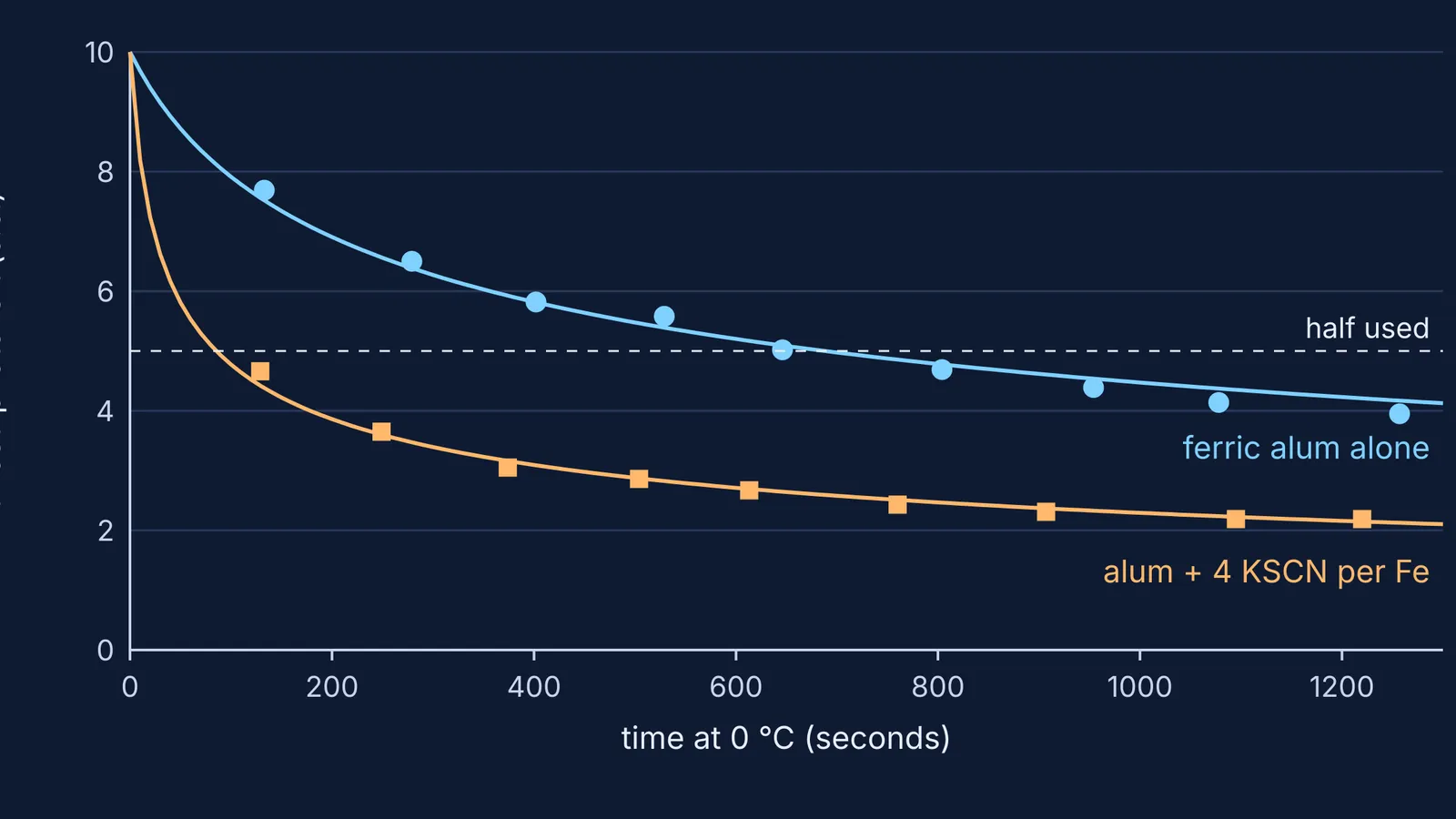
They took a = 10 (the c.c. in each sample), so a − x was simply the c.c. of iodine used. The units of k are arbitrary; they note that the constants must be multiplied by 80³ to refer to normal solutions. For ferric alum alone, two runs gave a mean k of 0.3392 × 10⁻⁵. They admitted that the constancy "leaves much to be desired", because the reaction was "half completed in about eleven minutes at 0°".
They also tested a two-step scheme: Fe³⁺ + S₂O₃²⁻ → Fe²⁺ + S₂O₃⁻, then 2S₂O₃⁻ → S₄O₆²⁻ (fast). That would look second order. Because their data did not, they ruled out the free S₂O₃⁻ ion.
How did thiocyanate and other additives change the rate?
This is the most interesting part of the paper. They mixed extra substances into the iron solution before adding thiosulphate:
3 KSCN per Fe: too fast to measure.
4 KSCN per Fe: mean k = 2.730 × 10⁻⁵, about 8 times the alum value. Half done "in about two minutes".
12 KSCN per Fe: k = 0.4066 × 10⁻⁵, only about 1.2 times the alum value.
4 phenol or 4 ethyl acetoacetate per Fe: 0.3428 and 0.3135 × 10⁻⁵, close to alum.
Acetylacetone: decolourised "very slowly", and the phosphate–acetate stop did not work.
The same iron(III) gave rates differing about eightfold, depending on what surrounded it. Their explanation: in alum, the iron sits inside a complex negative ion. They favoured Fe(SO₄)₂⁻, because a fourth-order reaction needs two iron-containing ions to meet two thiosulphate ions.
Can four ions really collide at once?
NCERT says no, in practice: "The probability that more than three molecules can collide and react simultaneously is very small", so reactions with molecularity three are already very rare (NCERT Class 12, Unit 3). Hewitt and Mann's picture is harder still. If the iron is Fe(SO₄)₂⁻, all four particles are negative and repel each other.
The weak step in their argument was the jump from order to molecularity. A rate law with exponents adding to four does not need a four-body collision. Here is one scheme, offered only as an illustration and not as the established mechanism:
Fe³⁺ + S₂O₃²⁻ ⇌ [FeS₂O₃]⁺ (fast equilibrium, constant K)
2[FeS₂O₃]⁺ → 2Fe²⁺ + S₄O₆²⁻ (slow, rate constant k′)
Step 2 is bimolecular and balances (charge +2 on each side). Its rate is k′[FeS₂O₃⁺]², and from step 1, [FeS₂O₃⁺] = K[Fe³⁺][S₂O₃²⁻]. So rate = k′K²[Fe³⁺]²[S₂O₃²⁻]², which is fourth order, built only from steps with one or two particles. Iron(III) and thiosulphate do give a short-lived violet colour in qualitative analysis, which suggests a complex like this, but we have not checked the modern mechanism.
The additives fit this picture: whatever holds the iron changes how much reactive form is present, and so the rate.
Worked example: testing the order from their numbers
Step 1: check a printed constant. With 4 KSCN, the first reading is t = 129 s and a − x = 4.66. Then k = (1/(3 × 129)) × (1/4.66³ − 1/10³) = (1/387) × (0.009882 − 0.001) = 2.295 × 10⁻⁵, exactly their value.
Step 2: half-life for fourth order. At half reaction, a − x = a/2, so 8/a³ − 1/a³ = 3kt½, giving t½ = 7/(3ka³). For alum, t½ = 7 ÷ (3 × 0.3392 × 10⁻⁵ × 1000) = 688 s, or 11.5 minutes, matching their "about eleven minutes". With 4 KSCN it is 85 s.
Step 3: which order keeps k steady? For alum (their first run), we computed the constant at the first and last reading for each trial order:
Second order: the last value is 0.54 times the first. Clearly wrong.
Third order: it falls to 0.83 times.
Fourth order: it rises to 1.34 times.
For alum alone the data lie between third and fourth order by our count. For the 4 KSCN run, the fourth-order constant changes least (1.12 against 0.58 for third order). Order is whatever the data say, and it need not be a whole number.
Step 4: why stoichiometry can't decide. The equation has four reactant particles, but that is not evidence. NCERT's own example, KClO₃ + 6FeSO₄ + 3H₂SO₄, looks tenth order and is second order. For the full contrast, read order vs molecularity of a reaction.
Where does this come up in JEE and NEET?
Exam line: order comes from experiment, molecularity from a proposed elementary step, and a fast pre-equilibrium lets a high order arise from small steps. You meet this in Class 12 Chemical Kinetics:
integrated rate laws and t½ ∝ 1/a^(n−1), covered in half-life for any reaction order;
deriving a rate law from a mechanism with a pre-equilibrium;
thiosulphate as a reductant and iodine back-titration.
To revise order, molecularity and mechanisms as linked ideas, use the Concept Library. For timed rate-law numericals, Fermi Test Prep covers JEE Main and Advanced preparation with an AI tutor.
Quick checklist
2Fe³⁺ + 2S₂O₃²⁻ → 2Fe²⁺ + S₄O₆²⁻; charge +2 each side.
Hewitt and Mann (1913): fourth order for ferric alum at 0 °C, t½ about 11 minutes.
4 KSCN per Fe: 8 times faster; 12 KSCN: back near alum.
They read fourth order as four ions colliding at once; NCERT says that is very improbable.
A fast equilibrium plus a slow bimolecular step can give rate = k[Fe³⁺]²[S₂O₃²⁻]².
Fourth order, equal concentrations: t½ = 7/(3ka³).


