

On this page
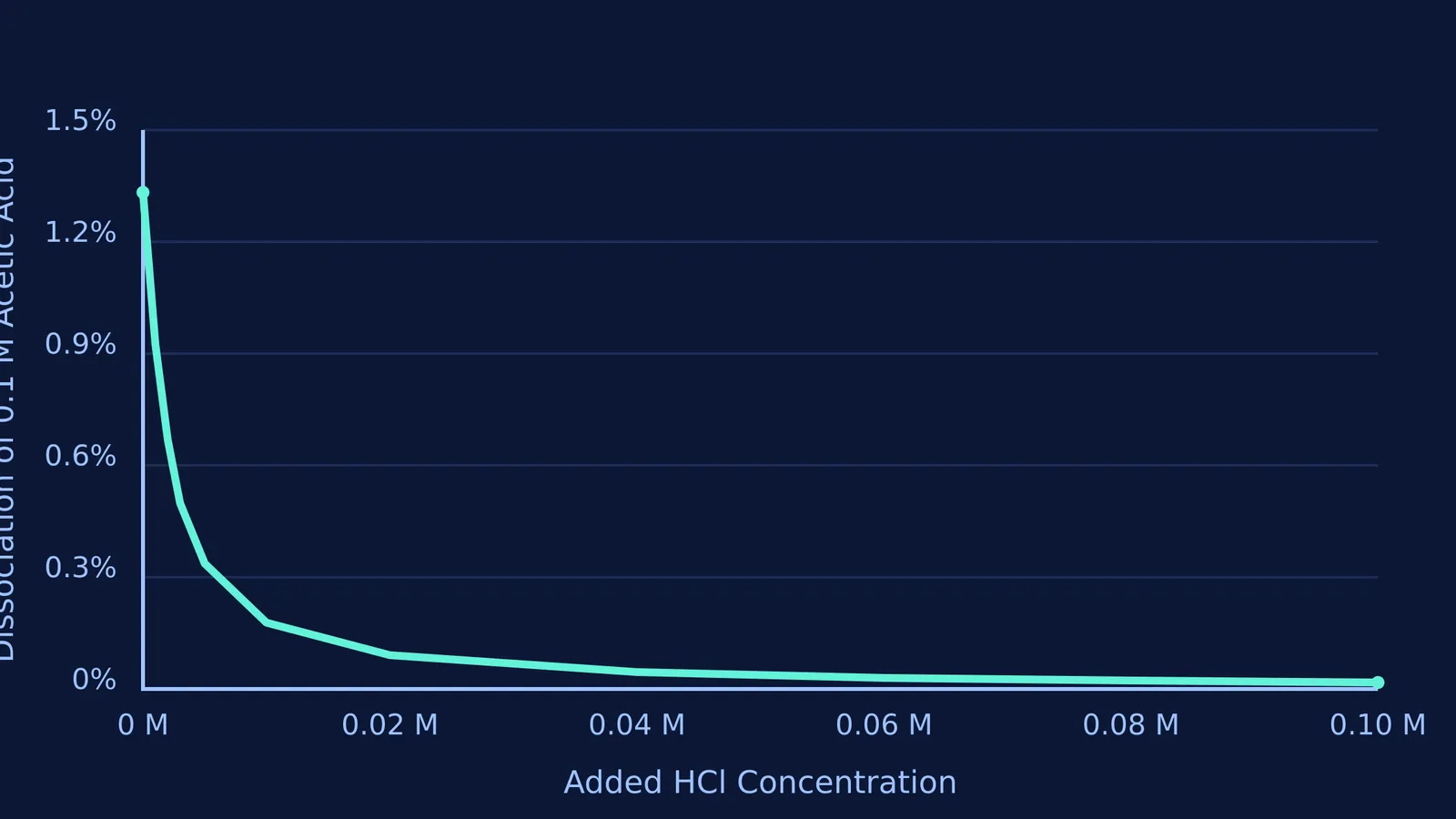
When you mix a strong acid with a weak acid, predicting the pH might seem like a complex balancing act. However, because both acids produce hydrogen ions in solution, they do not act independently. A phenomenon called the common-ion effect causes the strong acid to almost completely shut down the ionisation of the weak acid.
As a result, you can usually ignore the weak acid entirely when calculating the final pH. Here is how the chemistry works, why it happens, and how it simplifies exam numericals.
What is the common-ion effect?
The common-ion effect is the suppression of the ionisation of a weak electrolyte when a common ion is already present in the solution (LibreTexts/17%3A_Additional_Aspects_of_Aqueous_Equilibria/17.01%3A_The_Common-Ion_Effect)). This is a direct application of Le Châtelier's principle, which states that adding an ion that is a product of an equilibrium shifts the balance toward the reactants to counteract the change.
For example, acetic acid (CH₃COOH) is a classic weak acid that naturally ionises in water to form hydrogen ions (H⁺) and acetate ions (CH₃COO⁻). The equilibrium reaction looks like this:
CH₃COOH ⇌ H⁺ + CH₃COO⁻
If you add hydrochloric acid (HCl) to this system, the strong acid dissociates completely. This floods the solution with H⁺ ions. Because H⁺ is the common ion shared by both acids, its sudden high concentration forces the weak acid's equilibrium to the left. As a result, the weak acid ionises much less than it would in pure water.
If you struggle to picture how competing equilibria interact and shift, Fermi Simulation Lab provides interactive simulations for the ideas that are easier to see than to read, letting you adjust acid concentrations and watch the ions respond in real time.
How do you set up the ICE table framework?
To solve any mixture of a strong and weak acid, the most reliable framework is an Initial, Change, Equilibrium (ICE) table. Here is the exact step-by-step plan you should use on exams:
Write the major species: Identify the strong acid, which sets the initial hydrogen ion concentration.
Set the Initial row: Write the starting concentration of the weak acid. For the initial H⁺, plug in the molarity of the strong acid.
Set the Change row: The weak acid will ionise by an unknown amount, −*x*. The products will increase by +*x*.
Write the Equilibrium row: Sum the initial and change rows.
Apply the approximation: Assume *x* is so small that the initial concentration plus *x* is roughly equal to the initial concentration.
This framework makes it mathematically clear why the weak acid effectively disappears from the final pH calculation.
Does the weak acid change the pH of the mixture?
To see why the weak acid's contribution vanishes, let us look at a standard numerical: calculating the pH of a solution containing 0.10 M acetic acid and 0.10 M HCl.
In pure water, 0.10 M acetic acid (which has an equilibrium constant Ka = 1.8 × 10⁻⁵) produces a hydrogen ion concentration of roughly 1.3 × 10⁻³ M (LibreTexts/17%3A_Additional_Aspects_of_Aqueous_Equilibria/17.01%3A_The_Common-Ion_Effect)). The pH of this pure weak acid would normally be 2.88.
However, when mixed with 0.10 M HCl, the strong acid dictates the terms. Using our ICE table framework, the initial concentration of H⁺ is 0.10 M from the HCl alone. The equilibrium equation is:
Ka = [H⁺][CH₃COO⁻] / [CH₃COOH] 1.8 × 10⁻⁵ = (0.10 + *x*)(*x*) / (0.10 − *x*)
Because the ionisation is heavily suppressed by the common H⁺ ions, *x* is tiny compared to 0.10 M. We can simplify the equation by dropping *x* from the addition and subtraction terms: 1.8 × 10⁻⁵ ≈ (0.10)(*x*) / 0.10
This gives *x* = 1.8 × 10⁻⁵ M. The total H⁺ concentration is therefore 0.10 M plus 0.000018 M, which is simply 0.10 M. The weak acid's contribution is a microscopic fraction of a percent, leaving the final pH at exactly 1.00.
When does the weak acid matter?
There are only two rare exceptions where the weak acid's contribution cannot be ignored safely:
When the strong acid is extremely dilute. If you are dealing with strong acid concentrations around 10⁻⁷ M, it will not produce enough H⁺ to fully suppress the weak acid. This is mathematically similar to how water's natural H⁺ matters in the pH of 10⁻⁸ M HCl: why water's H⁺ cannot be ignored.
When the weak acid is concentrated and relatively strong. If the weak acid has an unusually high Ka value alongside a high concentration, the amount it ionises (*x*) may not be negligible compared to the strong acid. You can learn more about how Ka determines the strength of an acid in our guide to Conjugate acid-base pairs: Ka × Kb = Kw and what it tells you.
If you are ever unsure whether an approximation is safe, checking the Reaction quotient Q vs K: predicting which way a reaction moves is a reliable way to verify the state of the equilibrium. And if you are still stuck on exactly when to drop the *x* in the denominator, the Fermi Problem Library has worked problems with a step-by-step solver that explains the reasoning rather than just printing an answer.


