

On this page
In the late 1920s, measuring how strongly a chemical compound was attracted to or repelled by a magnetic field was a difficult mechanical challenge. Chemists had to weigh large samples on delicate mechanical balances, limited by friction and visual readings. In 1929, Indian scientists Shanti Swarup Bhatnagar and R.N. Mathur found an optical method, first described in their 1929 paper in Philosophical Magazine. They replaced mechanical pointers and used the wavelength of light as their ruler.
Their invention, the Bhatnagar-Mathur magnetic interference balance, became a sensitive instrument of its era. It helped establish the field of magnetochemistry, proving that the magnetic properties of a substance could reveal its chemical structure, its electron configuration, and its bonding.
What is the Bhatnagar-Mathur magnetic interference balance?
The Bhatnagar-Mathur balance is an instrument designed to measure magnetic susceptibility—the degree to which a substance becomes magnetised in an applied magnetic field. Paramagnetic materials have unpaired electrons that align with an external magnetic field, creating a net attractive force. Diamagnetic materials have all their electrons paired; the applied field induces a tiny opposing magnetic moment, leading to a weak repulsion.
Before 1929, scientists largely relied on the Gouy balance. The Gouy method suspends a long cylindrical sample between the poles of a strong magnet. When the field is turned on, the sample experiences a net force that is measured by detecting a change in its apparent physical weight using standard analytical scales. While effective for bulk measurements, the Gouy balance required significant amounts of material and often lacked the sensitivity needed for detecting subtle chemical changes. Bhatnagar and Mathur solved these limitations by replacing the physical weight reading with an optical measurement.
How does the magnetic interference balance work?
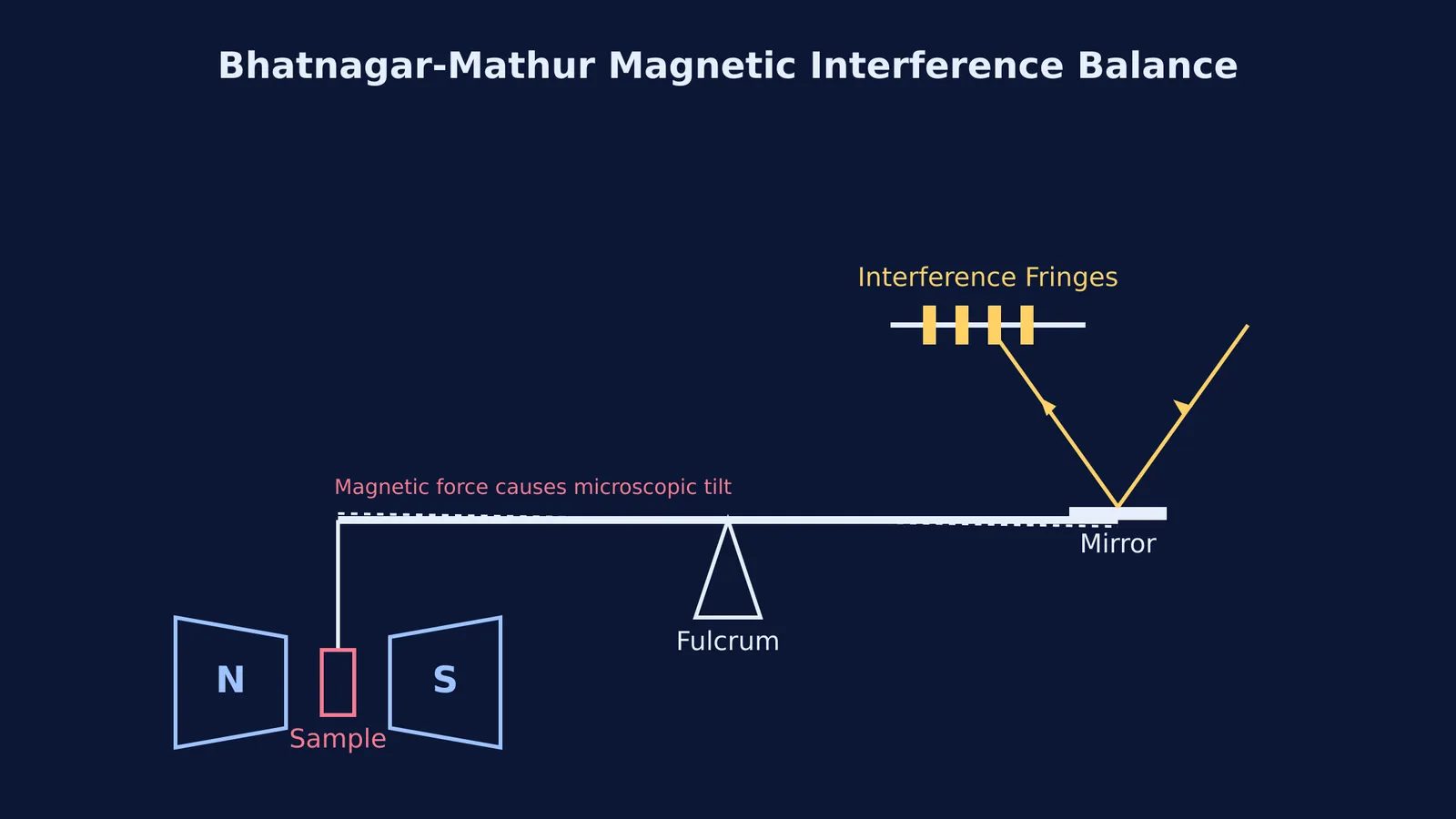
The instrument combines a strong electromagnet with a precision optical interferometer, linking a macroscopic force to a microscopic measurement.
The magnetic force: A small sample of the chemical being tested (which can be solid or liquid) is suspended from a balance beam into the narrow gap between two specially shaped magnetic poles. When the electromagnet is turned on, the sample experiences a tiny upward or downward force. The strength and direction of this force depend on whether the sample is diamagnetic or paramagnetic. Understanding how an applied field pulls on a material is a classic physics problem, similar to finding the force on a dipole in a non-uniform field.
The optical shift: This magnetic force causes the balance beam to tilt very slightly on its fulcrum. At the other end of the beam sits a mirror, which forms a crucial part of an optical interferometer.
The interference fringes: A beam of light is split, bounced off the moving mirror, and recombined to form a pattern of bright and dark bands known as interference fringes. When the magnetic force tilts the beam, the mirror moves, changing the distance the light travels. If the path difference shifts by half a wavelength, a bright fringe becomes a dark band.
Because the wavelength of light is only a few hundred nanometres, a microscopic movement of the sample shifts the fringes across a screen by a measurable amount. By observing how many fringes shift past a reference point, scientists can calculate the exact displacement of the balance beam. The instrument achieved a sensitivity beyond mechanical friction, allowing researchers to work with very small sample sizes.
Why was measuring magnetic susceptibility important?
Bhatnagar and Mathur used their balance to solve complex problems in chemistry. By measuring how a compound responded to a magnetic field, they could determine the oxidation states of transition metals. Since different oxidation states hold different numbers of unpaired electrons, their magnetic susceptibilities differ significantly. They could also study the arrangement of atoms in crystals (complementing discoveries by Max von Laue and X-rays diffracted by crystals), and observe changes during chemical reactions.
Their work laid the foundation for their 1935 textbook, *Physical Principles and Applications of Magnetochemistry*, which became a classic reference in the field. The precision of the interference balance demonstrated that physical properties could reveal the details of chemical structures, a principle that remains central to materials science today.
Fermi Concept Library holds lessons on the principles of magnetism and chemical bonding. If you are stuck on how magnetic fields interact with matter, Fermi's AI tutor can build a plan to walk you through the physics step by step.


