On this page
If you are preparing for JEE Main, NEET-UG or both, work, energy and power is a unit where you do not have to choose what to study. The two official syllabi list the same topics. What changes is how the paper asks about them, and that should change how you practise.
Is the work, energy and power syllabus the same for JEE Main and NEET?
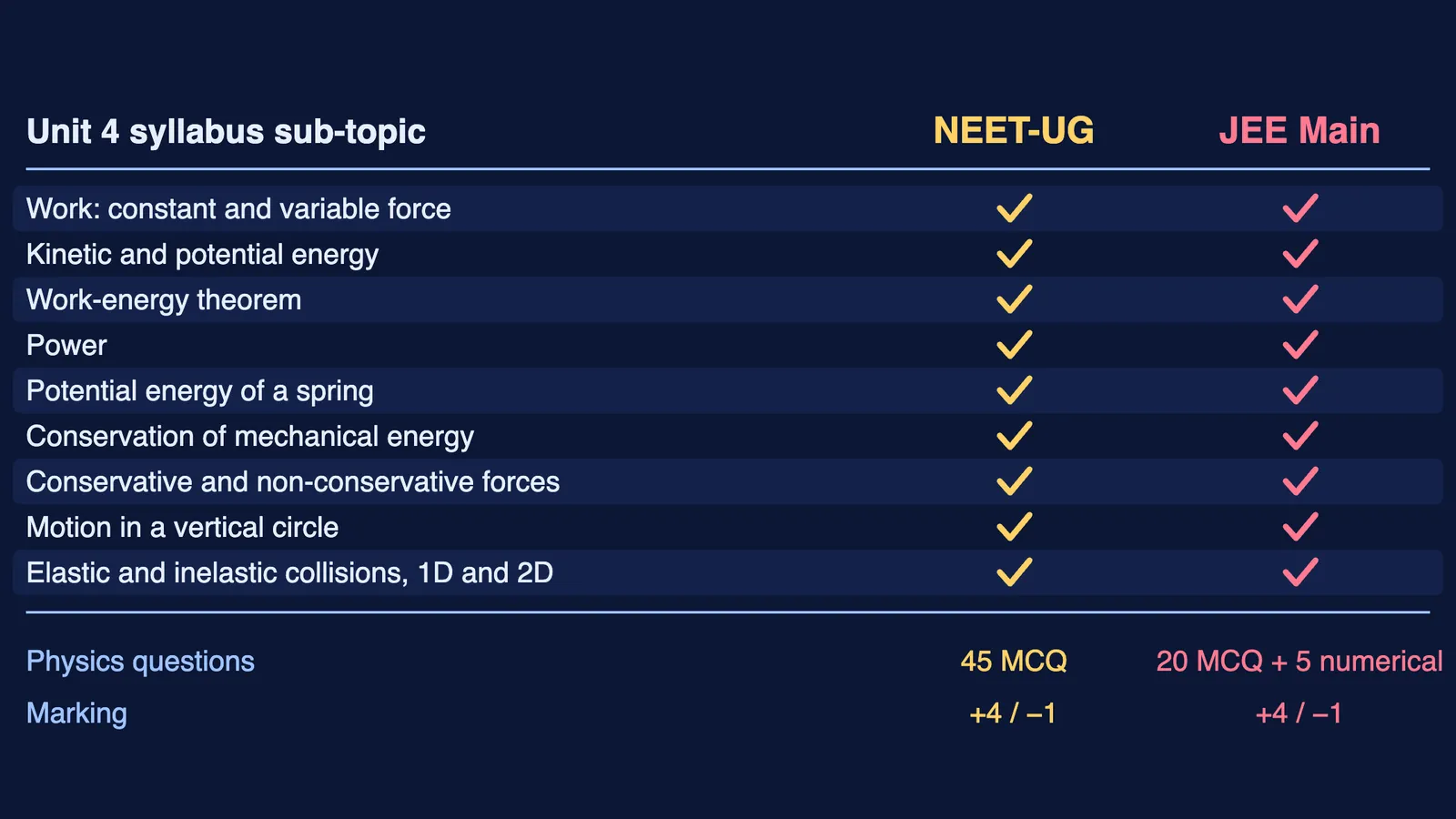
Yes. The sub-topics match line for line. Unit 4 of the NTA syllabus for JEE (Main) 2027 and Unit 4 of the NMC syllabus for NEET (UG)-2026, circulated by the National Medical Commission on 22 December 2025, carry the same unit text. Read side by side, both list:
"Work done by a constant force and a variable force"
"kinetic and potential energies, work-energy theorem, power"
the potential energy of a spring and "conservation of mechanical energy"
"conservative and non-conservative forces"
"motion in a vertical circle"
"Elastic and inelastic collisions in one and two dimensions"
We found no sub-topic in one list that is missing from the other. The wording differs only in small ways: the NEET text uses semicolons and a colon where the JEE text uses commas, and it reads "potential energy of spring" without the "a". The matching textbook chapter is Chapter 5 of NCERT Class 11 Physics Part I.
How is the question format different in JEE Main and NEET?
The NEET (UG)-2026 information bulletin says the paper has 180 compulsory questions in 180 minutes, with 45 in Physics. Every question is an MCQ "with four options and single correct answer/best option". A correct answer earns four marks and a wrong one loses one.
The JEE (Main) 2027 information bulletin gives Physics in Paper 1 two sections: 20 MCQs in Section A and 5 questions in Section B "whose answers are to be filled in as a numerical value". Section B answers are rounded off to the nearest integer and entered with the mouse on an on-screen numeric keypad. Both sections carry +4 for a correct answer and −1 for a wrong one, and the paper runs for three hours.
So in JEE Main, some questions give you no options to check against.
How does the style of questions differ?
This is a tendency you will notice in official past papers, not a rule. NEET questions on this unit usually test one idea at a time and reward speed: a direct use of the work-energy theorem, a statement about conservative forces, a quick power calculation. Some read like an NCERT sentence turned into a question.
JEE Main questions more often chain two or three steps. A block may slide down an incline, cross a rough floor and meet a spring, and you track energy through each stage. Variable forces, where work is the area under a force-displacement graph, and vertical-circle conditions tend to appear in longer setups.
Here is one idea, the work done by non-conservative forces, asked both ways.
NEET style. A 0.4 kg ball is dropped from rest from a height of 5 m and hits the ground at 9 m/s. Take g = 10 m/s². The work done on the ball by air resistance is: (A) −3.8 J (B) +3.8 J (C) −16.2 J (D) −20 J
Worked answer:
Loss of potential energy: mgh = 0.4 × 10 × 5 = 20 J.
Kinetic energy at the ground: ½ × 0.4 × 9² = 16.2 J.
By the work-energy theorem, gravity's work plus air's work equals the change in kinetic energy: 20 + W = 16.2, so W = −3.8 J. Answer (A).
The trap is (B). Air resistance opposes motion, so its work must be negative.
JEE Main style (numerical value). A 2 kg block starts from rest at the top of a 5 m rough incline at 37° to the horizontal (sin 37° = 0.6, cos 37° = 0.8). The friction coefficient on the incline is 0.25. At the bottom it moves onto a level floor where the friction coefficient is 0.4. Take g = 10 m/s². How far, in metres, does it slide on the floor before stopping?
Worked answer:
Gravity's work down the incline: mg sin 37° × 5 = 2 × 10 × 0.6 × 5 = 60 J.
Friction on the incline: 0.25 × mg cos 37° × 5 = 0.25 × 16 × 5 = 20 J.
Kinetic energy at the bottom: 60 − 20 = 40 J.
On the floor, friction is 0.4 × 20 = 8 N, so 8 × d = 40 and d = 5 m. Enter 5.
The mass cancels, and friction removes all 60 J of the original potential energy: two quick checks when there are no options to lean on.
How to prepare for both
Learn the chapter once, from NCERT. Since the unit text matches, one careful pass through Chapter 5 serves both exams. Redo the in-text examples without looking.
Write the energy equation before any numbers. For every problem, list the forces that do work and their signs. This habit stops sign errors in NEET MCQs and keeps multi-stage JEE problems organised.
Practise answers without options. For JEE Main Section B, solve a few problems a day with the options covered, then round to the nearest integer as the bulletin asks.
Drill speed separately for NEET. Time short sets of single-idea MCQs on power, spring energy and the work-energy theorem, and log each miss as concept, sign or arithmetic.
Give the vertical circle and 2D collisions extra time. Both syllabi name them, and they are where one-step thinking runs out fastest.
Stuck on why a sign or a stage went wrong? The Fermi Problem Library has worked problems with a step-by-step solver that explains the reasoning rather than printing an answer.
For a full plan for one exam, read our guides to preparing work, energy and power for NEET and preparing work, energy and power for JEE Main. Then test yourself with work, energy and power practice questions for JEE Main.