On this page
Magnetic effects of current and magnetism is one unit where the JEE Main and NEET-UG syllabi list the same sub-topics, with small differences in wording and punctuation. What changes is the question format and how many steps a question asks you to chain.
Is the magnetism syllabus the same for JEE Main and NEET?
Yes. In the NTA Syllabus for JEE (Main) - 2027, this is Physics Unit 13, "Magnetic Effects of Current and Magnetism". In the National Medical Commission's syllabus for NEET (UG)-2026, dated 22 December 2025, it is also Physics Unit 13, with the same title.
Read side by side, these phrases appear in both units, in the same order:
"Biot - Savart law and its application to" a "current carrying circular loop"
"Ampere's law and its applications to infinitely long current carrying straight wire and solenoid"
"Force on a moving charge in uniform magnetic and electric fields"
"Moving coil galvanometer, its sensitivity" and "conversion to ammeter and voltmeter"
"Current loop as a magnetic dipole" and a bar magnet "as an equivalent solenoid"
"dia- and ferromagnetic substances with examples" and the "effect of temperature on magnetic properties"
We found no sub-topic in one unit that is missing from the other, only small words and punctuation, such as "the" before "current carrying circular loop" in the JEE text. The practical lists match too: both documents include "Resistance and figure of merit of a galvanometer by half deflection method."
How are magnetism questions asked in JEE Main and NEET?
The JEE (Main) 2027 Information Bulletin sets Paper 1 Physics at 20 questions in Section A and 5 in Section B, for 100 marks, in a computer-based test. Section A is multiple choice. Section B answers are "filled in as a numerical value", and the bulletin says the answer "should be rounded off to the nearest integer." Both sections carry +4 for a correct answer and -1 for a wrong one.
The NEET (UG)-2026 Information Bulletin sets 180 compulsory questions in 180 minutes, with 45 Physics questions worth 180 marks. Every question is a multiple-choice item "with four options and single correct answer/best option", marked +4, -1 or 0 if unanswered, in pen and paper mode.
How does the question style differ?
Neither NTA nor NMC publishes a chapter weightage, so treat any figure you see quoted with suspicion. What you will notice in official past papers is a difference of tendency, not of topics.
NEET leans on one idea at a time. Many read like an NCERT line turned into a choice: a right-hand-rule direction, a ratio of fields, which material is weakly repelled.
JEE Main leans on chaining. A question may join the radius of a charged particle's path with geometry, or a galvanometer with a circuit. You find one quantity, then use it to find the one asked.
Numerical-value questions remove your safety net. With no options, you cannot eliminate or back-solve, so your own estimate is the only check.
What does the same idea look like in each exam?
Here is one idea, the force on a charge moving beside a long straight current, written both ways. Both questions are original. The force is F = qv × B, and Ampere's law gives the wire's field as B = μ₀I/(2πr).
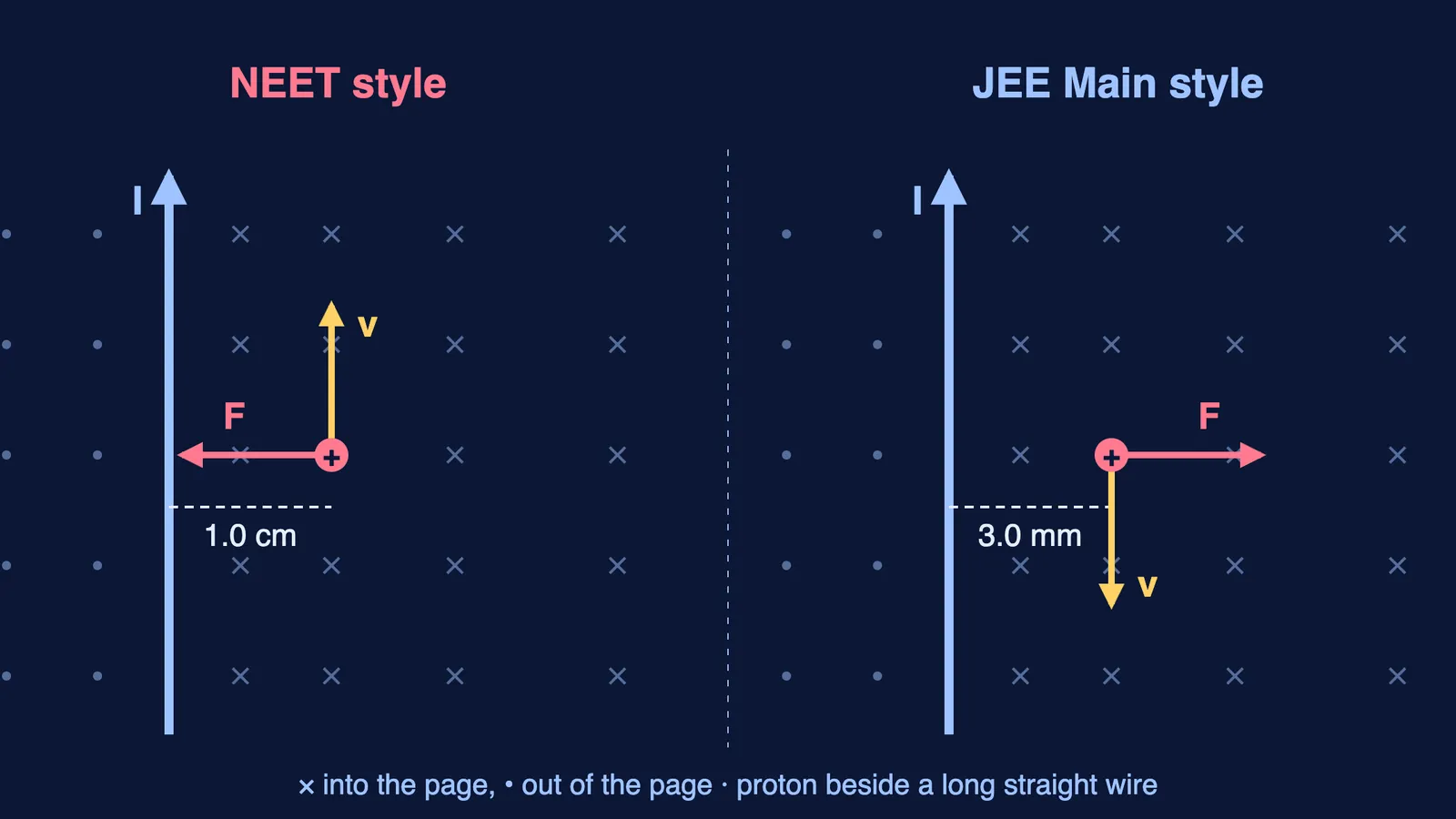
NEET style. A long straight vertical wire carries 5.0 A upward. A proton 1.0 cm to the right of the wire moves straight up, parallel to the current. At that instant, the magnetic force on the proton points:
(A) towards the wire (B) away from the wire (C) upward, along the wire (D) nowhere; it is zero because the proton moves parallel to the current
Answer: (A). By the right-hand rule, the wire's field to its right points into the page. For a positive charge, F = qv × B with v up and B into the page points left, towards the wire. Trap: (D). v is parallel to the current, not to B.
JEE Main style (numerical value). A long straight wire carries 15 A. A proton 3.0 mm from the wire moves parallel to it, opposite to the current, at 5.0 × 10⁵ m/s. Find the magnitude of its acceleration at that instant, in units of 10⁹ m/s². Take μ₀ = 4π × 10⁻⁷ T m/A, the proton's mass as 1.67 × 10⁻²⁷ kg and its charge as 1.6 × 10⁻¹⁹ C.
Answer: 48. First the field: B = μ₀I/(2πr) = (2 × 10⁻⁷ × 15)/(3.0 × 10⁻³) = 1.0 × 10⁻³ T. Then the force: F = qvB = 1.6 × 10⁻¹⁹ × 5.0 × 10⁵ × 1.0 × 10⁻³ = 8.0 × 10⁻¹⁷ N, directed away from the wire. Then the acceleration: a = F/m = 8.0 × 10⁻¹⁷/1.67 × 10⁻²⁷ ≈ 4.79 × 10¹⁰ m/s², which is 47.9 in units of 10⁹ and rounds to 48. Trap: writing μ₀I/(4πr) for the field halves everything and gives 24.
Three linked steps, and no options to catch a slip in any of them.
How to prepare for both
Learn the unit once. The Unit 13 text is the same for both exams, so one set of notes covers both.
Make directions automatic. Practise F = qv × B and the right-hand rule until "into" or "out of the page" comes without hesitation.
Chain formulas for JEE Main. A field from Ampere's law or Biot-Savart often feeds a force, then a motion. Write each link with units before you substitute.
Practise without options. Solve some questions with the choices covered, then round to the nearest integer as the JEE Main bulletin asks.
Revise NCERT lines for NEET. Statements on para-, dia- and ferromagnetism and the effect of temperature reward exact reading.
Do the galvanometer practical once. Both syllabi list the half-deflection method, so know what figure of merit means.
Can't picture which way the force points? The Fermi Simulation Lab has interactive simulations for the ideas that are easier to see than to read.
For exam-specific plans, read how to prepare magnetic effects of current for NEET and how to prepare moving charges and magnetism for JEE Main. Then check your directions and formulas against the eight common moving charges and magnetism mistakes.