On this page
Preparing for JEE Main and NEET-UG together? The official Current Electricity topic lists match, so one round of study covers both. What changes is how each exam asks about it.
Is the Current Electricity syllabus the same for JEE Main and NEET?
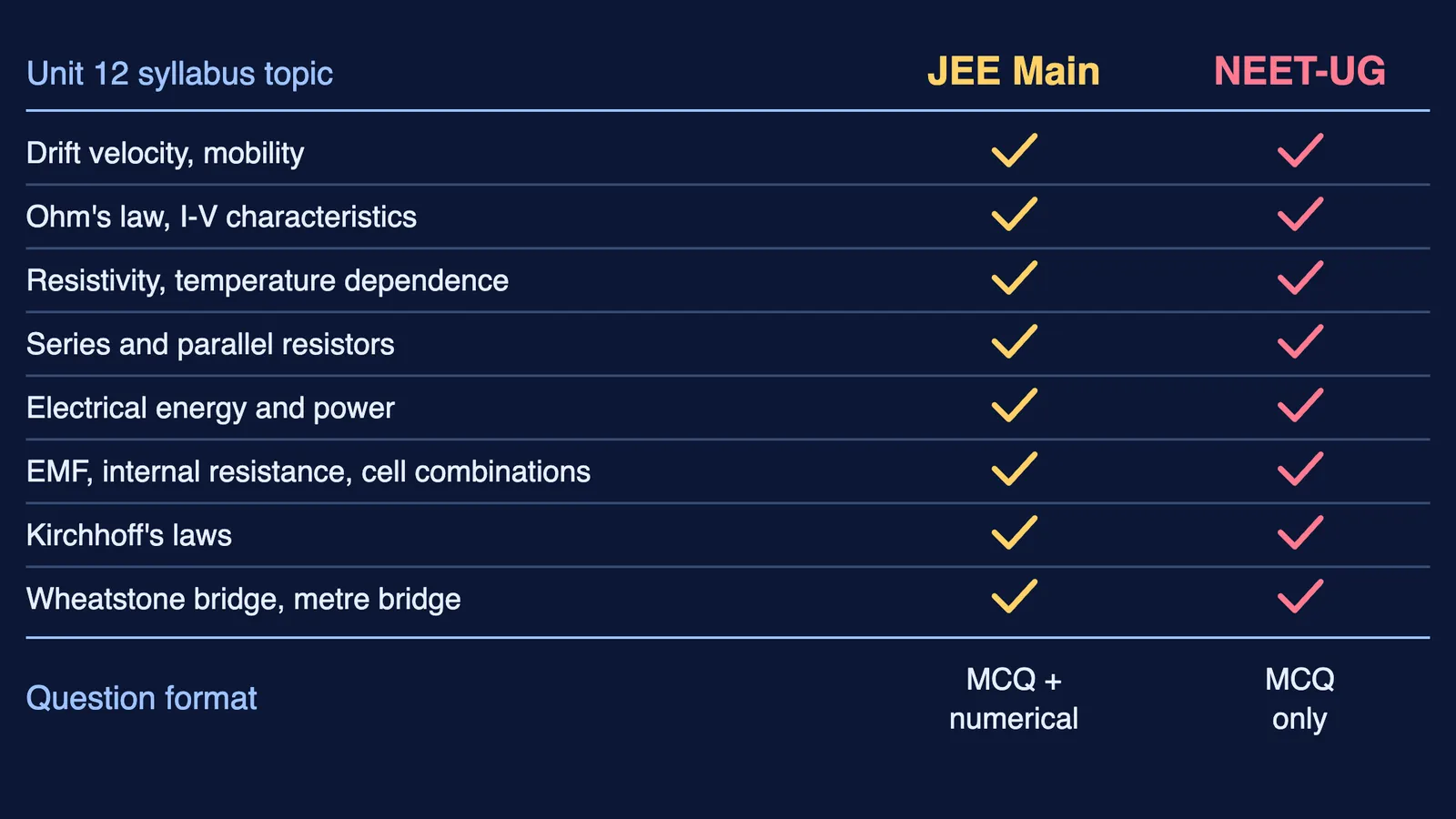
Yes. The two unit texts name the same sub-topics in the same order. Only capitals, punctuation and one label differ.
Unit 12 of the Syllabus for JEE (Main) - 2027, linked from the NTA JEE Main website, opens with "drift velocity, mobility and their relation with electric current". Unit 12 of the NMC's updated syllabus for NEET (UG)-2026, dated 22-12-2025, opens with "Drift velocity, mobility and their relation with electric current." JEE Main runs the items together with commas; NEET writes each as a short capitalised sentence. Line by line, in JEE Main's wording:
"Ohm's law, electrical resistance", then the graphs: JEE Main writes "I-V characteristics of Ohmic and non-ohmic conductors"; NEET writes "V-l characteristics of Ohmic and non-ohmic conductors". Same graphs.
"electrical energy and power, electrical resistivity and conductivity" (NEET: "Electrical energy and power. Electrical resistivity and conductivity.")
"series and parallel combinations of resistors" and "temperature dependence of resistance" (NEET capitalises both).
"Internal resistance, potential difference and emf of a cell, a combination of cells" in series and parallel, identical in both.
"Kirchhoff’s laws and their applications", then "Wheatstone bridge" and "Metre Bridge" in both.
No sub-topic appears in one list and not the other. The Experimental Skills unit also matches. Both include "The resistivity of the material of a given wire using a metre bridge" and "The resistance of a given wire using Ohm's law".
Neither list names the potentiometer. One gap: Chapter 3 of NCERT Class 12 Physics Part I (Reprint 2026-27) gives the meter bridge a single sentence, yet both syllabi list it. Learn how its balance lengths give the resistance ratio.
How is the question format different?
The JEE (Main) 2027 information bulletin splits each subject of Paper 1 into Section A, 20 multiple-choice questions, and Section B, 5 questions whose answer is a numerical value. You enter an integer on an on-screen keypad, rounded to the nearest integer. Both sections give +4 for a correct answer and −1 for a wrong one.
The NTA information bulletin for NEET (UG)-2026 sets 180 compulsory questions in 180 minutes, with 45 in Physics. Every question is a multiple-choice question "with four options and single correct answer/best option", marked +4, −1 and 0 if unanswered.
A JEE Main numerical question has no options to catch a slip in a unit prefix or a Kirchhoff sign.
How does the style of questions differ?
These are tendencies you may notice in official past papers, not rules.
NEET questions on this unit tend to be short. Many test one NCERT statement or one relation: what mobility depends on, how drift speed changes with area, the balance condition of a bridge. The arithmetic is light.
JEE Main questions tend to chain steps. A typical one moves from field to drift speed to current, or from a circuit to Kirchhoff's equations to the power in one branch.
The two original examples below test drift velocity and mobility in each style. NCERT Section 3.5.1 defines mobility as "the magnitude of the drift velocity per unit electric field", μ = v_d/E, and shows that μ = eτ/m.
NEET-style example. A copper lead on a sensor rig is lowered into a cold bath, while a controller holds the same electric field along it. Which is correct?
(A) Mobility increases and drift speed increases (B) Mobility is unchanged and drift speed increases (C) Mobility decreases and drift speed decreases (D) Mobility increases and drift speed is unchanged
Answer: (A). NCERT Section 3.8 states that the average collision time τ "decreases with temperature", so cooling lengthens τ. Mobility μ = eτ/m therefore rises, and with E fixed, v_d = μE rises too. Trap: (D) forgets that v_d = μE, and (B) treats mobility as a constant of the metal.
JEE Main-style example (numerical value). A student tests a flat alloy ribbon 4.0 mm wide and 0.125 mm thick. With 7.2 A through it, two probes 1.2 m apart read 0.60 V. The free-electron density is 6.0 × 10²⁸ m⁻³ and e = 1.6 × 10⁻¹⁹ C. Find the electron mobility in units of 10⁻⁴ m² V⁻¹ s⁻¹.
Answer: 30. Step 1: A = 5.0 × 10⁻⁷ m². Step 2: v_d = I/(neA) = 7.2/(6.0 × 10²⁸ × 1.6 × 10⁻¹⁹ × 5.0 × 10⁻⁷) = 1.5 × 10⁻³ m/s. Step 3: E = V/L = 0.60/1.2 = 0.50 V/m. Step 4: μ = v_d/E = 3.0 × 10⁻³ m² V⁻¹ s⁻¹ = 30 × 10⁻⁴. Check: ρ = RA/L ≈ 3.5 × 10⁻⁸ Ω m, which equals 1/(neμ). Trap: leaving the area in mm² gives an answer a million times too small.
Same idea, v_d = μE. NEET checks what changes and why; JEE Main wants the chain and the arithmetic, with no options.
What should you prepare differently?
For NEET, train fast recognition: name the relation, decide what stays fixed, choose. For JEE Main, add timed multi-step circuits and numericals without options. For full single-exam plans, read our guides on how to prepare Current Electricity for NEET and how to prepare Current Electricity for JEE Main.
Stuck halfway through a Kirchhoff circuit? The Fermi Problem Library has worked problems with a step-by-step solver that explains the reasoning rather than printing an answer.
How to prepare for both
Read NCERT Chapter 3 once, properly. Sections 3.1 to 3.13 cover the syllabus text. Mark every line saying what depends on what.
Keep one relation sheet: I = neAv_d, v_d = μE, ρ = m/(ne²τ), R = R₀(1 + αΔT), V = E − Ir.
Fix one Kirchhoff sign convention. Choose current directions, go round each loop the same way, and accept a negative answer as a reversed current.
Learn both bridges as a single idea. The Wheatstone balance condition and the metre bridge ratio of balance lengths are the same equation. Practise each with an unknown in either gap.
Practise in two modes. Quick one-step MCQs, then multi-step circuits with the options covered, answered as one integer as in Section B.
Review mistakes by type. Sort each miss as units, sign, wrong combination or arithmetic. Our list of common mistakes with cells, meters and electric power in JEE and NEET shows the usual ones.