On this page
Preparing for JEE Main and NEET-UG together? Electromagnetic Waves is the rare chapter where the syllabus gives you no surprises. What changes is how a question reaches you.
Is the Electromagnetic Waves syllabus the same for JEE Main and NEET?
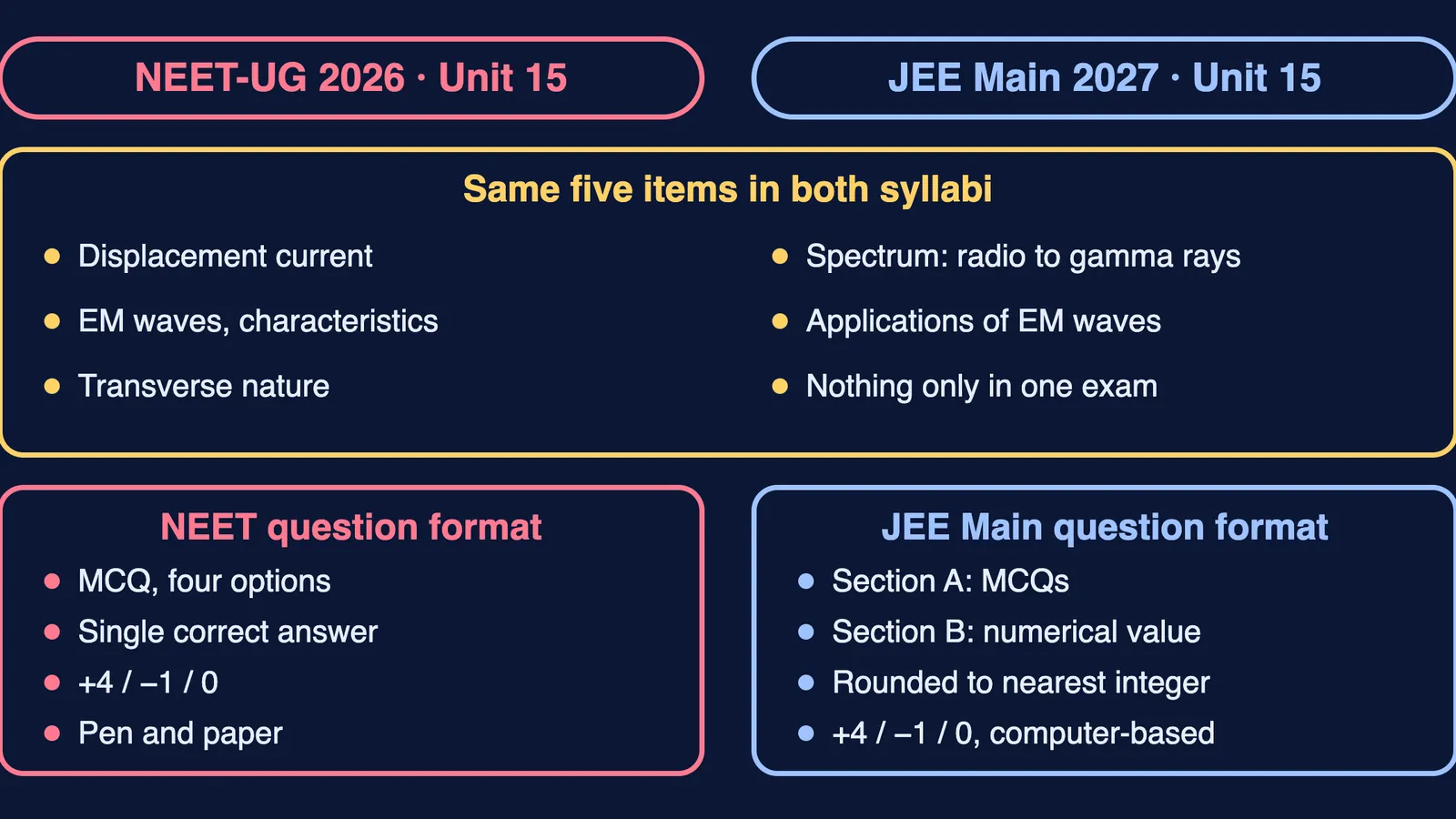
Yes. In the NTA Syllabus for JEE (Main) - 2027, Electromagnetic Waves is Physics Unit 15. In the National Medical Commission's syllabus for NEET (UG)-2026, dated 22 December 2025, it is also Physics Unit 15.
The two unit texts list the same items in the same order. Quoting JEE Main, with NEET's differences in brackets:
"Displacement current" (NEET: "Displacement current.")
"electromagnetic waves and their characteristics" (NEET capitalises "Electromagnetic")
"transverse nature of electromagnetic waves" (NEET: "Transverse nature")
"electromagnetic spectrum", bands "radio waves" to "Gamma rays" (NEET: "Electromagnetic", and "ultraviolet. X-rays. Gamma rays")
"applications of electromagnetic waves" (NEET: "Applications of e.m. waves.")
So the texts differ only in capitals, punctuation and one abbreviation. No sub-topic appears in one exam's unit and not the other. Both point to the same textbook chapter, Chapter 8 of NCERT Class 12 Physics Part I, so one careful reading of it serves both papers.
How are Electromagnetic Waves questions asked in JEE Main and NEET?
The JEE (Main) 2027 Information Bulletin sets Paper 1 Physics at 20 questions in Section A and 5 in Section B, for 100 marks, in a computer-based test. Section A is multiple choice. Section B answers are "filled in as a numerical value", and the bulletin says each "should be rounded off to the nearest integer." Both sections carry +4 for a correct answer, -1 for a wrong one and 0 if left blank.
The NEET (UG)-2026 Information Bulletin sets 180 compulsory questions in 180 minutes, with 45 Physics questions worth 180 marks. Every question is a multiple-choice item "with four options and single correct answer/best option", marked +4, -1 or 0 if unanswered, in pen and paper mode.
So an Electromagnetic Waves question in NEET always gives you four answers to test. In JEE Main, a Section B question gives you none.
How does the question style differ?
Neither body publishes a chapter weightage. What you may notice in official past papers is a difference in tendency, not in topics.
NEET tends to lean on recall and one-line relations. Items often read like an NCERT sentence turned into a question: which band a wavelength belongs to, which radiation has which use, or B₀ = E₀/c with one substitution.
NEET also likes statements. Which-statements-are-true items reward reading NCERT exactly.
JEE Main tends to lean on chaining. A question may join capacitance from Electrostatics, an alternating voltage, and the Ampere-Maxwell law, or ask you to read k and ω from a wave equation before finding anything else.
Numerical-value questions remove your safety net. With no options, you cannot eliminate or back-solve, and a lost factor of 2 or 4 goes unnoticed unless you check it yourself.
What does the same idea look like in each exam?
One idea from NCERT Chapter 8, written both ways: E₀/B₀ = c, and E × B points along the direction of travel. Both questions are original.
NEET style. A vertically polarised radio wave from a transmitter travels due north. At one instant, the electric field at a receiver is 0.60 V/m, pointing vertically upward. The magnetic field at that point and instant is:
(A) 2.0 nT, towards east (B) 2.0 nT, towards west (C) 2.0 nT, towards north (D) 1.8 × 10⁸ T, towards east
Answer: (A). B = E/c = 0.60/(3.0 × 10⁸) = 2.0 × 10⁻⁹ T. With east, north and up as x, y and z, up × east = north, so B points east. Traps: (B) takes B × E; (D) multiplies by c.
One relation and one direction check: typical NEET territory.
JEE Main style (numerical value). The same kind of wave, with amplitude 0.60 V/m, travels due north in air. At a receiver, the electric field reaches its upward maximum, and its next downward maximum arrives 5.0 ns later. At the instant of the upward maximum, how far north of the receiver, in centimetres, is the nearest point where the magnetic field is 2.0 nT pointing west?
Answer: 150. The gap between an upward and the next downward maximum is half a period, so T = 10 ns, ν = 100 MHz and λ = c/ν = 3.0 m. B₀ = E₀/c = 2.0 nT, so 2.0 nT is the peak value. At the receiver B peaks east, as in the NEET question, so the nearest westward peak is half a wavelength north: 1.5 m, or 150 cm.
The extra steps are the point. Treating 5.0 ns as the full period gives 75 cm, and with no options on screen, nothing warns you.
How to prepare for both
Read NCERT Chapter 8 once, line by line. Both unit texts name the same items, so one reading covers both. Then summarise displacement current, E₀ = cB₀, c = 1/√(μ₀ε₀) and the spectrum order on one page.
Learn the spectrum as a table you can rewrite. For NEET, add one source and one use per band, because recall items are quick marks. For JEE Main, add the wavelength range so you can place any frequency after λ = c/ν.
Drill directions with E × B. A few orientations a day helps in both exams.
For JEE Main, link back to Electrostatics and AC. Practise displacement current with capacitance and a sinusoidal voltage, and always ask whether your loop is inside or outside the plates.
For JEE Main, practise without options. Cover the choices on some MCQs, solve, then round to the nearest integer as the bulletin asks.
For NEET, train speed on statements. Timed sets of short items help, because 45 Physics questions share one 180-minute paper with 135 others, per the bulletin.
Struggling to picture E and B oscillating together as a wave moves past you? The Fermi Simulation Lab has interactive simulations for the ideas that are easier to see than to read.
For the full exam-specific plans, read how to prepare Electromagnetic Waves for NEET and how to prepare Electromagnetic Waves for JEE Main. Then check your working against our list of common Electromagnetic Waves mistakes in JEE and NEET.