On this page
Preparing Atoms and Nuclei for JEE Main and NEET-UG together? The two syllabi list the same sub-topics, with only small wording differences. What differs is the question format and how many steps a question chains.
Is the Atoms and Nuclei syllabus the same for JEE Main and NEET?
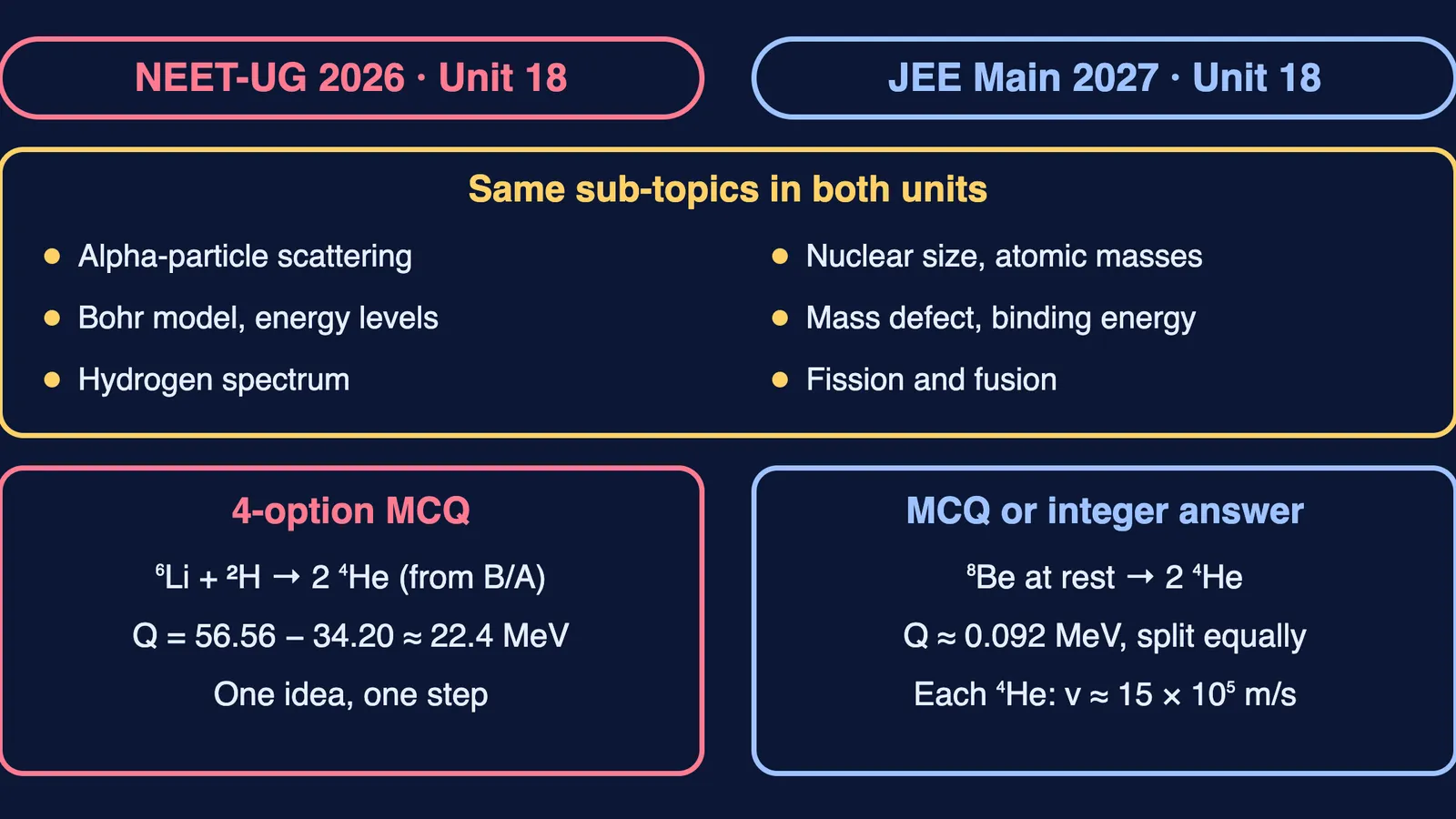
Yes. In the NTA Syllabus for JEE (Main) - 2027, Atoms and Nuclei is Physics Unit 18. In the National Medical Commission's updated syllabus for NEET (UG)-2026, dated 22 December 2025, it is also Unit 18.
Read side by side, both units list the same sub-topics in the same order. The JEE Main text runs:
"Alpha-particle scattering experiment, Rutherford's model of atom, Bohr model"
"energy levels, hydrogen spectrum. Composition and size of nucleus"
"atomic masses, mass-energy relation, mass defect"
"binding energy per nucleon and its variation with mass number"
"nuclear fission and fusion."
The NEET text differs only in small words and punctuation. It uses semicolons in places ("Alpha-particle scattering experiment; Rutherford's model of atom;"), capitalises "Mass-energy relation", and ends "nuclear fission, and fusion." No sub-topic appears in one unit and not the other.
Neither unit lists radioactivity, decay laws or half-life. The NCERT Class 12 Nuclei chapter keeps a short descriptive section, 13.6, on alpha, beta and gamma decay; read it once, but skip half-life numerical drills.
How are Atoms and Nuclei questions asked in JEE Main and NEET?
The JEE (Main) 2027 Information Bulletin sets Paper 1 Physics at 20 questions in Section A and 5 in Section B, for 100 marks, in a computer-based test. Section A is multiple choice. Section B answers are "filled in as a numerical value", and the bulletin says the answer "should be rounded off to the nearest integer." Both sections carry +4 for a correct answer and -1 for a wrong one.
The NEET (UG)-2026 Information Bulletin sets 180 compulsory questions in 180 minutes, with 45 Physics questions worth 180 marks. Every question is a multiple-choice item "with four options and single correct answer/best option", marked +4, -1, or 0 if unanswered, in pen-and-paper mode.
So an Atoms and Nuclei question in NEET always gives you four options to check against. In JEE Main it may give you only a box for an integer.
How does the question style differ?
What you will notice in official past papers is a difference in tendency, not in topics.
NEET leans on one idea per question. Many items read like an NCERT line turned into a choice: what the scattering experiment showed, which way the binding-energy curve bends, why fusion releases energy.
JEE Main leans on chaining. A question often joins this unit to another: a nuclear reaction with momentum conservation, or a Bohr transition with the photoelectric effect. Mass arithmetic carried to several decimal places tends to appear.
Numerical-value questions change your checking. With no options, a sign slip in a mass defect has nothing to catch it.
What does the same idea look like in each exam?
Here is one idea, energy released when nuclei become more tightly bound, written both ways. Both questions are original.
NEET style. A lithium-6 nucleus absorbs a deuteron and the product splits into two helium-4 nuclei: ⁶Li + ²H → 2 ⁴He. Binding energies per nucleon: ⁶Li 5.33 MeV, ²H 1.11 MeV, ⁴He 7.07 MeV. The energy released is about
(A) 0.63 MeV (B) 22.4 MeV (C) 24.6 MeV (D) 90.8 MeV
Answer: (B). Energy released is the gain in total binding energy. Products: 8 × 7.07 = 56.56 MeV. Reactants: 6 × 5.33 + 2 × 1.11 = 34.20 MeV. Q = 56.56 − 34.20 ≈ 22.4 MeV. Traps: (A) subtracts per-nucleon values only; (C) forgets the deuteron; (D) adds instead of subtracting.
The values are rounded from the AME2020 atomic mass evaluation, which lists about 5.332 MeV per nucleon for lithium-6, 1.112 MeV for deuterium and 7.074 MeV for helium-4. NCERT's summary gives the reason: energy is released when less tightly bound nuclei become more tightly bound ones.
JEE Main style (numerical value). A beryllium-8 nucleus at rest breaks into two helium-4 nuclei. Atomic masses: ⁸Be = 8.005305 u, ⁴He = 4.002603 u; 1 u = 931.5 MeV/c² = 1.66 × 10⁻²⁷ kg; 1 MeV = 1.6 × 10⁻¹³ J. What is the speed of each helium nucleus, in units of 10⁵ m/s, to the nearest integer?
Answer: 15. Mass defect: 8.005305 − 2 × 4.002603 = 0.000099 u, so Q = 0.000099 × 931.5 ≈ 0.092 MeV. Atomic masses are safe here because four electrons appear on each side. Now mechanics: with no initial momentum, the two equal masses fly apart with equal speeds, so each gets half of Q, about 0.046 MeV. Then v = √(2K/m) ≈ 1.5 × 10⁶ m/s.
The masses are from AME2020. The extra steps are the point: a tiny mass defect that needs all six decimal places, momentum from another unit, then a unit conversion. Give each nucleus the whole Q and you type 21, with no option to warn you.
How to prepare for both
Learn the shared unit once. Unit 18 is the same text in both syllabi, so one set of notes serves both exams.
Know the binding-energy curve as a picture. Sketch it from memory and explain why fission and fusion both release energy.
Drill exact mass arithmetic for JEE Main. Work with six decimal places, decide whether you are using atomic or nuclear masses, and keep electrons balanced.
Practise links to other units. For JEE Main, pair reactions with momentum conservation, and Bohr transitions with photon energy and photoelectric questions.
Train speed and close reading for NEET. 45 Physics questions share 180 minutes with 135 others, per the bulletin, so timed sets of short NCERT-statement items help.
Skip the decay-law drills. Read NCERT 13.6 for context only; neither syllabus unit lists it.
Can't see why the curve makes fusion pay off for light nuclei? The Fermi Concept Library covers every concept in physics, chemistry, biology, mathematics and computing, each with its own lesson and its place in the map.
For the full exam-specific plans, read how to prepare Atoms and Nuclei for NEET and how to prepare Atoms and Nuclei for JEE Main. Then check the traps in Atoms and Nuclei mistakes in JEE and NEET.