On this page
Preparing for JEE Main and NEET-UG together? In Optics the syllabi line up; the differences lie in how questions use the ideas.
Is the Optics syllabus the same for JEE Main and NEET?
Yes, the sub-topics match, though the wording differs in punctuation and capitals. In the NTA Syllabus for JEE (Main) - 2027, Optics is Physics Unit 16. In the National Medical Commission's syllabus for NEET (UG)-2026, dated 22 December 2025, it is also Physics Unit 16.
Both units list the same ray optics sub-topics. Quoting the JEE Main text, with NEET's differences noted:
"Reflection of light, spherical mirrors, mirror formula" (the NEET PDF prints "morror formula")
"thin lens formula and lens maker formula" (identical in both)
"total internal reflection and its applications" (NEET capitalises "Total")
"magnification, power of a lens" (NEET: "Magnification. Power of a Lens."), lenses in contact, and "refraction of light through a prism"
the microscope and astronomical telescope, "reflecting and refracting", and their magnifying powers
The wave optics sub-topics also match:
"wavefront and Huygens' principle" (NEET's wording) and reflection and refraction using it
"Young's double-slit experiment and expression for fringe width" (identical in both)
"coherent sources and sustained interference of light" (NEET adds a comma after "sources")
"Diffraction due to a single slit, width of central maximum"
"Brewster's law, uses of plane-polarized light and Polaroid" (NEET's wording)
Neither unit has a sub-topic the other lacks. The experimental skills lists match too: both include focal lengths of a convex mirror, concave mirror and convex lens by parallax, the deviation against incidence plot for a prism, and the refractive index of a glass slab with a travelling microscope.
How are Optics questions asked in JEE Main and NEET?
The JEE (Main) 2027 Information Bulletin sets Paper 1 Physics at 20 questions in Section A and 5 in Section B, for 100 marks, in a computer-based test. Section A is multiple choice. Section B answers are typed as a numerical value, which the bulletin says "should be rounded off to the nearest integer." Both sections carry +4 for a correct answer and -1 for a wrong one.
The NEET (UG)-2026 Information Bulletin sets 180 compulsory questions in 180 minutes, with 45 Physics questions worth 180 marks. Every question is a multiple-choice item "with four options and single correct answer/best option", marked +4, -1 or 0 if unanswered, in pen and paper mode.
So a NEET Optics question always gives four options; a JEE Main one may give none.
How does the question style differ?
Neither body publishes chapter weightage. What you will notice in official past papers is a difference in tendency, not topics.
NEET leans on single-idea questions. Many read like an NCERT line turned into a calculation: one formula, one sign check, one ratio.
JEE Main leans on chaining. A question may join a lens with a mirror, a fringe pattern with a change of medium, or an intensity condition with a position on the screen.
Numerical-value questions change your checking. With no options, you cannot eliminate or back-solve, so your own sanity check (sign, units, which order of fringe) is the only one.
What does the same idea look like in each exam?
Here is one idea from Young's double-slit experiment, written both ways. Both are original and rest on the intensity relation in NCERT Class 12 Physics Part II, Chapter 10, Wave Optics (Reprint 2026-27), equation 10.11: I = 4I₀ cos²(φ/2), where I₀ is the intensity from each slit, so the maximum is 4I₀. A path difference Δ gives a phase difference φ = 2πΔ/λ.
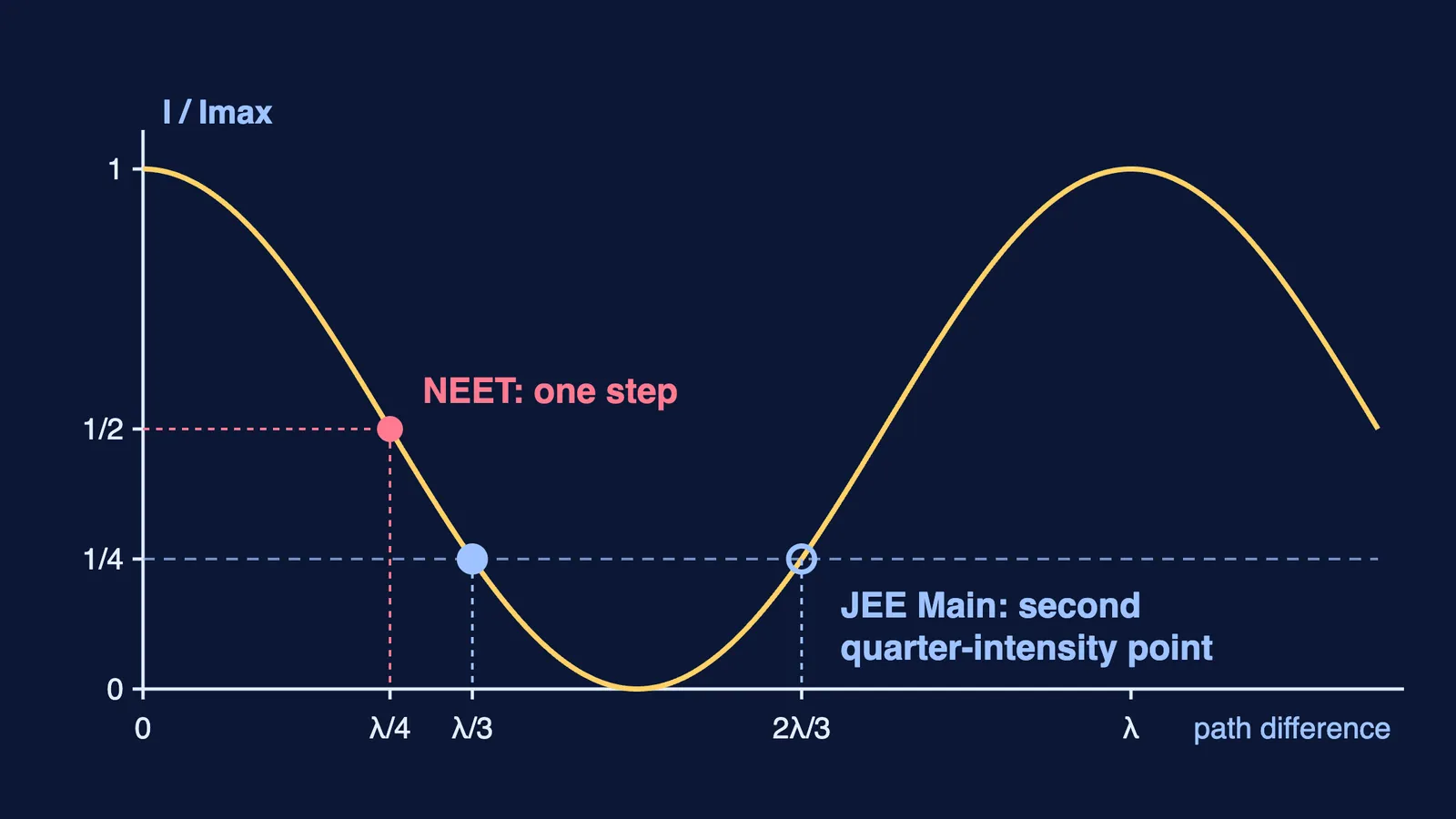
NEET style. In Young's double-slit experiment with two identical slits, a light sensor is placed on the screen halfway between the central bright fringe and the first dark fringe. If the central intensity is I_max, what does the sensor read?
(A) 0 (B) I_max/4 (C) I_max/2 (D) 3I_max/4
Answer: (C). The first dark fringe sits at half a fringe width, β/2, so the sensor is at β/4, where the path difference is λ/4. Then φ = 2π × (1/4) = π/2 and I = I_max cos²(π/4) = I_max/2. Trap: (A) comes from using cos²φ instead of cos²(φ/2).
JEE Main style (numerical value). Two identical slits 0.50 mm apart are lit by light of wavelength 600 nm, and the screen is 1.25 m away. Moving away from the central maximum on one side, find the distance from the centre, in micrometres, of the second point where the intensity is one quarter of the maximum.
Answer: 1000. Quarter intensity means cos²(φ/2) = 1/4, so φ/2 = π/3 or 2π/3, giving path differences λ/3 and 2λ/3 within the first fringe. The second point is at Δ = 2λ/3. Fringe width β = λD/d = (600 × 10⁻⁹ × 1.25)/(0.50 × 10⁻³) m = 1.5 mm, and y = (Δ/λ)β = (2/3) × 1.5 mm = 1.0 mm = 1000 µm. Trap: 500, the first such point, or 2000, which skips the point just past the first dark fringe.
How to prepare for both
Learn the shared unit once. Mirror and lens formulas, the lens maker formula, total internal reflection, prisms, instruments, interference, single-slit diffraction and polarisation are the same lines in both syllabi.
Fix one sign convention and never switch.
Cover Brewster's law separately. Both syllabi list it, but the 2026-27 NCERT Wave Optics chapter does not name it, so learn tan i_B = n and why the reflected light is plane-polarised.
Practise wave optics without options for JEE Main. Cover the options on some questions, then round your answer to the nearest integer, as the bulletin asks.
Train speed for NEET. The bulletin's 45 Physics questions share one 180-minute paper with 135 others, so drill short single-formula items under time.
Do the three optics experiments on paper. Both syllabi list parallax focal lengths, the prism deviation plot and the travelling microscope, so know what each graph or reading looks like.
Can't picture why intensity falls as cos² between fringes? The Fermi Simulation Lab has interactive simulations for the ideas that are easier to see than to read.
For the exam-specific plans, read how to prepare Optics for NEET, how to prepare Ray Optics for JEE Main and how to prepare Wave Optics for JEE Main.