On this page
Preparing for JEE Main and NEET-UG together? Electromagnetic induction and alternating currents is easy to share between them, because the two official syllabi list the same sub-topics. The differences sit in how questions are asked and how many steps they chain.
Is the EMI and AC syllabus the same for JEE Main and NEET?
In scope, yes. In the NTA Syllabus for JEE (Main) - 2027, this is Physics Unit 14, "Electromagnetic Induction and Alternating Currents". In the National Medical Commission's syllabus for NEET (UG)-2026, dated 22 December 2025, it is also Unit 14, with the same title in capitals.
Read line by line, both units list the same sub-topics in the same order. Only capital letters and punctuation differ. The induction half, as printed:
JEE Main: "Faraday's law, induced emf and current, Lenz’s law, eddy currents, self and mutual inductance."
NEET: "Faraday's law. Induced emf and current: Lenz’s Law, Eddy currents. Self and mutual inductance."
The AC half follows the same pattern. JEE Main has "reactance and impedance, LCR series circuit, resonance, power in AC circuits", where NEET has "reactance and impedance: LCR series circuit, resonance: power in AC circuits". Both also list "peak and RMS value of alternating current/voltage", "wattless current" and "AC generator and transformer". No sub-topic appears in one unit and not the other.
How are EMI and AC questions asked in JEE Main and NEET?
The JEE (Main) 2027 Information Bulletin sets Paper 1 Physics at 20 questions in Section A and 5 in Section B, for 100 marks, as a computer-based test. Section A is multiple choice. Section B questions have answers "filled in as a numerical value", and the bulletin says the answer "should be rounded off to the nearest integer." Both sections carry +4 for a correct answer and -1 for a wrong one.
The NEET (UG)-2026 Information Bulletin sets 180 compulsory questions in 180 minutes, with 45 Physics questions worth 180 marks. Every question is a multiple-choice item "with four options and single correct answer/best option", marked +4, -1 or 0 if unanswered, in pen and paper mode.
So a NEET question in this unit always gives you four options. In JEE Main it may give you none.
How does the question style differ?
Neither NTA nor NMC publishes chapter weightage, so ignore anyone who quotes one. What you will notice in official past papers is a difference in tendency, not in topics.
NEET leans on one idea per question. Many items read like an NCERT statement turned into a calculation or a choice: the direction of an induced current, why a transformer core is laminated, how reactance changes with frequency.
JEE Main leans on chaining. A question often joins induction to mechanics or energy, such as an induced current producing a force that someone must work against. In AC, phasor diagrams and power factor tend to carry more steps.
Numerical-value questions change your checking. With no options to eliminate, a limiting-case or energy check is often your only safety net.
What does the same idea look like in each exam?
Here is one idea, inductive reactance rising with frequency, written both ways. Both questions are original. The setting is a loudspeaker crossover: an inductor in series with a woofer lets low notes through and holds back high ones.
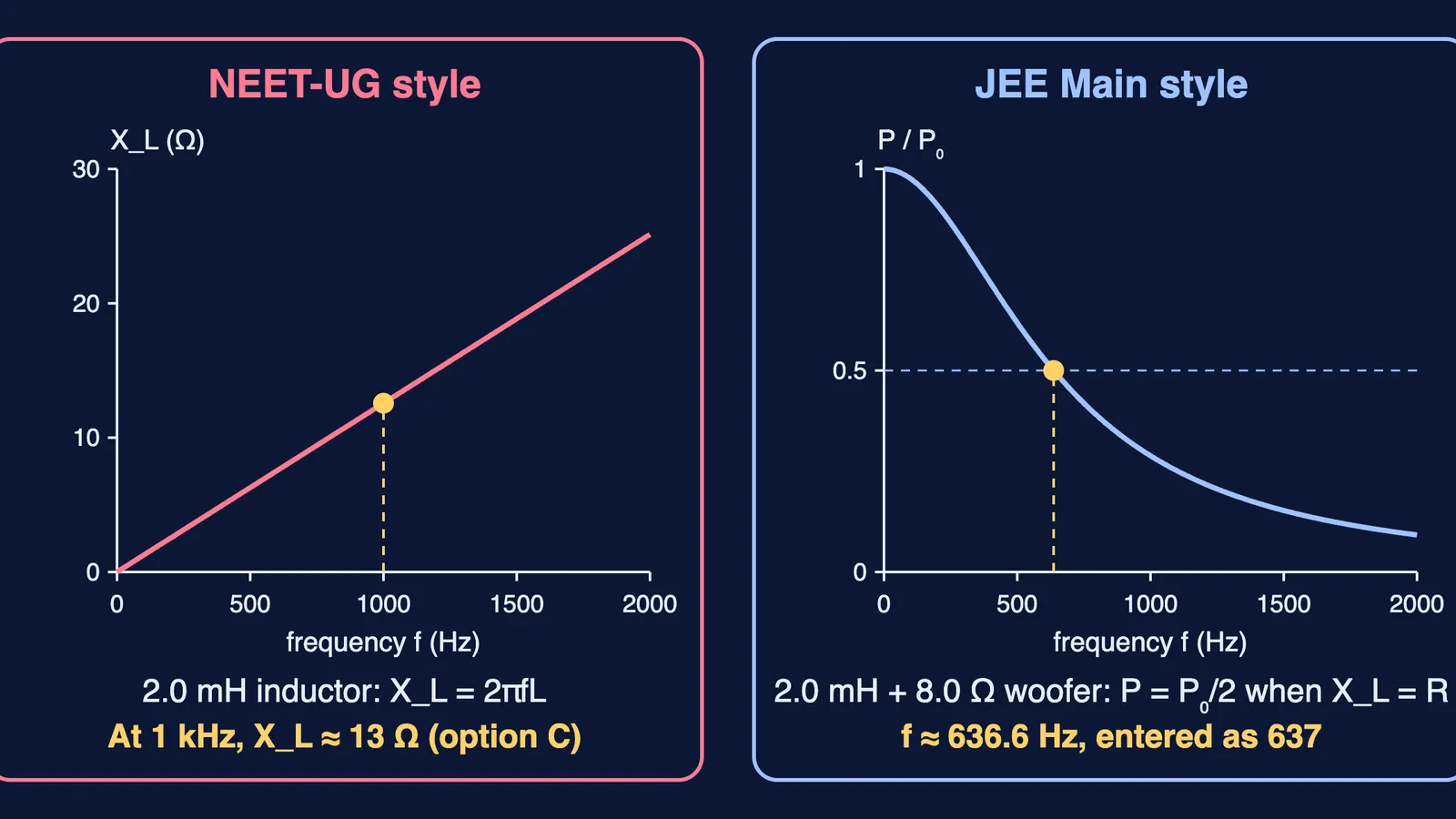
NEET style. A loudspeaker crossover uses an ideal 2.0 mH inductor. Its reactance at 1.0 kHz is closest to:
(A) 0.080 Ω (B) 2.0 Ω (C) 13 Ω (D) 13 kΩ
Answer: (C). X_L = 2πfL = 2π × 1000 × 0.0020 ≈ 12.6 Ω, which rounds to 13 Ω. Traps: (B) is fL, with the 2π forgotten. (A) is 1/(2πfL), the capacitor-style formula. (D) comes from leaving L in millihenry. Because X_L grows with f, high notes see more opposition than low ones.
One formula, one substitution: typical NEET territory.
JEE Main style (numerical value). The same 2.0 mH inductor is in series with an 8.0 Ω woofer, treated as a pure resistance. The source keeps a fixed rms voltage at every frequency. At what frequency, in hertz, does the average power delivered to the woofer fall to half its value at very low frequency?
Answer: 637. Average power is P = V²R/Z², with Z² = R² + (2πfL)². At very low frequency X_L is close to zero, so P₀ = V²/R. P = P₀/2 when Z² = 2R², that is when X_L = R. So 2πfL = 8.0 Ω, and f = 8.0/(2π × 0.0020) ≈ 636.6 Hz, entered as 637. Check: at that frequency the power factor is R/Z = 1/√2 and the current lags the voltage by 45°.
The trap is halving the current instead of the power. That sets Z = 2R, so X_L = √3 R, and you type 1103, with no option to warn you.
How to prepare for both
Learn Unit 14 once. The two syllabi list the same sub-topics, so one set of notes serves both exams.
Read NCERT closely for NEET. Statement-based items reward exact wording on eddy currents, laminated cores, wattless current and why an ideal inductor draws no average power.
Add an energy step for JEE Main. For every motional-emf problem, find the force on the conductor and check that work done equals heat produced.
Practise AC without options. Cover the options on some LCR questions, solve for impedance, phase and power, then round to the nearest integer as the JEE Main bulletin asks.
Draw before you calculate. A quick sketch of flux direction for induction and a phasor diagram for AC prevents many sign and phase errors in both exams.
Keep one mistake log. Tag each miss as concept, sign, unit or arithmetic.
Finding it hard to picture why an inductor holds back high frequencies? The Fermi Simulation Lab has interactive simulations for the ideas that are easier to see than to read.
For full exam-specific plans, read how to prepare EMI and AC for NEET, plus the JEE Main guides to electromagnetic induction and alternating current.