On this page
Preparing for JEE Main and NEET-UG together? Electrostatics is a unit you can plan once: both official syllabuses list the same sub-topics. What changes is how questions are asked.
Is the Electrostatics syllabus different for JEE Main and NEET?
Unit 11, Electrostatics, names the same sub-topics in the same order in both lists. The wording differs only in small details such as punctuation, capitals and one plural.
The NTA's Syllabus for JEE (Main) - 2027, linked from the JEE Main website, and the NMC's updated syllabus for NEET (UG) 2026, dated 22-12-2025, both cover these five blocks (quotes below are from the JEE Main text):
Charges: "conservation of charge", Coulomb's law, the "superposition principle and continuous charge distribution".
Field: field of a point charge, field lines, the dipole and "torque on a dipole in a uniform electric field".
Gauss's law: flux, and the field of a long charged wire, an "infinite plane sheet" and a "thin spherical shell".
Potential: potential of a point charge, a dipole and a system of charges, "equipotential surfaces", and the potential energy of two point charges and of a dipole in a field.
Conductors and capacitors: "dielectrics and electric polarization", series and parallel combinations, the parallel plate capacitor "with and without dielectric medium", and "energy stored in a capacitor".
The NEET text capitalises several of these phrases ("Conservation of charge", "Equipotential surfaces", "Energy stored in a capacitor"). Where JEE Main has "capacitors and capacitance", NEET has "capacitors and capacitances".
No sub-topic appears in one list and not the other. Both map to Chapters 1 and 2 of the NCERT Class 12 Physics Part I textbook (Reprint 2026-27): Electric Charges and Fields and Electrostatic Potential and Capacitance.
How are the question formats different?
The Information Bulletin for JEE (Main) 2027 says Paper 1 (B.E./B.Tech.) has Physics in two sections: Section A with 20 multiple-choice questions and Section B with 5 questions whose answer is a numerical value. For Section B, "the answer should be rounded off to the nearest integer". Both sections carry +4 for a correct answer and -1 for a wrong one, and the paper lasts 3 hours.
The Information Bulletin for NEET (UG) 2026, the latest on the NTA NEET website, sets 180 compulsory questions in 180 minutes, with 45 in Physics. Every one is an MCQ "with four options and single correct answer/best option", marked +4, -1 or 0.
So a JEE Main Section B answer has no options to catch a power-of-ten slip. NEET always gives four options, at about a minute a question.
How does the style of Electrostatics questions differ?
These are tendencies you may notice in official past papers, not rules.
NEET leans on direct use of NCERT results. A question often needs one formula, such as Coulomb's law or C = ε₀A/d, applied carefully with signs.
JEE Main leans on joined steps. A question may combine several results, or link Electrostatics to work and energy, ending in a number you type.
Both test signs and setups. Is the battery still connected? Is the charge enclosed? Is the potential energy negative? Our post on capacitor and dielectric mistakes in JEE Main and NEET collects the capacitor traps.
What does each exam's version of the same idea look like?
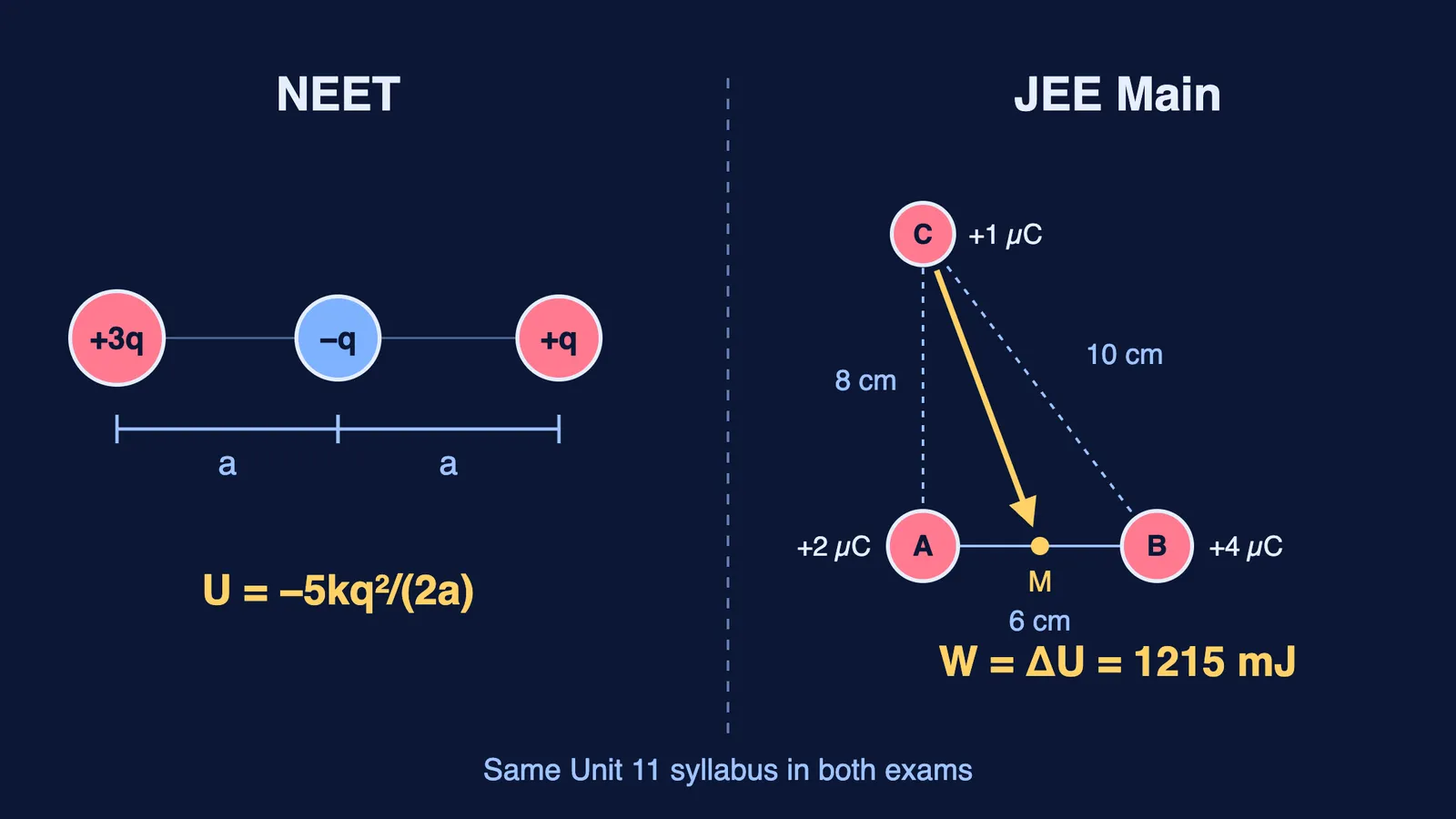
Both questions use one NCERT idea from section 2.7 of Electrostatic Potential and Capacitance: the potential energy of a system of point charges is the work an external agent does to assemble it from infinity. For several charges, add kq₁q₂/r for every pair, with k = 1/(4πε₀) = 9 × 10⁹ N m² C⁻². Both questions are original.
NEET style. Three point charges sit on a straight line: +3q at x = 0, −q at x = a and +q at x = 2a. How much work must an external agent do to assemble this arrangement?
(a) −5kq²/(2a) (b) −4kq²/a (c) −11kq²/(2a) (d) +5kq²/(2a)
Answer: (a). There are three pairs: (+3q, −q) at a gives −3kq²/a; (−q, +q) at a gives −kq²/a; (+3q, +q) at 2a gives +3kq²/(2a). The sum is −5kq²/(2a). Option (b) forgets the far pair, and option (c) gives it the wrong sign.
JEE Main style (numerical value). Small charges +2 µC and +4 µC are fixed at points A and B, 6 cm apart. A third charge, +1 µC, sits at C, 8 cm from A, with angle CAB = 90°. How much work, in mJ, must an external agent do to move it slowly to the midpoint M of AB? Give the nearest integer.
Answer: 1215.
Geometry: BC = √(6² + 8²) = 10 cm, and M is 3 cm from both A and B.
Only the two pairs that include the moving charge change. The A–B pair stays put and drops out.
At C: U = 9 × 10⁹ × 10⁻⁶ × (2 × 10⁻⁶/0.08 + 4 × 10⁻⁶/0.10) = 0.585 J.
At M: U = 9 × 10⁹ × 10⁻⁶ × (6 × 10⁻⁶/0.03) = 1.8 J.
Work = 1.8 − 0.585 = 1.215 J = 1215 mJ.
Using 1/r² from Coulomb's force law gives a number about 44 times too large, and no option warns you.
How to prepare for both
Read NCERT Chapters 1 and 2 once, closely. Spend extra time on sections 2.7 and 2.8 (potential energy) and 2.13 to 2.15 (dielectrics, combinations and stored energy).
Write every formula as a proportionality. Force goes as 1/r², potential and potential energy as 1/r, capacitance as KA/d. This speeds up NEET options and checks JEE Main answers.
Practise numerical-value questions without options. Keep powers of ten in a separate column, carry three significant figures and round once at the end, as the JEE Main bulletin asks.
List the pairs before you add. For any system of charges, write each pair, its distance and its sign first. When one charge moves, cross out pairs that do not change.
Time NEET-style sets at about a minute each. Tag each error as formula, sign or arithmetic.
Use the exam-specific guides for the rest. Our Electrostatics guide for NEET and Electrostatics guide for JEE Main add worked examples and a practice plan.
Finding it hard to picture field lines and equipotential surfaces? The Fermi Simulation Lab has interactive simulations for the ideas that are easier to see than to read.