On this page
For kinetic theory of gases, JEE Main and NEET-UG share the same official topic list. What changes is how the questions are asked, and that should change how you practise.
Is the kinetic theory syllabus different for JEE Main and NEET?
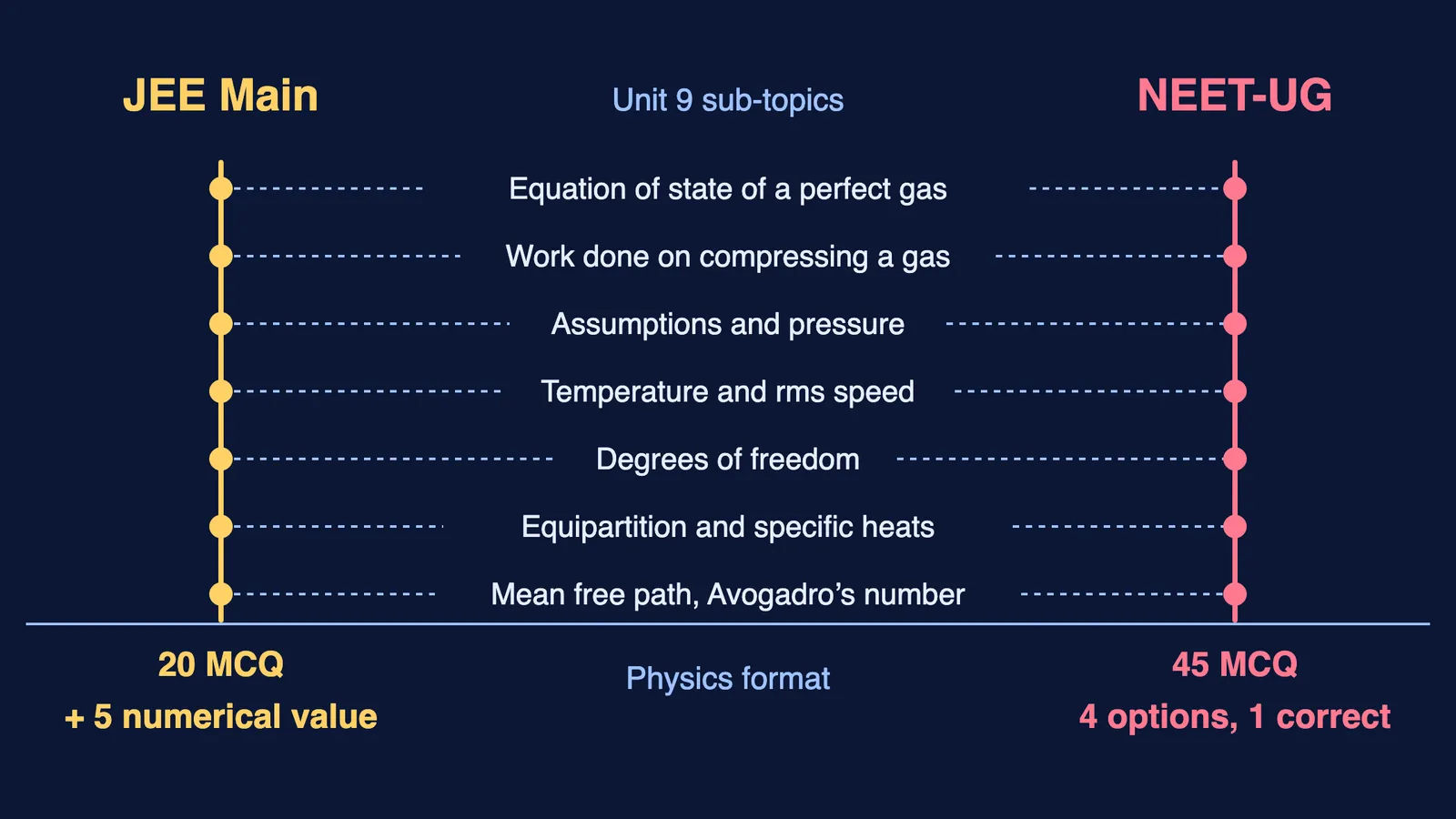
No. Unit 9, Kinetic Theory of Gases, has the same text in the Syllabus for JEE (Main) - 2027 from NTA and in the updated syllabus for NEET (UG)-2026 from the National Medical Commission. Phrase by phrase, both list:
"Equation of state of a perfect gas"
"work done on compressing a gas"
kinetic theory "assumptions, the concept of pressure"
"kinetic interpretation of temperature" and "RMS speed of gas molecules"
"degrees of freedom"
"law of equipartition of energy and applications to specific heat capacities of gases"
"mean free path" and "Avogadro's number"
Only punctuation and capitals differ; no sub-topic appears in one and not the other. Neither names the Maxwell speed distribution, mean speed or most probable speed, so treat those as background, not separate topics.
Both map to Chapter 12, Kinetic Theory, of NCERT Class 11 Physics Part II. One item, work done on compressing a gas, is worked out in Section 11.8 of the Thermodynamics chapter, so study the two chapters together for either exam.
How is the question format different?
JEE Main. The Information Bulletin for JEE (Main) 2027 gives Paper 1 Physics 20 questions in Section A and 5 in Section B, for 100 marks. Section A is multiple-choice. Section B questions have "answers to be filled in as a numerical value", typed on an on-screen keypad and "rounded off to the nearest integer". Both sections score +4 for a correct answer and −1 for a wrong one, in a 3-hour computer-based test.
NEET-UG. The Information Bulletin NEET (UG)-2026 set 180 compulsory questions in 180 minutes, with Physics at 45 questions and 180 marks. Every question is an MCQ "with four options and single correct answer/best option", marked +4, −1 or 0 if unanswered. The 2026 exam was pen and paper. The NTA NEET site had no 2027 bulletin when we checked, so look there before your exam.
So JEE Main can ask you for a bare number, while every NEET-UG 2026 question came with four options.
How does the style of questions differ?
These are tendencies you will notice in official past papers, not rules.
NEET questions on this unit usually test one relation or one NCERT statement. The work is short; the trap is often a word, such as "translational" versus "total" energy, or Celsius versus kelvin.
JEE Main questions more often chain two or three relations, or make you work backwards from data to the molecule: from heat absorbed to a specific heat, then to degrees of freedom.
NEET rewards fast, exact recall of NCERT statements; JEE Main rewards setting up a short chain of steps without help from options.
What do the two styles look like on the same idea?
Both examples below test equipartition of energy: each translational or rotational degree of freedom carries ½k_BT, as stated in the summary of NCERT Chapter 12. A rigid diatomic molecule has 3 translational and 2 rotational degrees of freedom, 5 in all.
NEET style (single correct). What is the average total energy of one molecule of a rigid diatomic ideal gas at 300 K? (k_B = 1.38 × 10⁻²³ J/K)
(a) 2.1 × 10⁻²¹ J
(b) 6.2 × 10⁻²¹ J
(c) 1.0 × 10⁻²⁰ J
(d) 1.4 × 10⁻²⁰ J
Answer: (c). Five degrees of freedom give (5/2)k_BT = 2.5 × 1.38 × 10⁻²³ × 300 ≈ 1.04 × 10⁻²⁰ J. Option (b) is the translational part alone; (d) adds one vibrational frequency, which NCERT counts as two modes worth k_BT.
JEE Main style (numerical value). Two moles of an ideal gas are heated at constant pressure through 25 K and absorb 1454 J of heat. How many degrees of freedom does each molecule have? (R = 8.31 J/mol K)
Answer: 5. Step 1: Cp = Q/(nΔT) = 1454/(2 × 25) = 29.08 J/mol K. Step 2: Cv = Cp − R = 20.77 J/mol K. Step 3: Cv = (f/2)R, so f = 2 × 20.77/8.31 ≈ 4.999, which rounds to 5, as for a rigid diatomic gas.
How to prepare for both
Learn the unit once. One pass through NCERT Chapter 12 and Section 11.8 covers both exams. Write the equipartition table (monatomic, rigid diatomic, vibrating diatomic) from memory.
Drill NEET-style recall. Turn each NCERT statement into a one-line question and answer it in under a minute. The NEET guide to kinetic theory of gases has a day-by-day plan.
Drill JEE-style chains. Take any data (heat, temperature change, pressure, density) and work back to f, γ or rms speed without options. The JEE Main guide to kinetic theory of gases has worked numericals.
Keep the units honest for both. Kelvin, M in kg/mol and n in moles. The common kinetic theory mistakes in JEE and NEET covers the slips that cost marks in either paper.
Practise in the right format. Timed four-option sets on paper for NEET; integer-answer questions for JEE Main.
Stuck on a chain of steps and not sure where it went wrong? The Fermi Problem Library has worked problems with a step-by-step solver that explains the reasoning rather than printing an answer.