On this page
Dual nature of matter and radiation is one of the shortest physics units in both JEE Main and NEET-UG, and both official syllabi list the same sub-topics for it. What changes is the way the questions reach you: the format, the time you have and how many steps a question chains together.
Is the dual nature syllabus different for JEE Main and NEET?
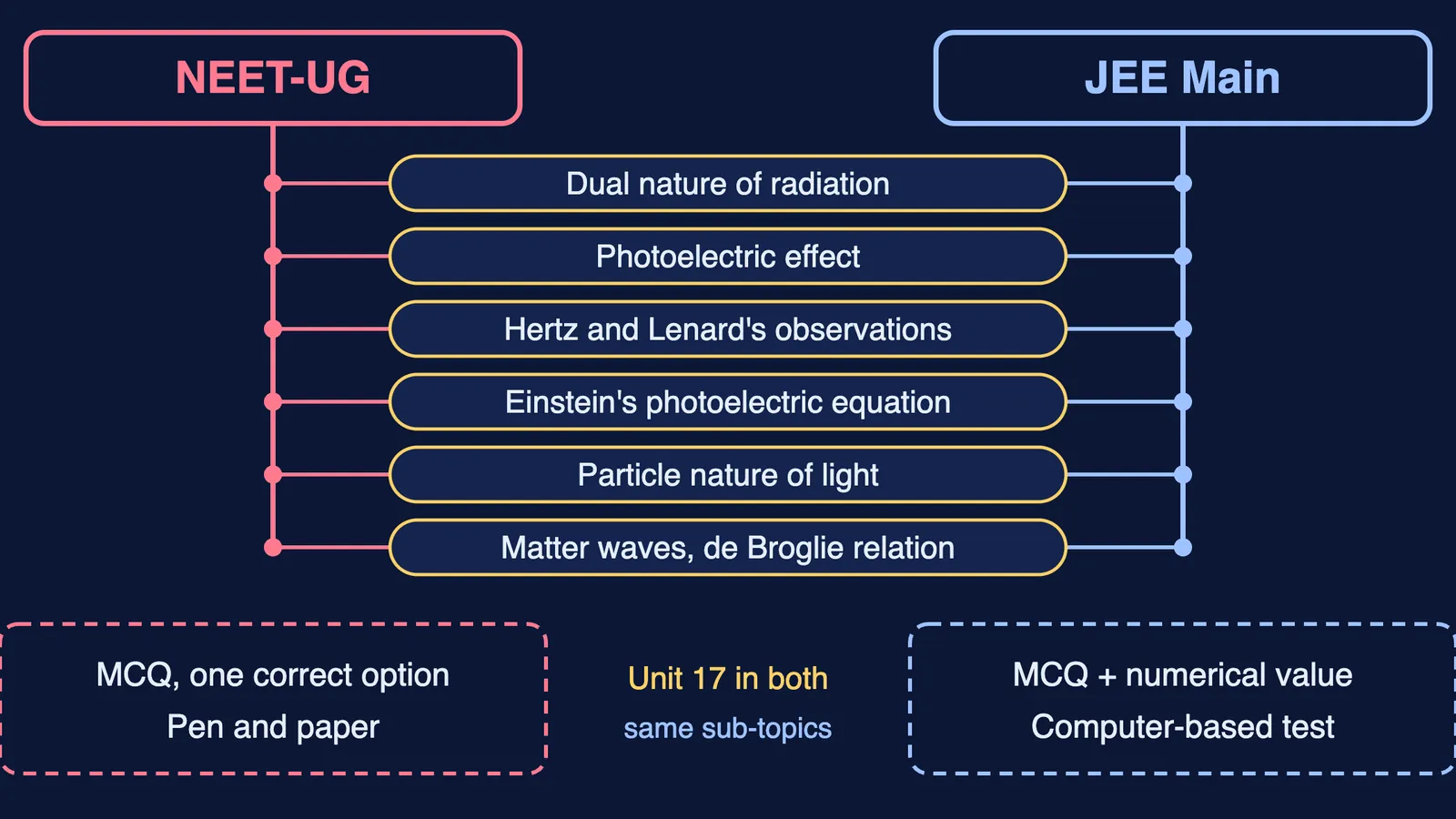
No. Both syllabi call it Unit 17, "Dual Nature of Matter and Radiation", and list the same ideas in the same order.
In NTA's Syllabus for JEE (Main) - 2027, Physics Unit 17 reads, in short phrases: "Dual nature of radiation, Photoelectric effect, Hertz and Lenard's observations", then "Einstein's photoelectric equation, particle nature of light", then "Matter waves: wave nature of particle, de- Broglie relation". The National Medical Commission's syllabus for NEET (UG)-2026 lists for its Unit 17:
Dual nature of radiation
Photoelectric effect
Hertz and Lenard's observations
Einstein's photoelectric equation
Particle nature of light
"Matter waves-wave nature of particle, de Broglie relation"
The wording differs only in punctuation and spacing: JEE Main writes "Matter waves: wave" and "de- Broglie", NEET writes "Matter waves-wave" and "de Broglie", and NEET uses full stops, a semicolon and a colon where JEE Main mostly uses commas. No sub-topic appears in one exam and not the other.
The matching textbook is NCERT Class 12 Physics Part II, Chapter 11, Dual Nature of Radiation and Matter (Reprint 2026-27). It runs from electron emission and work function (Section 11.2) to the wave nature of matter (Section 11.8). Neither it nor either syllabus covers the Davisson-Germer experiment, so one set of notes serves both exams.
How is the question format different in each exam?
The JEE (Main) 2027 information bulletin gives Paper 1 Physics two sections: Section A with 20 multiple-choice questions and Section B with 5 questions whose answer is a numerical value. For Section B you enter an integer on an on-screen keypad, and the answer "should be rounded off to the nearest integer". Both sections carry +4 for a correct answer and -1 for an incorrect one. Paper 1 is computer-based.
The NEET (UG)-2026 information bulletin, sets 180 compulsory questions in 180 minutes, 45 of them in Physics. Every question is a multiple-choice question "with four options and single correct answer/best option", marked +4 if correct, -1 if incorrect and 0 if unanswered. NEET is pen-and-paper.
So a JEE Main numerical question gives no options to check against, while NEET's one-minute-per-question average favours quick, direct answers.
How does the style of questions differ?
These are tendencies, not rules, that you may notice in official past papers:
NEET questions on this unit tend to test one relation or one NCERT observation at a time, such as how stopping potential responds to intensity.
JEE Main questions tend to chain steps: find a work function from one reading, then use it to get a speed or a de Broglie wavelength.
Both reward fluency with electronvolts and proportionalities such as λ ∝ 1/√K.
What does the same idea look like in each exam?
Both examples test one idea: the de Broglie relation λ = h/p = h/mv, and how wavelength links to kinetic energy through K = p²/2m. Both questions are original.
NEET-style. In a lab beam, slow electrons have a de Broglie wavelength of 0.20 nm. A student raises the accelerating voltage until the electrons move twice as fast (well below light speed). Which statement is correct? (A) The wavelength becomes 0.10 nm and the kinetic energy becomes 4 times (B) The wavelength becomes 0.10 nm and the kinetic energy doubles (C) The wavelength becomes 0.05 nm and the kinetic energy becomes 4 times (D) The wavelength becomes 0.14 nm and the kinetic energy doubles
Answer: (A). λ = h/mv, so doubling v halves λ to 0.10 nm; K = ½mv², so doubling v makes K four times larger. Traps: (B) assumes K grows like v; (D) applies 1/√K to a doubled K that is itself wrong.
JEE Main-style (numerical value). An electron starting from rest is accelerated through a potential difference V and then has a de Broglie wavelength of 0.150 nm. Through how many more volts must it be accelerated for its wavelength to fall to 0.100 nm? Take h = 6.63 × 10⁻³⁴ J s, m = 9.1 × 10⁻³¹ kg and e = 1.6 × 10⁻¹⁹ C. Give the answer to the nearest integer.
Answer: 84.
For an electron accelerated from rest through V, K = eV, so λ = h/√(2meV).
With these constants, h/√(2me) ≈ 1.229 nm V^½, so V = (1.229/λ)² with λ in nm.
At 0.150 nm, V₁ ≈ 67.1 V.
At 0.100 nm, V₂ ≈ 151.0 V. (Check: V₂/V₁ = (0.150/0.100)² = 2.25.)
Extra potential difference = 151.0 - 67.1 ≈ 83.9 V, which rounds to 84.
Trap: typing 151 gives the total voltage, not the extra.
How to prepare for both
Learn the unit once. The syllabus sub-topics are identical, so read NCERT Chapter 11 section by section and write the six syllabus items as headings in one set of notes.
Own four relations in electronvolts. E = hc/λ with hc ≈ 1240 eV nm, K(max) = hν - φ = eV₀, λ₀ = hc/φ and λ = h/√(2mK).
Memorise the graphs as statements. Photocurrent against intensity, collector potential and frequency each turn into a one-line NEET question or a JEE Main first step.
Train two speeds. Time NEET-style single-relation questions at about a minute each, then practise JEE Main chains where you type an integer without looking at options.
Log each miss by cause. Mark it as unit slip (metres in the 1240 shortcut), missing square root, or intensity-frequency confusion; our list of common dual nature mistakes in JEE and NEET shows each one with a fix.
Hard to picture why brighter light gives more photoelectrons but not faster ones? The Fermi Simulation Lab has interactive simulations for the ideas that are easier to see than to read.
For a full plan, read our guides on how to prepare Dual Nature of Matter and Radiation for NEET and how to prepare Dual Nature of Matter for JEE Main.