On this page
Dual nature of matter and radiation is a short chapter with a few formulas, which is exactly why small slips cost marks. Unit 17 of the NTA Syllabus for JEE (Main) - 2027 and Unit 17 of the NMC syllabus for NEET (UG)-2026 list the same ideas: the photoelectric effect, Hertz and Lenard's observations, Einstein's equation, the particle nature of light and the de Broglie relation. The matching text is NCERT Class 12 Physics Chapter 11 (Reprint 2026-27). Below are eight frequent slips, each with the wrong working, the physics, a fix on fresh numbers and a habit.
Constants used: h = 6.63 × 10⁻³⁴ J s, e = 1.6 × 10⁻¹⁹ C, electron mass 9.11 × 10⁻³¹ kg and proton mass 1.67 × 10⁻²⁷ kg, rounded from the NIST CODATA values. Since h = 4.136 × 10⁻¹⁵ eV s, hc ≈ 1240 eV nm.
Why do energy calculations in the photoelectric effect go wrong?
Mixing electron-volts and joules in E = hc/λ
Wrong: for 310 nm light, E = 1240/(310 × 10⁻⁹) = 4.0 × 10⁹ eV.
Why: the shortcut 1240 eV nm only works with λ in nanometres. Putting metres into it gives an energy a billion times too large.
Fix: E = 1240/310 = 4.0 eV. In joules, 4.0 × 1.6 × 10⁻¹⁹ = 6.4 × 10⁻¹⁹ J.
Habit: write the unit beside every number before you divide.
Scaling stopping potential with frequency
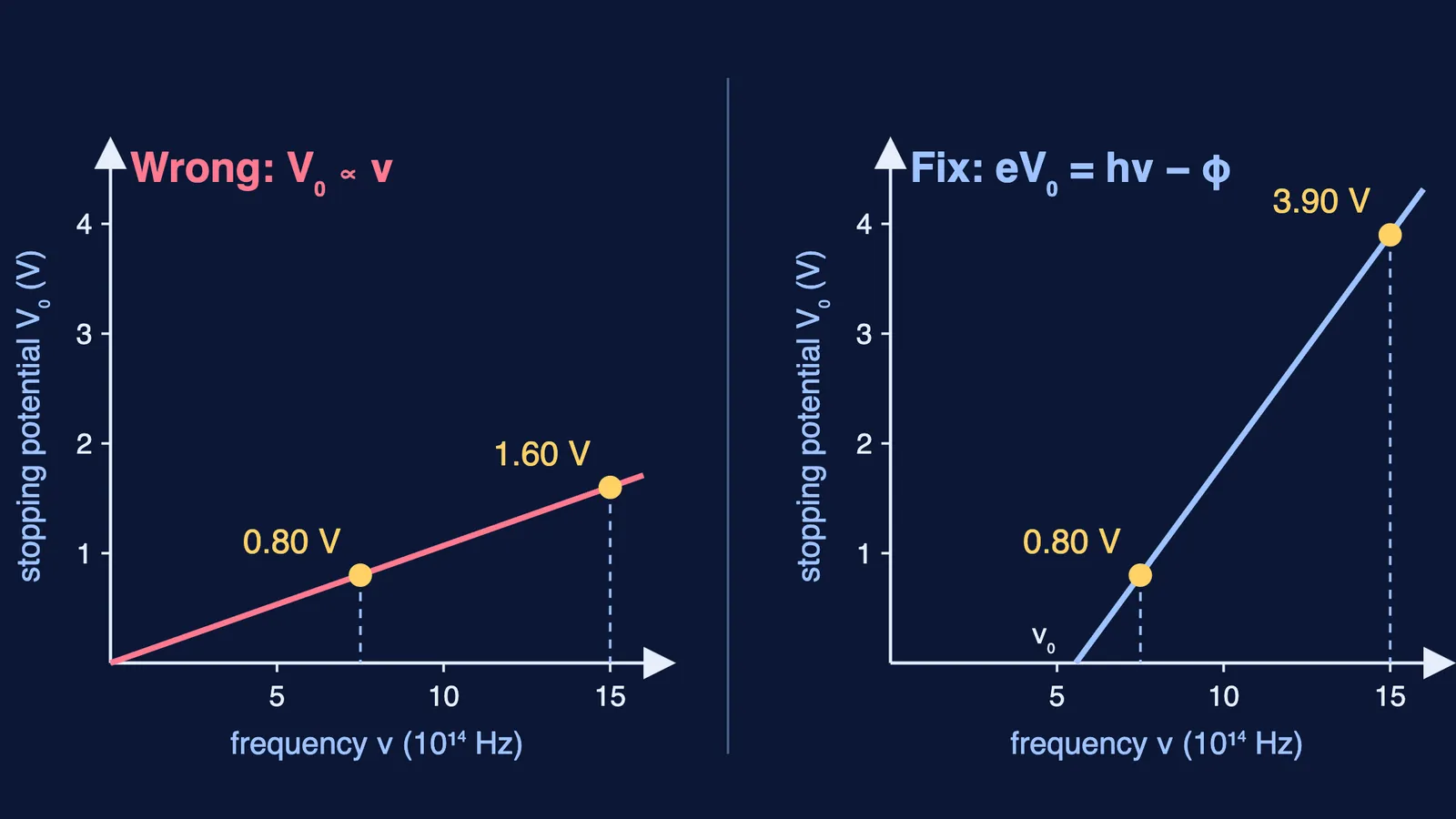
Wrong: a metal with φ = 2.3 eV gives V₀ = 0.80 V at 7.5 × 10¹⁴ Hz, so doubling the frequency gives 1.60 V.
Why: Einstein's equation is eV₀ = hν − φ. The work function is subtracted once, so V₀ is a straight line that does not pass through the origin.
Fix: at 1.5 × 10¹⁵ Hz, hν = 4.136 × 10⁻¹⁵ × 1.5 × 10¹⁵ = 6.20 eV, so V₀ = 6.20 − 2.3 = 3.90 V, nearly five times the first value.
Habit: never scale V₀ or K(max); recompute hν, then subtract φ.
Reading the threshold wavelength backwards
Wrong: a larger work function means a longer threshold wavelength.
Why: λ₀ = hc/φ, so wavelength and work function are inversely related. Tightly bound electrons need more energetic, shorter-wavelength photons.
Fix: φ = 2.0 eV gives λ₀ = 1240/2.0 = 620 nm; φ = 4.0 eV gives 310 nm. Doubling φ halves λ₀.
Habit: before answering, say aloud "harder to free, shorter wavelength".
Does brighter light change the stopping potential?
No. NCERT's Section 11.4 records that saturation current is proportional to intensity, while stopping potential depends on frequency and is independent of intensity (NCERT Chapter 11).
Letting intensity raise K(max)
Wrong: 400 nm light on a metal with φ = 2.2 eV gives V₀ = 0.90 V and a saturation current of 1.5 µA. Tripling the intensity gives V₀ = 2.7 V.
Why: more intensity at the same frequency means more photons per second, not more energy per photon. Each electron still gets one photon of 3.1 eV.
Fix: saturation current triples to 4.5 µA; V₀ stays 3.1 − 2.2 = 0.90 V.
Habit: frequency sets energy per electron; intensity sets the number of electrons. Our explainer on why brighter light doesn't give faster photoelectrons goes deeper.
Expecting emission below threshold if the light is strong enough
Wrong: 520 nm light on a metal with φ = 2.75 eV will eject electrons if the lamp is bright enough, or if you wait.
Why: one photon frees one electron. Below threshold, no single photon has enough energy, and NCERT notes that above threshold, emission starts without any apparent time lag (about 10⁻⁹ s or less).
Fix: λ₀ = 1240/2.75 ≈ 451 nm. A 520 nm photon carries 1240/520 ≈ 2.38 eV, less than 2.75 eV, so there is no emission at any intensity.
Habit: compare photon energy with φ first; stop there if it falls short.
How do you read the slope of a photoelectric graph correctly?
Calling the slope of V₀ against ν "h"
Wrong: a metal gives V₀ = 0.59 V at 6.5 × 10¹⁴ Hz and 1.83 V at 9.5 × 10¹⁴ Hz, so h = 1.24/(3.0 × 10¹⁴) = 4.13 × 10⁻¹⁵ J s.
Why: dividing eV₀ = hν − φ by e gives V₀ = (h/e)ν − φ/e. The slope is h/e, in volt seconds.
Fix: slope = 4.13 × 10⁻¹⁵ V s, so h = 1.6 × 10⁻¹⁹ × 4.13 × 10⁻¹⁵ ≈ 6.61 × 10⁻³⁴ J s. Extending the line to V₀ = 0 gives ν₀ ≈ 5.07 × 10¹⁴ Hz, so φ = hν₀ ≈ 2.10 eV.
Habit: write the axis units, then the slope's unit, before naming the slope. On a K(max) against ν graph the slope is h itself.
Where do de Broglie wavelength questions go wrong?
Using the electron shortcut for a proton
Wrong: a proton accelerated through 150 V has λ = 1.227/√150 ≈ 0.100 nm.
Why: 1.227/√V nm comes from λ = h/√(2meV) with the electron's mass built in. A proton is about 1,836 times heavier, per the NIST proton mass.
Fix: λ = h/√(2mₚeV) = 6.63 × 10⁻³⁴/√(2 × 1.67 × 10⁻²⁷ × 1.6 × 10⁻¹⁹ × 150) ≈ 2.34 × 10⁻¹² m, about 43 times shorter.
Habit: use λ = h/√(2mqV) and put in the particle's own mass and charge.
Using a photon formula for an electron
Wrong: an electron with 50 eV of kinetic energy has λ = hc/E = 1240/50 = 24.8 nm.
Why: E = hc/λ holds only for photons, which have no rest mass. For an electron, λ = h/p with p = √(2mK).
Fix: K = 50 × 1.6 × 10⁻¹⁹ = 8.0 × 10⁻¹⁸ J; p = √(2 × 9.11 × 10⁻³¹ × 8.0 × 10⁻¹⁸) ≈ 3.82 × 10⁻²⁴ kg m/s; λ ≈ 0.174 nm.
Habit: ask "photon or particle with mass?" before choosing the formula.
Stuck on why your answer is off? The Fermi Problem Library has worked problems with a step-by-step solver that explains the reasoning rather than printing an answer.
A 60-second self-check before you mark
For the full chapter plan, read our guides on Dual Nature for NEET and Dual Nature of Matter for JEE Main.