On this page
A common way to go wrong in thermodynamic processes is to use a correct formula on the wrong process. Here are eight frequent slips in JEE Main and NEET-UG style questions, each with the wrong working, the physics, a fix and a habit. Physics-versus-chemistry sign conventions are a separate topic, so we skip them here. We use NCERT's ΔQ = ΔU + ΔW, with W done by the gas, and R = 8.314 J mol⁻¹ K⁻¹.
Which formula fits a sudden process?
Both the JEE (Main) 2027 syllabus and the NEET (UG) 2026 syllabus list reversible and irreversible processes in Unit 8. NCERT Class 11 Physics, Chapter 11 gives PV^γ = constant and W = nRT ln(V₂/V₁) for quasi-static processes only. A sudden drop in outside pressure is not one.
Using PV^γ = constant for a sudden adiabatic expansion.
Wrong: 1 mol of monatomic gas at 400 K and 300 kPa is insulated, and the outside pressure drops at once to 100 kPa. "T₂ = 400 × (1/3)^0.4 ≈ 258 K."
Why: the gas passes through non-equilibrium states, so the adiabatic curve does not apply. Only energy balance does: Q = 0, so ΔU = −P_ext(V₂ − V₁).
Fix: with V = RT/P, (3/2)R(T₂ − 400) = −R(T₂ − 400/3). That gives 2.5T₂ = 733.3, so T₂ ≈ 293 K. It cools less than the slow case.
Habit: before PV^γ, ask "slowly, or suddenly?"
Using nRT ln(V₂/V₁) for an isothermal expansion against a fixed outside pressure.
Wrong: 2 mol at 300 K, held at constant temperature, expand from 250 kPa against a constant 100 kPa. "W = 2 × 8.314 × 300 × ln 2.5 ≈ 4571 J."
Why: the log formula integrates the gas's own pressure along an equilibrium path; here the gas pushes against 100 kPa throughout.
Fix: W = P_ext(V₂ − V₁) = nRT(1 − 100/250) ≈ 2993 J. ΔU = 0, so Q ≈ 2993 J too.
Habit: if a question names an external pressure, use W = P_ext ΔV.
Why do adiabatic and isothermal answers come out wrong?
Writing TV^γ = constant instead of TV^(γ−1).
Wrong: a diatomic gas (γ = 1.4) at 300 K is compressed slowly and adiabatically from 18 L to 3 L. "T₂ = 300 × 6^1.4 ≈ 3686 K."
Why: substituting P = nRT/V into PV^γ leaves V^(γ−1), not V^γ. NCERT section 11.8.3 states only PV^γ = constant.
Fix: T₂ = 300 × 6^0.4 ≈ 614 K.
Habit: derive the T–V form in one line from PV^γ instead of recalling it.
Inverting the pressure ratio in isothermal work.
Wrong: 3 mol at 280 K are compressed isothermally from 150 kPa to 450 kPa. "W = nRT ln(P₂/P₁) ≈ +7672 J, so the gas absorbs heat."
Why: at constant T, V₂/V₁ = P₁/P₂, so the ratio flips when you swap to pressures.
Fix: W = 3 × 8.314 × 280 × ln(150/450) ≈ −7672 J. Work is done on the gas, and it gives out about 7672 J of heat.
Habit: compression must give negative W by the gas; check the sign before the size.
How do you read work and heat from a graph?
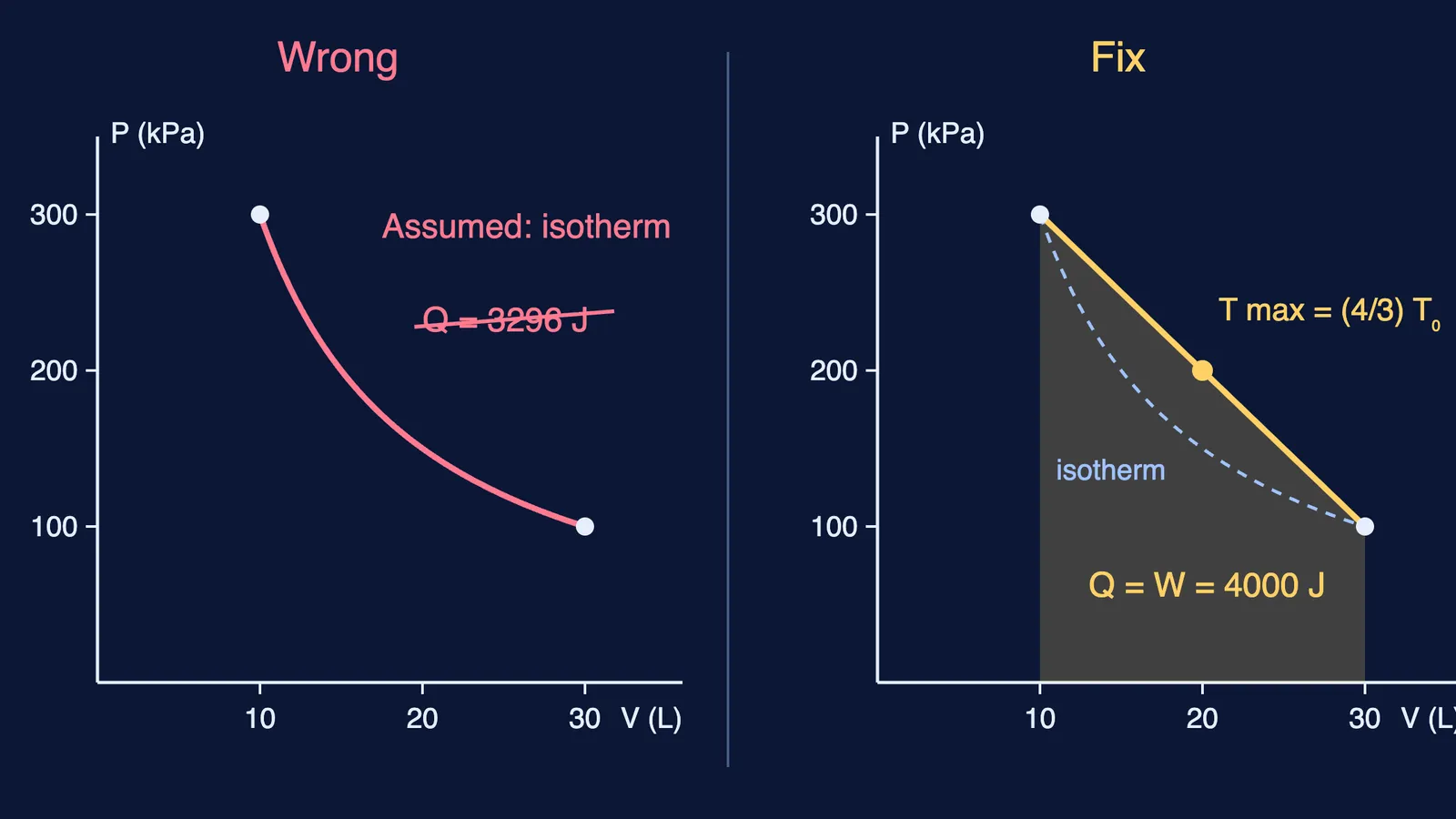
Treating a straight line between two points on one isotherm as isothermal.
Wrong: an ideal gas goes in a straight line on a P–V graph from (10 L, 300 kPa) to (30 L, 100 kPa). Both ends have PV = 3000 J, so "T is constant and Q = 3000 ln 3 ≈ 3296 J."
Why: equal end temperatures make ΔU = 0, but the path is a line, not the curve PV = constant. Along P = 400 − 10V (kPa, L), PV peaks at 4000 J when V = 20 L, so T rises to 4/3 of its end value in the middle.
Fix: W = area under the line = 200 kPa × 20 L = 4000 J. Since ΔU = 0, Q = 4000 J.
Habit: find work as the area under the path actually drawn.
Reading the area on a V–T or P–T graph as work.
Wrong: 1 mol goes round a rectangle on a V–T graph between 300 K and 500 K and between 10 L and 20 L. "W = 10 L × 200 K = 2000 J."
Why: work is ∫P dV, so only a P–V area is work. L × K is not an energy unit, and "clockwise means positive" holds only on P–V axes.
Fix: the isochoric sides do no work. The isothermal sides give a net |W| = R(500 − 300) ln 2 ≈ 1153 J. It is positive if the gas expands at 500 K.
Habit: redraw any cycle on P–V axes before you look at areas.
What do the second law and Carnot really limit?
Saying heat can never be fully turned into work.
Wrong: "2 mol expand isothermally at 360 K from 8 L to 20 L, absorbing 5485 J and doing 5485 J of work. That breaks the second law."
Why: the Kelvin-Planck statement forbids complete conversion as the *sole result*. Here the gas is also left at 40% of its starting pressure, so this is not a cycle.
Fix: Q = W = 2 × 8.314 × 360 × ln 2.5 ≈ 5485 J is allowed. Only a cyclic engine cannot have η = 1.
Habit: apply Kelvin-Planck to cycles, not single steps.
Thinking a 100 K change helps equally at either reservoir.
Wrong: a Carnot engine runs between 600 K and 300 K. "Raising T₁ or lowering T₂ by 100 K widens the gap by 100 K either way, so the gain is the same."
Why: η = 1 − T₂/T₁ (NCERT section 11.11) depends on the ratio, not the difference.
Fix: now η = 0.50. With T₁ = 700 K, η = 1 − 300/700 ≈ 0.571. With T₂ = 200 K, η = 1 − 200/600 ≈ 0.667. Lowering the sink helps more.
Habit: compute both efficiencies; never compare differences.
A 60-second self-check before you mark
Stuck on why your answer is off? The Fermi Problem Library has worked problems with a step-by-step solver that explains the reasoning rather than printing an answer.
For the full chapter map and a weekly plan, read Thermodynamics for NEET: how to prepare or Thermodynamics for JEE Main: how to prepare.