On this page
Huygens construction, single-slit diffraction and polaroids are short sections, so JEE Main and NEET-UG questions on them look easy. Marks go on a ratio written upside down, a dark band read as bright, or an angle taken from the wrong polaroid. Below are eight slips, each with the wrong working, the physics, an original example and a habit. Young's double-slit slips are left out on purpose.
Both exams list wavefront and Huygens principle, laws of reflection and refraction using Huygens principle, diffraction due to a single slit with the width of the central maximum, and polarisation with Polaroids, in the NTA Syllabus for JEE (Main) 2027 and the NMC NEET (UG) 2026 syllabus. The textbook is sections 10.2, 10.3, 10.6 and 10.7 of NCERT Class 12 Physics Part II, Chapter 10 (Reprint 2026-27).
Where do Huygens construction answers go wrong?
Writing the refraction ratio upside down.
Wrong: light passes from a medium where v1 = 2.4 × 10⁸ m/s into one where v2 = 1.8 × 10⁸ m/s at i = 35°, so sin r = sin 35° × v1/v2 = 0.765 and r = 49.9°.
Why: in the NCERT construction, the incident wavefront covers BC = v1τ while the wavelet from A grows to AE = v2τ, giving sin i / sin r = v1/v2. Slower light bends towards the normal.
Fix: sin r = sin 35° × 1.8/2.4 = 0.430, so r = 25.5°, smaller than i, as it must be in a slower medium.
Habit: after any refraction answer, check that slower means a smaller angle.
Growing the wavelets at c, or drawing a backward wavefront.
Wrong: inside glass of n = 1.6, the wavefront moves 3 × 10⁸ × 1.5 ns = 45 cm in 1.5 ns, and a second wavefront forms behind the first.
Why: NCERT draws each secondary wavelet with radius vt, where v is the speed in that medium, and takes the new wavefront as the forward envelope. The backwave does not exist.
Fix: v = c/1.6 = 1.875 × 10⁸ m/s, so the wavefront moves 28.1 cm forward only.
Habit: write v = c/n before drawing any wavelet.
Why do single-slit positions and widths come out wrong?
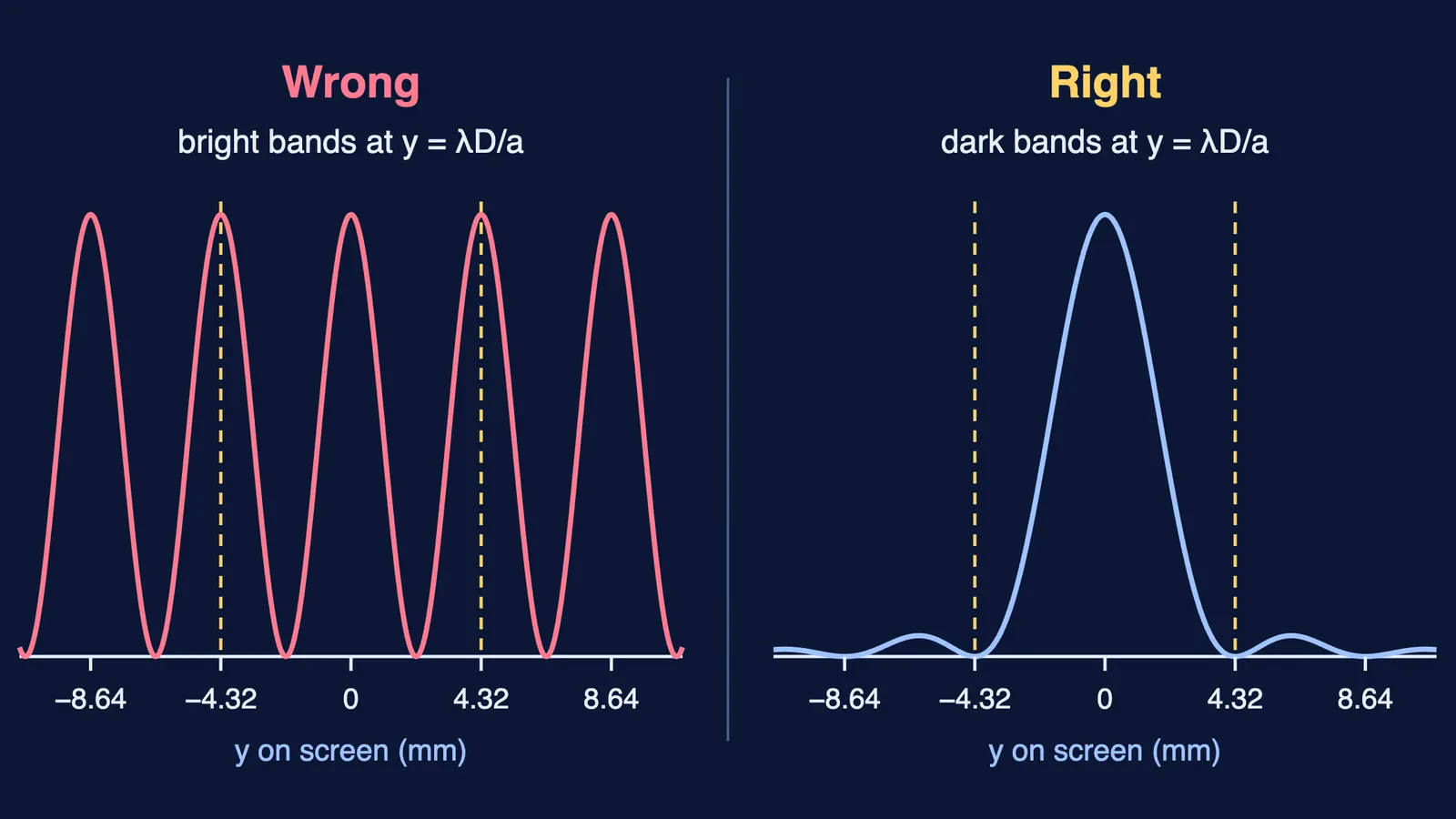
Treating a sin θ = nλ as the bright condition.
Wrong: with λ = 540 nm, a = 0.15 mm and D = 1.2 m, the first bright side band sits at λD/a = 4.32 mm, as in a double slit.
Why: for a single slit, NCERT section 10.6.1 puts the minima at θ ≈ nλ/a with n = ±1, ±2, and the weaker secondary maxima at about (n + ½)λ/a. The double-slit habit of "nλ means bright" flips the answer.
Fix: 4.32 mm is the first dark band. The first secondary maximum is near 1.5λD/a = 6.48 mm, and the second dark band is at 8.64 mm.
Habit: for one slit, say "nλ over a is dark" before you write the formula.
Thinking the angular width changes when the screen moves.
Wrong: moving the screen from 1.2 m to 1.8 m makes the central maximum 1.5 times wider in angle.
Why: the angular width, from −λ/a to +λ/a, depends only on λ and a. The linear width 2λD/a grows with D because the same angle is projected further away.
Fix: the angular width stays 7.2 × 10⁻³ rad; the linear width goes from 8.64 mm to 12.96 mm.
Habit: before answering, underline whether the question says angular or linear width.
Expecting blue light to spread more, or a coloured centre.
Wrong: with white light through a slit of a = 0.20 mm and a screen at 1.0 m, the blue band is wider and the centre is coloured.
Why: the minima at nλ/a grow with λ, so red spreads more. NCERT notes that the position of every band except the central one depends on wavelength, so only the side bands show colours.
Fix: the central maximum is 2λD/a = 6.80 mm wide for red light of 680 nm and 4.50 mm for blue light of 450 nm. The centre stays white.
Habit: longer wavelength, wider pattern; check the colour claim against λ.
What goes wrong with polaroids and Malus's law?
Taking the pass axis along the aligned molecules.
Wrong: a polaroid has its long-chain molecules aligned vertically, so vertically polarised light of 18 W/m² passes through unchanged.
Why: NCERT section 10.7 says the electric field along the aligned molecules is absorbed. The pass axis is perpendicular to the molecules.
Fix: for an ideal sheet, vertically polarised light is blocked, about 0 W/m², while horizontally polarised light of 18 W/m² passes.
Habit: draw the molecules and the pass axis as two crossed lines.
Using each polaroid's angle from the first one.
Wrong: unpolarised light of 64 W/m² meets P1 at 0°, P2 at 25° and P3 at 70°, so the output is 32 × cos²25° × cos²70° = 3.07 W/m².
Why: Malus's law, I = I₀cos²θ, uses the angle between the pass axes of the two polaroids the light goes through in turn. In NCERT's three-polaroid example, P3 uses the angle between P2 and P3.
Fix: after P1, 32 W/m²; after P2, 32 × cos²25° = 26.28 W/m²; P2 to P3 is 45°, so the output is 13.14 W/m².
Habit: label the angle between each neighbouring pair before multiplying.
Expecting one bright and one dark position per full turn.
Wrong: polarised light of 40 W/m² falls on a rotating polaroid; it is brightest at 0° and darkest at 180°.
Why: cos²θ repeats every 180°. NCERT's summary says a full turn through 2π shows two maxima and two minima.
Fix: the intensity is 40 W/m² at 0°, 0 at 90°, 30 W/m² at 150°, 40 W/m² again at 180° and 0 at 270°.
Habit: mark the dark positions 90° and 270° on a quick circle sketch.
What should you check in the last 60 seconds?
Stuck on why your answer is off? The Fermi Problem Library has worked problems with a step-by-step solver that explains the reasoning rather than printing an answer.
For syllabus maps and a study plan, read our Optics for NEET preparation guide and our Wave Optics for JEE Main preparation guide.