On this page
Drift velocity, resistivity and resistor combinations look like plug-in topics, so students rush them. Below are eight frequent slips, each with the wrong working, the physics, a fix on an original example and one habit.
Everything here sits inside Unit 12, Current Electricity, of the NTA syllabus for JEE (Main) and the NMC syllabus for NEET (UG)-2026, which both list drift velocity, mobility, resistivity, resistor combinations and temperature dependence of resistance. The formulas come from sections 3.5 to 3.8 of NCERT Class 12 Physics, Chapter 3. Cell, meter, power and Kirchhoff slips are covered in our other mistakes posts.
Is drift speed the same wherever the current is the same?
NCERT gives drift speed as v_d = I/(neA), with n free electrons per cubic metre, and as v_d = eEτ/m, with E the field in the wire (NCERT Chapter 3, Eqs. 3.17 and 3.18).
Assuming two wires in series have the same drift speed because they carry the same current.
Wrong: wire P (n = 8.0 × 10²⁸ m⁻³, 1.0 mm²) is joined to wire Q (n = 6.0 × 10²⁸ m⁻³, 0.50 mm²) carrying 3.0 A, so "drift is equally fast in both".
Why it fails: v_d also depends on n and A. Fewer carriers through a smaller area must each move faster.
Fix: in P, v_d = 3.0/(8.0 × 10²⁸ × 1.6 × 10⁻¹⁹ × 1.0 × 10⁻⁶) ≈ 2.3 × 10⁻⁴ m/s. In Q, v_d = 3.0/(6.0 × 10²⁸ × 1.6 × 10⁻¹⁹ × 0.50 × 10⁻⁶) ≈ 6.3 × 10⁻⁴ m/s, about 2.7 times faster.
Habit: same current means same nev_dA, not the same v_d.
Keeping the voltage fixed and forgetting that the field depends on length.
Wrong: 2.0 V is put across 1.0 m, then 4.0 m, of one wire, so "same voltage, same drift speed".
Why it fails: electrons respond to the field, and for a uniform wire E = V/L. A longer wire has a weaker field.
Fix: with μ = 4.0 × 10⁻³ m²/(V s), v_d = μV/L gives 8.0 × 10⁻³ m/s on 1.0 m but 2.0 × 10⁻³ m/s on 4.0 m.
Habit: before using v_d = eEτ/m, write E = V/L on the line above.
Which unit slips cost marks in mobility and the temperature formula?
Converting mobility from cm²/(V s) with a factor of 100.
Wrong: μ = 30 cm²/(V s), so "μ = 30 × 10⁻² = 0.30 m²/(V s)". With E = 20 V/m, that gives v_d = 6.0 m/s.
Why it fails: the unit is squared. NCERT states that the SI unit m²/(V s) is 10⁴ times the practical unit cm²/(V s) (NCERT Chapter 3, Section 3.5.1).
Fix: μ = 30 × 10⁻⁴ = 3.0 × 10⁻³ m²/(V s), so v_d = μE = 0.06 m/s, a hundred times smaller.
Habit: square the conversion factor whenever the unit is squared.
Writing R = R₀ + αΔT.
Wrong: R₀ = 40 Ω at 0 °C, α = 4.0 × 10⁻³ °C⁻¹, heated to 75 °C, so "R = 40 + 0.3 = 40.3 Ω".
Why it fails: NCERT's relation is ρ_T = ρ₀[1 + α(T − T₀)], so αΔT is a fraction of R₀, not a number of ohms. You cannot add a pure number to ohms.
Fix: R = 40(1 + 4.0 × 10⁻³ × 75) = 40 × 1.3 = 52 Ω.
Habit: check that every term you add has the same unit.
How does resistance really change with temperature?
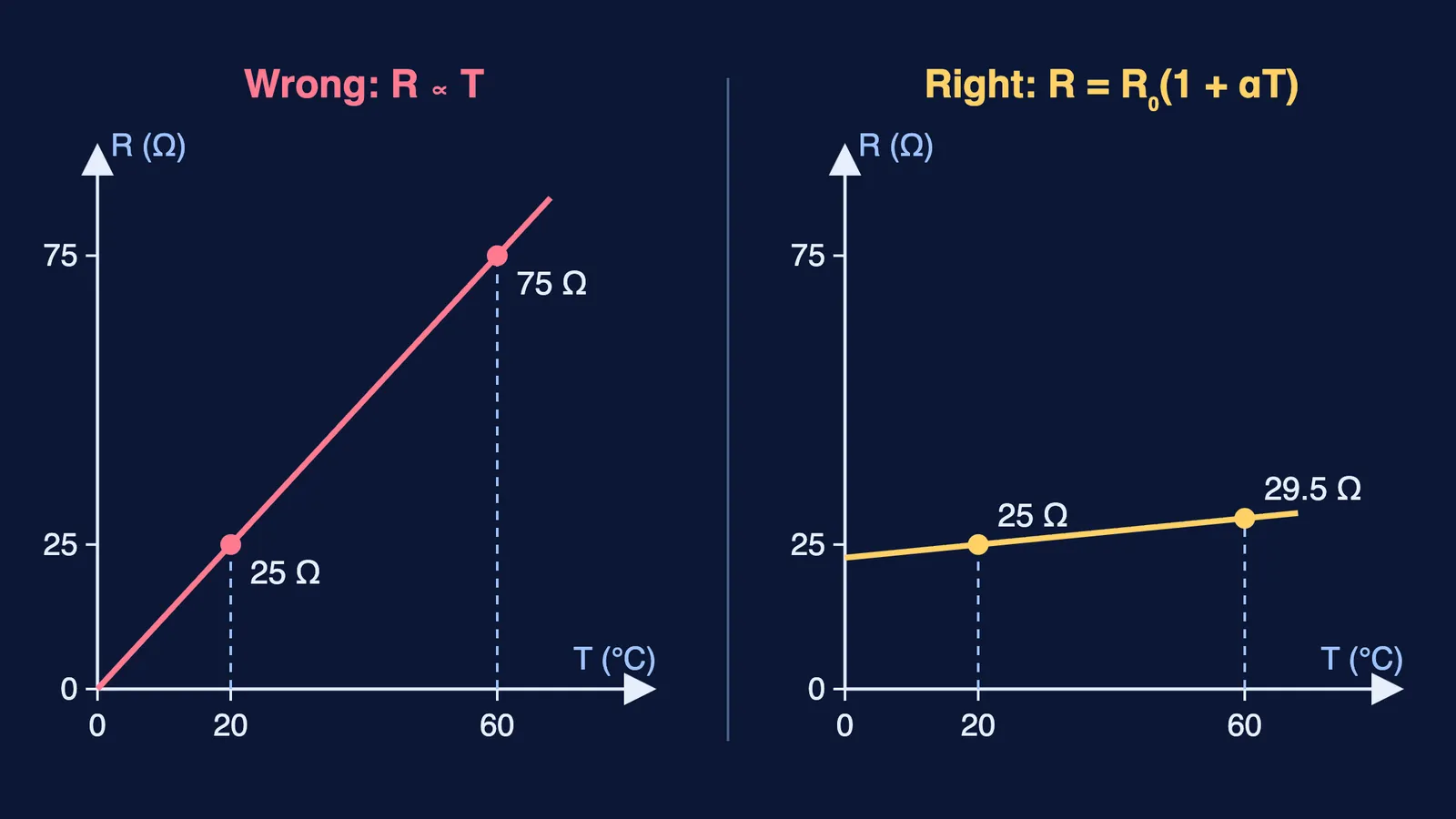
Treating resistance as proportional to temperature.
Wrong: a wire is 25 Ω at 20 °C, with α = 5.0 × 10⁻³ °C⁻¹ measured from 0 °C. At 60 °C, "three times the temperature, so 75 Ω".
Why it fails: resistance at 0 °C is not zero, so the R-T line does not pass through the origin and Celsius temperatures cannot be scaled.
Fix: divide so R₀ cancels. R₆₀/R₂₀ = (1 + 60α)/(1 + 20α) = 1.3/1.1, so R₆₀ = 25 × 1.3/1.1 ≈ 29.5 Ω.
Habit: for two temperatures, write the ratio (1 + αT₂)/(1 + αT₁) before any arithmetic.
How do you combine resistors and resistivities without slips?
Forgetting to flip the reciprocal for resistors in parallel.
Wrong: 6 Ω, 12 Ω and 4 Ω in parallel: 1/6 + 1/12 + 1/4 = 6/12, "so R = 0.5 Ω".
Why it fails: 6/12 is 1/R, in Ω⁻¹, not R.
Fix: 1/R = 1/2, so R = 2 Ω. Check at 12 V: currents of 2 A, 1 A and 3 A total 6 A, and 12/6 = 2 Ω.
Habit: write "1/R =" on the left and invert as a separate line.
Cutting a wire into equal parts, joining them in parallel and dividing by n once.
Wrong: a 45 Ω wire is cut into three equal pieces joined side by side, "so R = 45/3 = 15 Ω".
Why it fails: 15 Ω is one piece; three in parallel divide by three again.
Fix: R = (45/3)/3 = 45/9 = 5 Ω. For n pieces, R/n².
Habit: count two steps, cutting then combining.
Averaging resistivities of two wires joined side by side.
Wrong: two wires, both 2.0 m long with area 1.0 mm², with ρ = 2.0 × 10⁻⁸ Ω m and 6.0 × 10⁻⁸ Ω m, are joined in parallel, "so the pair acts like ρ = 4.0 × 10⁻⁸ Ω m".
Why it fails: in parallel, conductances add, not resistivities. The plain average is the series answer for equal lengths.
Fix: R₁ = ρL/A = 0.04 Ω and R₂ = 0.12 Ω, so R = 0.04 × 0.12/0.16 = 0.03 Ω. As one 2.0 mm² wire, ρ = RA/L = 3.0 × 10⁻⁸ Ω m.
Habit: turn every resistivity into a resistance with R = ρL/A, combine, then convert back.
Can't picture why one current crawls in one wire and hurries in the next? The Fermi Simulation Lab has interactive simulations for the ideas that are easier to see than to read.
A 60-second self-check before you mark
For the full chapter plan, read Current Electricity for JEE Main: how to prepare, with solved circuits or Current Electricity for NEET: how to prepare, with worked examples. Tonight, redo one wrong answer from this chapter with the five checks.