On this page
Refraction questions in JEE Main and NEET-UG rarely need a new formula. Marks go on where an angle is measured, which index goes on top and which sign R takes. Here are nine slips, each with the wrong working, the physics, a fix on fresh numbers and a habit.
Both exams list refraction at plane and spherical surfaces, total internal reflection and thin lenses in contact in Unit 16, Optics: see the NTA Syllabus for JEE (Main) 2027 and the NMC NEET (UG) 2026 syllabus. The textbook is sections 9.3 to 9.5 of NCERT Class 12 Physics Part II, Chapter 9.
Why do refraction angles and depths come out wrong?
Measuring the angle from the surface instead of the normal.
Wrong: a ray meets a liquid of n = 1.4 at 35° to the surface, so sin r = sin 35° / 1.4 and r = 24.2°.
Why: in Snell's law, i and r are the angles the rays make with the normal, as NCERT section 9.3 stresses.
Fix: i = 90° − 35° = 55°, so sin r = 0.819 / 1.4 = 0.585 and r = 35.8°.
Habit: draw the dashed normal before you write any angle.
Thinking refraction changes the frequency.
Wrong: light of 540 nm enters glass of n = 1.6, so its frequency drops by a factor of 1.6.
Why: NCERT's Wave Optics chapter shows that on refraction speed and wavelength change but frequency stays the same.
Fix: f = (3 × 10⁸ m/s) / (540 × 10⁻⁹ m) = 5.56 × 10¹⁴ Hz in both media; in the glass the wavelength is 540/1.6 = 337.5 nm.
Habit: frequency fixed; speed and wavelength both divide by n.
Dividing by n when the viewer is in the denser medium.
Wrong: a diver under water (n = 4/3) sees a bird 2.4 m above the surface at 2.4 ÷ 4/3 = 1.8 m.
Why: real depth ÷ n is for viewing from air, near the normal, as NCERT section 9.3 states. With R infinite, NCERT's single-surface equation gives n₂/v = n₁/u, so distance scales by (index at the eye) ÷ (index at the object).
Fix: v = (4/3) × 2.4 m = 3.2 m. The bird looks higher, not lower.
Habit: ask which side the eye is on before you multiply or divide.
When does total internal reflection really happen?
Calling TIR when light goes from rarer to denser.
Wrong: light in air hits glass of n = 1.65 at 70°, above the critical angle of 37.3°, so it is totally reflected.
Why: NCERT section 9.4 defines TIR for light going from an optically denser medium to a rarer one.
Fix: sin r = sin 70° / 1.65 = 0.570, so r = 34.7° and the light enters.
Habit: first check the direction (dense to rare), then the angle.
Comparing the entry angle with C instead of the angle at the face being tested.
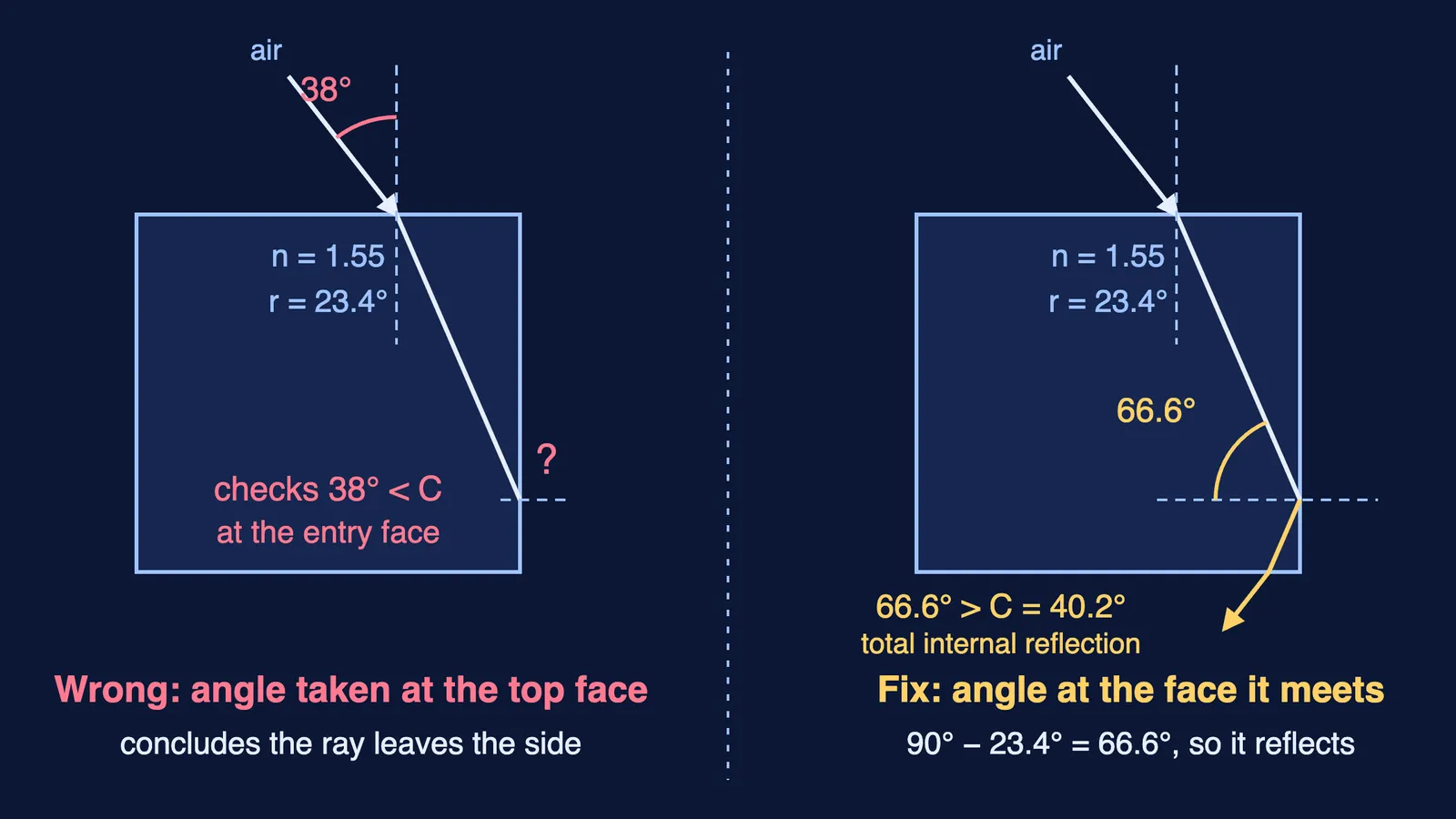
Wrong: a ray enters the top of a glass block (n = 1.55) at 38°, less than C = 40.2°, so it leaves through the side.
Why: TIR depends on the angle at the face where it might happen, here 90° − r.
Fix: sin r = sin 38° / 1.55, so r = 23.4°. At the side face the angle is 66.6°, above 40.2°, so the ray is totally reflected.
Habit: mark the normal at the second face and find the angle there.
Why do curved-surface answers flip sign?
Swapping n₁ and n₂ in the spherical-surface formula.
Wrong: an object in air is 40 cm from the convex end of a glass rod (n = 1.6, R = 12 cm). With n₁ = 1.6 and n₂ = 1, v = −11.1 cm.
Why: NCERT Eq. 9.16 is n₂/v − n₁/u = (n₂ − n₁)/R, with n₂ the medium the light enters.
Fix: n₁ = 1, n₂ = 1.6, u = −40 cm, R = +12 cm. Then 1.6/v = 0.05 − 0.025, so v = +64 cm, a real image inside the rod.
Habit: write "from n₁ into n₂" above the equation.
Keeping R positive when the light leaves through a convex surface.
Wrong: a speck in a glass ball (n = 1.6, radius 10 cm) is 6 cm inside the near surface. With R = +10 cm, v = −3.1 cm.
Why: R is positive only if the centre of curvature lies on the side the light goes to. Here the centre is on the side the light comes from.
Fix: n₁ = 1.6, n₂ = 1, u = −6 cm, R = −10 cm. Then 1/v = 0.06 − 0.267, so v = −4.8 cm: the speck appears 4.8 cm inside.
Habit: sign R by where the centre sits, not by the surface's look.
How do you combine two lenses correctly?
Adding focal lengths for lenses in contact.
Wrong: f₁ = +15 cm and f₂ = −40 cm in contact give f = −25 cm, a diverging pair.
Why: NCERT section 9.5.4 adds reciprocals, 1/f = 1/f₁ + 1/f₂, which is the algebraic sum of powers.
Fix: P = 100/15 − 100/40 = 6.67 − 2.50 = +4.17 D, so f = +24 cm: still converging.
Habit: convert each lens to dioptres, add, then invert.
Using the contact formula for lenses that are apart.
Wrong: lenses of f = +12 cm and −24 cm sit 6 cm apart. Treated as touching, f = +24 cm, and an object 36 cm away gives v = 72 cm.
Why: P = P₁ + P₂ assumes the lenses touch. Otherwise, as in NCERT's Example 9.8, image through one lens at a time.
Fix: lens 1 gives 1/v₁ = 1/12 − 1/36, so v₁ = +18 cm, 12 cm beyond lens 2: a virtual object, u₂ = +12 cm. Then 1/v₂ = −1/24 + 1/12, so v₂ = +24 cm behind lens 2. Total m = m₁m₂ = (−0.5)(2) = −1.
Habit: re-measure u from each new lens, and multiply magnifications.
What should you check in the last 60 seconds?
Can't picture where the ray goes after it enters the block? The Fermi Simulation Lab has interactive simulations for the ideas that are easier to see than to read.
For a study plan, read our Optics for NEET preparation guide and our Ray Optics for JEE Main preparation guide.