On this page
Circular motion questions in JEE Main and NEET-UG look short, but marks go on slips in geometry, friction, units and the vertical circle. Here are nine, each with the wrong working, the physics, an original example and a habit.
The NTA Syllabus for JEE (Main) 2027 and the NMC NEET (UG) 2026 syllabus list uniform circular motion under kinematics, the level and banked road under laws of motion, and motion in a vertical circle under work, energy and power. Examples use g = 9.8 m/s².
Why do free-body diagrams go wrong on curved paths?
Taking the string length as the radius.
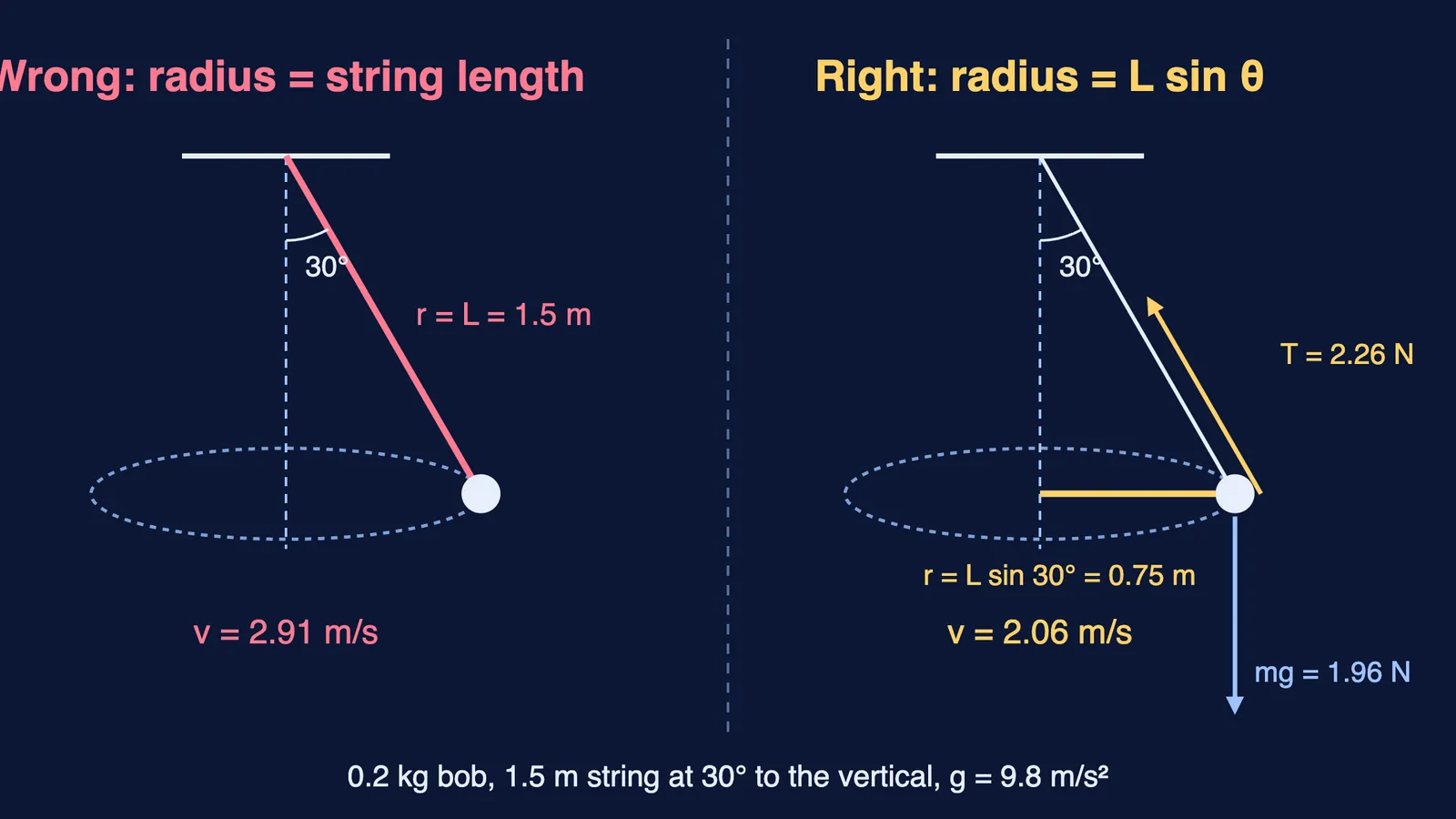
Wrong: a 0.2 kg bob on a 1.5 m string moves in a horizontal circle with the string at 30° to the vertical. A student puts r = 1.5 m into tan θ = v²/(rg) and gets v = √(9.8 × 1.5 × tan 30°) = 2.91 m/s.
Why: the bob circles the vertical axis below the support, so the radius is the horizontal distance r = L sin θ. Section 4.10 of NCERT Class 11 Physics, Laws of Motion notes that for a stone on a string the centripetal force is provided by the tension; here it is the horizontal part T sin θ, while T cos θ balances mg.
Fix: r = 1.5 × sin 30° = 0.75 m, so v = √(9.8 × 0.75 × 0.577) = 2.06 m/s, and T = mg/cos 30° = 2.26 N.
Habit: mark the centre of the circle on the diagram before writing any radius.
Using kinetic friction for a car that is not skidding.
Wrong: a flat curve has radius 50 m, μs = 0.6 and μk = 0.45. Using μk, v_max = √(0.45 × 50 × 9.8) = 14.8 m/s.
Why: a tyre that is not skidding does not slide sideways on the road, so the NCERT chapter uses static friction, v_max = √(μs R g).
Fix: v_max = √(0.6 × 50 × 9.8) = 17.1 m/s.
Habit: no skid, no μk.
What goes wrong on a banked road?
Quoting the no-friction speed when the question gives friction.
Wrong: a curve of radius 80 m is banked at 10° with μs = 0.25. For the maximum safe speed, a student writes √(Rg tan θ) = 11.8 m/s.
Why: √(Rg tan θ) is the optimum speed, where friction is not needed at all. The maximum uses friction too: v_max = √[Rg(μs + tan θ)/(1 − μs tan θ)], NCERT Eq. 4.21.
Fix: v_max = √[80 × 9.8 × (0.25 + 0.176)/(1 − 0.25 × 0.176)] = 18.7 m/s.
Habit: underline the words "optimum" and "maximum" before choosing a formula.
Assuming friction always points down the slope.
Wrong: on the same bank, a 1000 kg car at 4 m/s is drawn with friction down the slope.
Why: the NCERT text notes that below the optimum speed, friction acts up the slope.
Fix: resolving forces gives N = 9.69 kN and friction 1.50 kN up the slope, a ratio of 0.155, below 0.25, so the car holds.
Habit: find v₀ first; below it friction acts up the slope, above it down.
Which unit and vector slips spoil uniform circular motion?
Putting rpm straight into ω²r.
Wrong: a fan blade tip at r = 0.6 m turns at 300 rpm. Taking ω = 300 gives 54 000 m/s².
Why: ω must be in rad/s, and ω = 2πν. NCERT Class 11, Motion in a Plane gives a_c = ω²R = 4π²ν²R.
Fix: ω = 300 × 2π/60 = 31.4 rad/s, so a = 31.4² × 0.6 = 592 m/s².
Habit: convert rpm with ×2π/60 on the first line.
Treating constant speed as constant velocity.
Wrong: a ball moves at 6 m/s on a circle of radius 3 m. "Same speed after a quarter turn, so the average acceleration is zero."
Why: velocity changes direction, and the NCERT chapter stresses that centripetal acceleration is not a constant vector.
Fix: after a quarter turn the two velocities are perpendicular, so |Δv| = 6√2 = 8.49 m/s. The time is (π × 3/2)/6 = 0.785 s, so the average acceleration is 10.8 m/s². The instantaneous value is v²/r = 12 m/s².
Habit: subtract velocities as arrows, never as numbers.
How is a vertical circle different from uniform circular motion?
Taking v²/r as the whole acceleration when speed is changing.
Wrong: a bob on a 1.2 m string passes the horizontal position at 4 m/s; its acceleration is 4²/1.2 = 13.3 m/s².
Why: with the string horizontal, all of mg is tangential, so there is a tangential acceleration g on top of the centripetal one.
Fix: a = √(13.3² + 9.8²) = 16.5 m/s².
Habit: if the speed is changing, add a tangential part.
Using the bottom speed at the top.
Wrong: a 0.5 kg ball on a 1.0 m string has 8 m/s at the bottom. At the top, T = 0.5 × (64 − 9.8) = 27.1 N.
Why: the ball rises 2L and loses kinetic energy. Example 5.7 in NCERT Work, Energy and Power links the two points by energy conservation.
Fix: v_top² = 64 − 4 × 9.8 × 1.0 = 24.8 m²/s², so T_top = 0.5 × (24.8 − 9.8) = 7.5 N.
Habit: energy first, then the force equation, at every point you need.
Treating a rod like a string.
Wrong: a mass on a light rigid rod of length 0.9 m needs √(5gL) = 6.64 m/s at the bottom to complete the circle.
Why: √(5gL) comes from needing tension of zero or more at the top. A rod can also push, so the mass only has to reach the top with speed just above zero: v_bottom² = 4gL.
Fix: v_min = √(4 × 9.8 × 0.9) = 5.94 m/s.
Habit: ask whether the support can push; a string cannot, a rod can. For the string case, see when the string goes slack in a vertical circle.
A 60-second self-check before you mark
The Fermi Problem Library has worked problems with a step-by-step solver that explains the reasoning rather than printing an answer.
For syllabus maps and a study plan, see our Laws of Motion for NEET preparation guide and our Laws of Motion for JEE Main preparation guide.