On this page
Many friction and pulley answers in JEE Main and NEET-UG go wrong before the algebra starts: a friction value picked before checking whether anything moves, or an arrow pointing the wrong way. Here are seven slips, each with the wrong working, the physics, an original example and a habit. Examples use g = 9.8 m/s².
Both exams test the same ideas. The NTA Syllabus for JEE (Main) 2027 and the NMC NEET (UG) 2026 syllabus both list static and kinetic friction and the laws of friction under Unit 3, Laws of Motion.
When is friction not equal to μN?
Assuming a connected system moves.
Wrong: a 10 kg block on a table (μs = 0.4, μk = 0.25) is tied over a pulley to a hanging 3 kg block. A student writes a = (3g − 0.25 × 10g)/13 = 0.38 m/s².
Why: static friction is self-adjusting. Section 4.9.1 of NCERT Class 11 Physics, Laws of Motion gives the law of static friction as fs ≤ μs N, so μs N is only a ceiling. Kinetic friction μk N applies only once sliding has started.
Fix: the hanging weight is 29.4 N and the limit is 0.4 × 98 = 39.2 N. Nothing moves, so friction is 29.4 N and T = 29.4 N.
Habit: compare the driving force with μs N before writing any acceleration.
Mixing up which coefficient does which job.
Wrong: a 3 kg crate has μs = 0.6 and μk = 0.4. Pushed with 15 N, "kinetic friction is 11.76 N, so it slides at 1.08 m/s²". Pushed with 20 N, a student uses μs and gets 0.79 m/s².
Why: the NCERT text says a body begins to slide only when the applied force exceeds μs N, and once relative motion starts, friction drops to μk N, with μk less than μs.
Fix: the limit is 0.6 × 29.4 = 17.64 N. At 15 N the crate stays at rest, with friction 15 N. At 20 N it slides: a = (20 − 11.76)/3 = 2.75 m/s².
Habit: μs answers "does it move?"; μk answers "how fast does it speed up?"
Which way does friction point?
Drawing friction against the motion instead of against the slip.
Wrong: a 2 kg book sits on a 6 kg board on a smooth floor (μs = 0.5 between them). A 30 N pull on the board moves both. A student draws friction on the book backwards, "because friction opposes motion".
Why: the NCERT chapter stresses that friction opposes relative motion, not motion. Without friction the board would slide out from under the book, so friction on the book points forward.
Fix: together, a = 30/8 = 3.75 m/s². The book needs 2 × 3.75 = 7.5 N forward, below the 9.8 N limit, so no slip.
Habit: ask "which way would this surface slip without friction?" and point friction the other way.
Guessing the direction on an incline-pulley system.
Wrong: a 4 kg block on a 30° incline (μs = 0.3, μk = 0.2) is tied over a pulley at the top to a hanging 1.5 kg block. A student assumes the hanging block wins, puts friction down the slope, gets a = −2.13 m/s², and reads the minus sign as "it slides down at 2.13 m/s²".
Why: friction's direction depended on the assumed motion, so a minus sign cannot simply be flipped.
Fix: without friction, the pull down the slope is 19.6 N against 14.7 N, so the tendency is down by 4.9 N. The static limit is 0.3 × 4 × 9.8 × cos 30° = 10.18 N. The system stays at rest, with 4.9 N of friction up the slope and T = 14.7 N.
Habit: find the no-friction tendency first, then place friction.
Why does the pulley answer come out wrong?
Setting tension equal to the hanging weight.
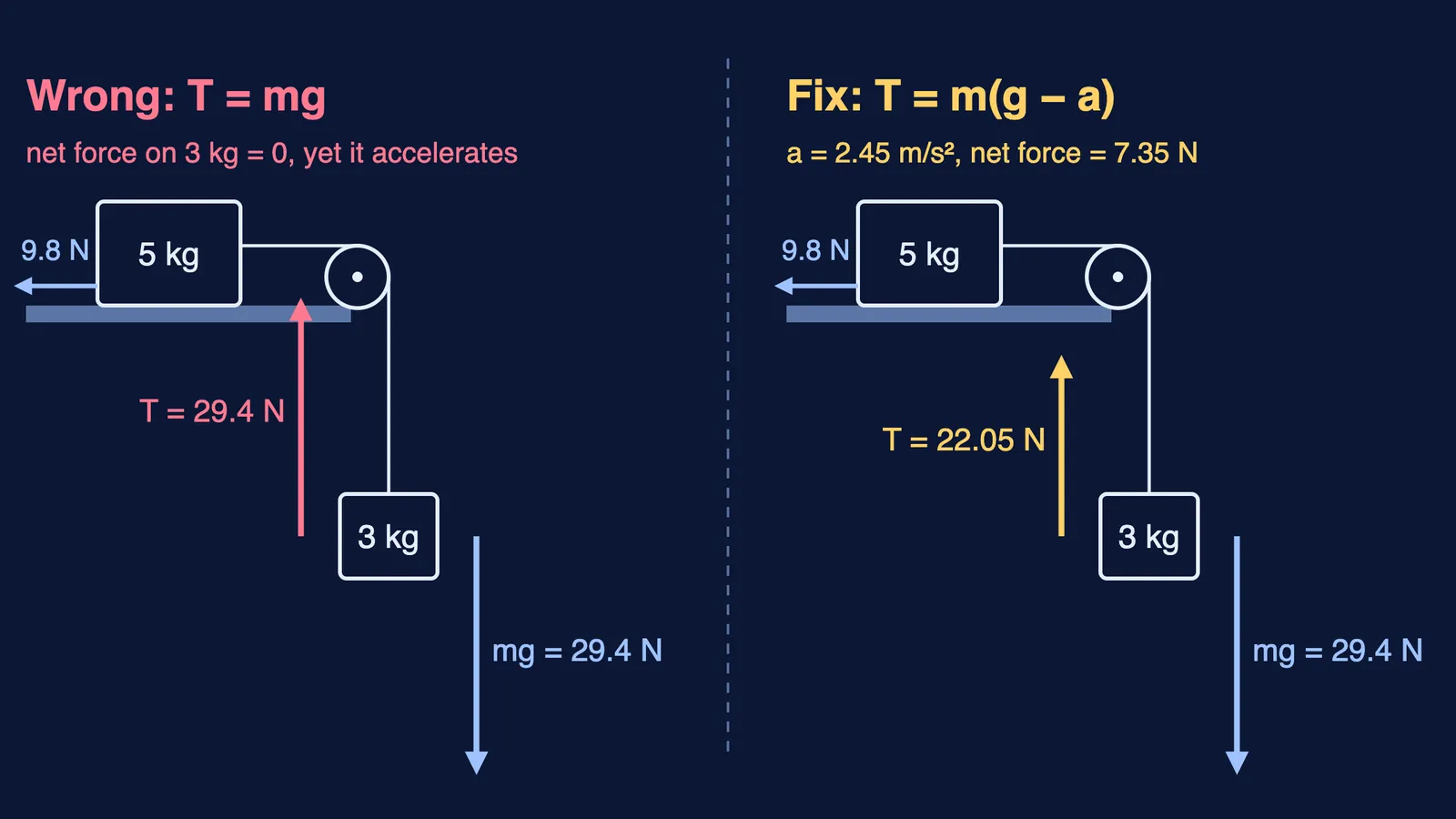
Wrong: a 5 kg block on a table (μs = 0.3, μk = 0.2) is pulled by a hanging 3 kg block. "The string holds 3 kg, so T = 29.4 N."
Why: T = mg only if the hanging block does not accelerate. Here 29.4 N beats the 14.7 N limit, so the blocks accelerate and T falls below the weight.
Fix: a = (29.4 − 9.8)/8 = 2.45 m/s², and T = 3 × (9.8 − 2.45) = 22.05 N.
Habit: if the block accelerates downwards, T must come out below its weight.
Charging friction to the hanging block too.
Wrong: same set-up. Friction = 0.2 × (5 + 3) × 9.8 = 15.68 N, so a = 1.72 m/s².
Why: friction acts only where a surface touches. The normal force from the table supports the 5 kg block alone, so friction is 0.2 × 49 = 9.8 N.
Fix: a = 2.45 m/s², as above.
Habit: write N for each surface separately and name the body it pushes on.
Giving both blocks the same acceleration with a movable pulley.
Wrong: a 4 kg block on a table (μs = 0.3, μk = 0.25) is tied to a string that runs over a fixed pulley, under a movable pulley carrying 6 kg, and up to a hook. Treating it like a simple pulley, with one tension and one acceleration for both blocks, gives a = (58.8 − 9.8)/10 = 4.9 m/s².
Why: two strands hold the movable pulley, so it feels 2T upwards and moves half as far as the table block. Our post on checking a pulley constraint answer derives this from the string length.
Fix: with a for the 6 kg block and 2a for the 4 kg block, T − 9.8 = 4(2a) and 58.8 − 2T = 6a. So a = 1.78 m/s², the table block accelerates at 3.56 m/s², and T = 24.05 N.
Habit: count the strands on every movable pulley before writing forces.
A 60-second self-check before you mark
Stuck on why your answer is off? The Fermi Problem Library has worked problems with a step-by-step solver that explains the reasoning rather than printing an answer.
For the chapter map and a study plan, see our Laws of Motion for NEET preparation guide and our Laws of Motion for JEE Main preparation guide.