On this page
In magnetism and matter, marks usually go on a power of r, a sign or a symbol in the wrong place, not on hard algebra. Below are eight frequent slips, each with the wrong working, the physics, a fix on our own numbers and a habit to keep.
The scope is the same for both exams. Unit 13 of the NTA Syllabus for JEE (Main) - 2027 and of the NMC NEET (UG)-2026 syllabus lists the bar magnet as an equivalent solenoid, its axial and equatorial field, torque on a dipole, and para-, dia- and ferromagnetism with the effect of temperature. The textbook is NCERT Class 12 Physics Chapter 5, Magnetism and Matter; the rationalised text (2026-27 reprint) no longer has a section on the Earth's magnetism, so we leave it out. Take μ₀/4π = 10⁻⁷ T m/A.
Where does the bar magnet's field calculation go wrong?
Using the axial formula at a point on the equator.
Wrong: a short magnet of moment 2.5 A m², at 5.0 cm on its equatorial line, gives B = 10⁻⁷ × 2 × 2.5/(0.050)³ = 4.0 × 10⁻³ T.
Why: for a short dipole, NCERT gives B = (μ₀/4π)(2m/r³) on the axis but B = −(μ₀/4π)(m/r³) on the equator. The minus sign means the equatorial field points opposite to m.
Fix: B = 10⁻⁷ × 2.5/(0.050)³ = 2.0 × 10⁻³ T, directed from the N end towards the S end, antiparallel to m.
Habit: ask "axis or equator?" before writing the 2.
Scaling the dipole field like a point charge's.
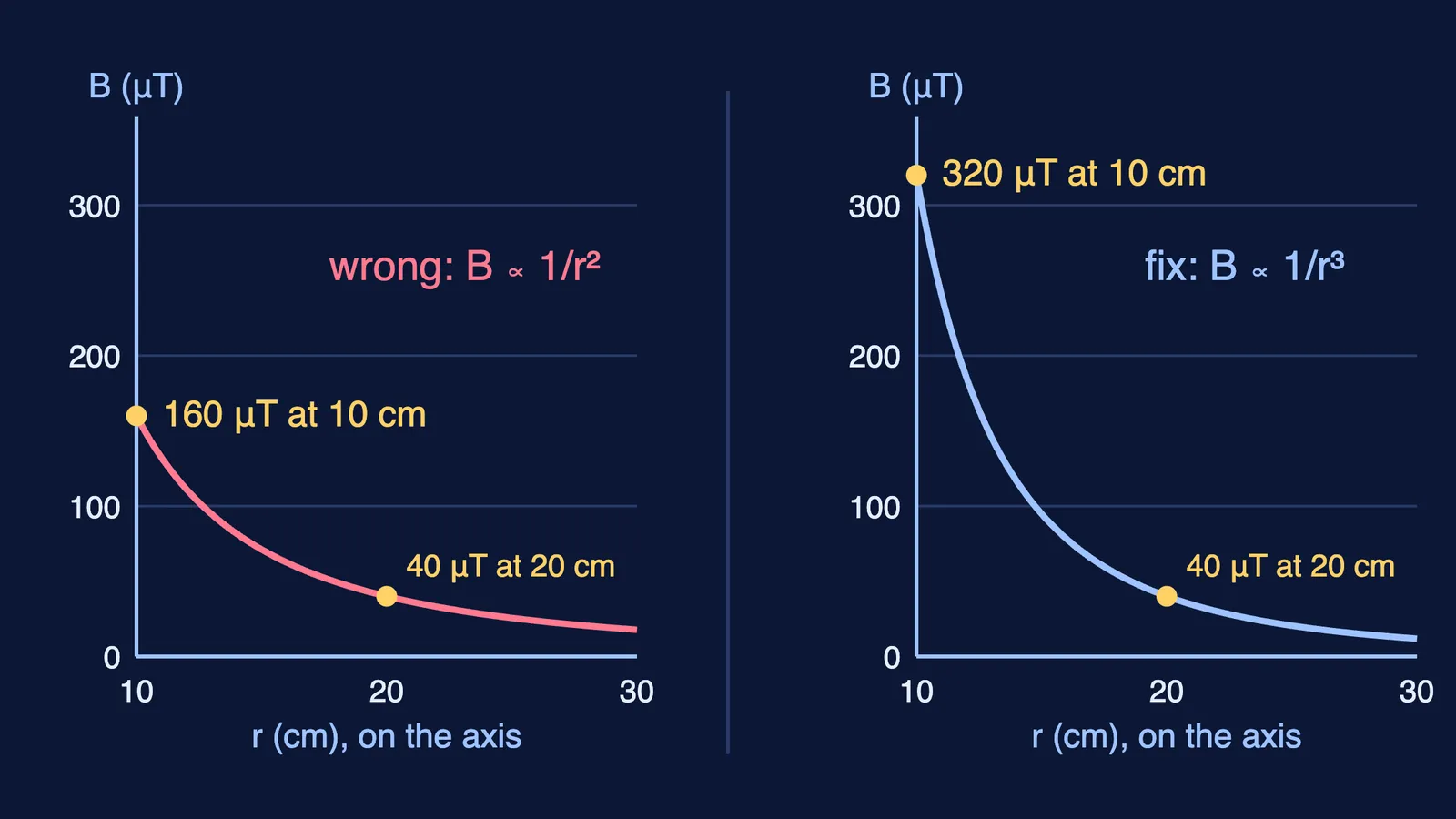
Wrong: a short magnet gives 40 μT at 20 cm on its axis; at 10 cm, halving r multiplies B by 4, so B = 160 μT.
Why: a dipole's field falls as 1/r³, not 1/r²; the picture at the top plots both curves through the same 40 μT point.
Fix: halving r multiplies B by 2³ = 8, so B = 320 μT. This holds while r stays much larger than the magnet.
Habit: check the power of r before comparing two distances.
Why does my energy answer for a magnet in a field come out wrong?
Using mB sin θ as the work done to turn a magnet.
Wrong: a 0.60 J/T magnet lies along a 0.40 T field. Turning it to 120° takes W = mB sin 120° = 0.21 J.
Why: mB sin θ is a torque, not work. Work is the change in U = −mB cos θ (NCERT Eq. 5.3), so W = mB(cos θ₁ − cos θ₂).
Fix: W = 0.60 × 0.40 × (cos 0° − cos 120°) = 0.24 × 1.5 = 0.36 J.
Habit: write U at the start and the end, then subtract.
Calling both zero-torque positions stable.
Wrong: torque is zero at 0° and 180°, so the magnet is stable at either.
Why: at 180°, U = +mB is a maximum; nudge the magnet and torque pushes it further away. Only 0°, where U = −mB, is stable.
Fix: here U = −0.24 J at 0° and +0.24 J at 180°. Released just off 180°, a frictionless magnet reaches 0° with 0.48 J of kinetic energy.
Habit: decide stability from U, not from the torque alone.
How do M, H, χ and μr get mixed up?
Thinking each half of a cut magnet keeps the full moment.
Wrong: a 4.0 A m² bar magnet of volume 8.0 cm³ is cut in half; each piece is still 4.0 A m².
Why: magnetisation is moment per unit volume, M = m/V. NCERT compares cutting a magnet to cutting a solenoid: two weaker magnets, never a lone pole.
Fix: M = 4.0/(8.0 × 10⁻⁶) = 5.0 × 10⁵ A/m. Each half keeps that M but has 4.0 cm³, so m = 5.0 × 10⁵ × 4.0 × 10⁻⁶ = 2.0 A m², whichever way you cut.
Habit: when a sample changes size, hold M fixed and recompute m.
Using μr where χ belongs.
Wrong: a 600 turns/m solenoid carries 1.5 A around a core with χ = 3.0 × 10⁻⁵, so H = nI = 900 A/m and M = μr H ≈ 900 A/m.
Why: M = χH; μr = 1 + χ belongs in B = μ₀μr H.
Fix: M = 3.0 × 10⁻⁵ × 900 = 0.027 A/m. The core adds only μ₀M ≈ 3.4 × 10⁻⁸ T to the 1.13 × 10⁻³ T of the empty coil.
Habit: write B = μ₀(H + M) first, then put in χ or μr.
Giving a diamagnet a negative μr.
Wrong: χ = −1.5 × 10⁻⁵, so μr = −1.5 × 10⁻⁵.
Why: μr = 1 + χ, and NCERT puts diamagnets at 0 ≤ μr < 1; μr = 0 is the superconductor, χ = −1.
Fix: μr = 0.999985. In H = 2.0 × 10⁴ A/m, M = χH = −0.30 A/m, opposite to H, and B falls below μ₀H by only about 3.8 × 10⁻⁷ T.
Habit: χ can go negative; μr never can.
How do you tell dia, para and ferromagnets apart?
Expecting a heated paramagnet to magnetise more strongly.
Wrong: samples have χ = −2.0 × 10⁻⁵, +4.0 × 10⁻⁵ and +1500. Warming the second gives its atoms energy to line up, so M rises.
Why: negative χ means diamagnetic, small positive paramagnetic, large positive ferromagnetic. Thermal motion scrambles a paramagnet's dipoles; NCERT says cooling raises M towards saturation.
Fix: they are dia-, para- and ferromagnetic. In H = 900 A/m the paramagnet starts at M = 0.036 A/m; heating lowers it.
Habit: read the sign and size of χ first.
Mixing up H, M and χ again? Fermi's Concept Library gives every concept in physics its own lesson and its place in the map.
A 60-second self-check before you mark
For the full chapter plan, see our guides to moving charges and magnetism for JEE Main and magnetic effects of current and magnetism for NEET, and our note on magnetisation M and magnetic intensity H.