On this page
Elasticity questions in JEE Main and NEET-UG look friendly: one formula, a wire, a load. Marks slip away not because students forget Y = (F/A)/(ΔL/L) but because the area, tension, strain or energy fed into it is wrong. Both the NMC NEET (UG)-2026 syllabus and the NTA JEE (Main) syllabus list elastic behaviour, the stress-strain relationship, Hooke's law, and Young's, bulk and rigidity moduli. The definitions below follow NCERT Class 11 Physics Chapter 8, Mechanical Properties of Solids (2026-27 reprint).
Why does your wire extension come out wrong?
Using the diameter as the radius, or leaving mm² unconverted.
Wrong: a brass wire 1.2 m long, 0.80 mm in diameter, Y = 1.0 × 10¹¹ Pa, carries 40 N. "A = π(0.80 × 10⁻³)², so ΔL = 0.24 mm."
Why it fails: using the diameter makes A, which goes as r², four times too big, and ΔL four times too small. And 1 mm² is 10⁻⁶ m², not 10⁻³ m².
Fix: r = 0.40 mm, so A = π(0.40 × 10⁻³)² = 5.03 × 10⁻⁷ m². ΔL = FL/(AY) = (40 × 1.2)/(5.03 × 10⁻⁷ × 1.0 × 10¹¹) = 9.5 × 10⁻⁴ m, about 0.95 mm.
Habit: write "r = d/2" on its own line before you touch π.
Doubling the tension when a wire is pulled from both ends.
Wrong: a steel wire 3.0 m long, 2.0 mm² in cross-section, is pulled by 150 N at each end. "Tension = 300 N, so ΔL = 2.25 mm."
Why it fails: NCERT's Points to Ponder make the same point for a wire hung from a ceiling and loaded with F: the tension at any cross-section is F, not 2F.
Fix: with Y = 2.0 × 10¹¹ Pa, ΔL = (150 × 3.0)/(2.0 × 10⁻⁶ × 2.0 × 10¹¹) = 1.1 × 10⁻³ m, about 1.1 mm.
Habit: cut the wire in your head and ask what force one piece pulls with.
Forgetting that a redrawn wire keeps its volume.
Wrong: a 1.0 m wire stretches 0.30 mm under a load. The same piece of metal is drawn into a 2.0 m wire and given the same load. "Length doubles, so ΔL = 0.60 mm."
Why it fails: the volume AL is fixed, so doubling L halves A. In ΔL = FL/(AY) both changes raise ΔL.
Fix: ΔL goes up by 2 × 2 = 4, giving 1.2 mm.
Habit: on "drawn" or "same mass", write AL = constant first.
Which modulus and which strain does the question need?
Calling the material that stretches more "more elastic".
Wrong: "Under the same load, Q stretches more than P, so Q is more elastic."
Why it fails: NCERT calls this a misnomer. The material that stretches less for a given load has the larger Y and is more elastic.
Fix: put 100 N on 1.0 m wires of 1.0 mm² cross-section. P (Y = 2.0 × 10¹¹ Pa) stretches 0.50 mm; Q (Y = 7.0 × 10¹⁰ Pa) stretches 1.4 mm. P is more elastic.
Habit: read "more elastic" as "larger Y".
Measuring shear strain along the wrong side.
Wrong: a rubber pad 0.20 m × 0.15 m and 5.0 cm thick has its top face pushed sideways by 600 N; G = 1.0 × 10⁶ Pa. "Strain = Δx/0.20, so Δx = 4.0 mm."
Why it fails: shearing strain is Δx/L, with L the distance between the sliding faces, perpendicular to the force: the 5.0 cm thickness.
Fix: stress = 600/(0.20 × 0.15) = 2.0 × 10⁴ Pa; strain = stress/G = 0.020; Δx = 0.020 × 0.050 = 1.0 × 10⁻³ m, or 1.0 mm.
Habit: shade the two sliding faces and take L between them.
Treating volume strain as the change in radius.
Wrong: a copper sphere of radius 3.0 cm is put under an extra pressure of 4.2 × 10⁷ Pa. Using B = 140 GPa for copper (NCERT Table 8.3), ΔV/V = 3.0 × 10⁻⁴, "so Δr = 3.0 × 10⁻⁴ × 3.0 cm = 9.0 µm."
Why it fails: V ∝ r³, so for small changes ΔV/V = 3Δr/r.
Fix: Δr/r = 3.0 × 10⁻⁴/3 = 1.0 × 10⁻⁴, so the radius shrinks by 3.0 µm.
Habit: for spheres and cubes, divide the volume strain by 3 to get the linear strain.
How do you get elastic energy and graphs right?
Writing the stored energy as F × ΔL.
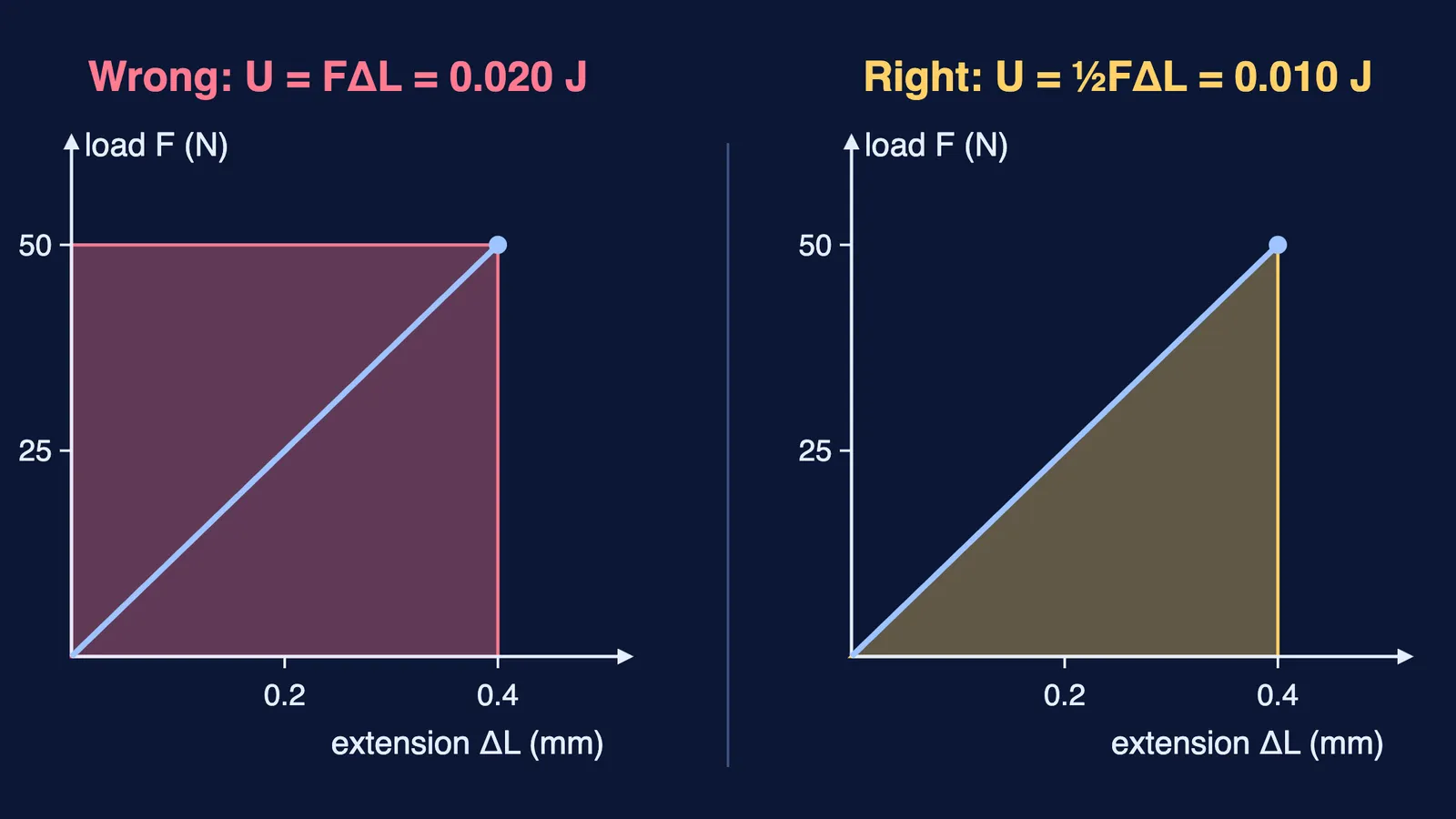
Wrong: a 50 N load stretches a wire by 0.40 mm. "U = 50 × 0.40 × 10⁻³ = 0.020 J."
Why it fails: the tension grows from zero to 50 N during stretching, so the work is the triangle under the force-extension line. NCERT derives U = ½ × stress × strain × volume, which is ½FΔL.
Fix: U = ½ × 50 × 0.40 × 10⁻³ = 0.010 J. The load does lose 0.020 J of gravitational energy; the other half goes to the hand lowering it, or is dissipated as the wire oscillates if it is dropped.
Habit: energy per unit volume is u = ½σε; multiply by AL for the wire.
Reading the slope of an extension-load graph as Y.
Wrong: a 2.0 m wire of cross-section 0.50 mm² gives a straight line of extension against load with slope 2.0 × 10⁻⁵ m/N. "Y is the slope" or "Y = 1/slope = 5 × 10⁴ Pa."
Why it fails: ΔL = (L/AY)F, so the slope is L/(AY). Only a stress-strain graph has Y as its slope, and only in its straight part; NCERT notes Hooke's law holds in the linear region alone.
Fix: Y = L/(A × slope) = 2.0/(0.50 × 10⁻⁶ × 2.0 × 10⁻⁵) = 2.0 × 10¹¹ Pa.
Habit: label both axes with units before you calculate any slope.
A 60-second self-check before you mark
Stuck on why your answer is off? The Fermi Problem Library has worked problems with a step-by-step solver that explains the reasoning rather than printing an answer.
For the whole unit, use the Properties of Solids and Liquids for NEET preparation guide or the Properties of Solids and Liquids for JEE Main preparation guide.