On this page
Collision and centre-of-mass questions in JEE Main and NEET-UG rest on two ideas: momentum and the centre of mass. Marks go on small slips in applying them: a dropped sign, a vector added like a number. Below are eight slips, each with the wrong working, the physics, an original example and a habit.
The NTA Syllabus for JEE (Main) 2027 and the NMC NEET (UG) 2026 syllabus list momentum conservation in Unit 3, elastic and inelastic collisions in one and two dimensions in Unit 4, and the centre of mass in Unit 5. The textbook sections are 5.11 of NCERT Class 11 Physics Chapter 5 and 6.2 to 6.4 of Chapter 6.
Which sign goes on each velocity?
Giving both velocities a plus sign in a head-on collision.
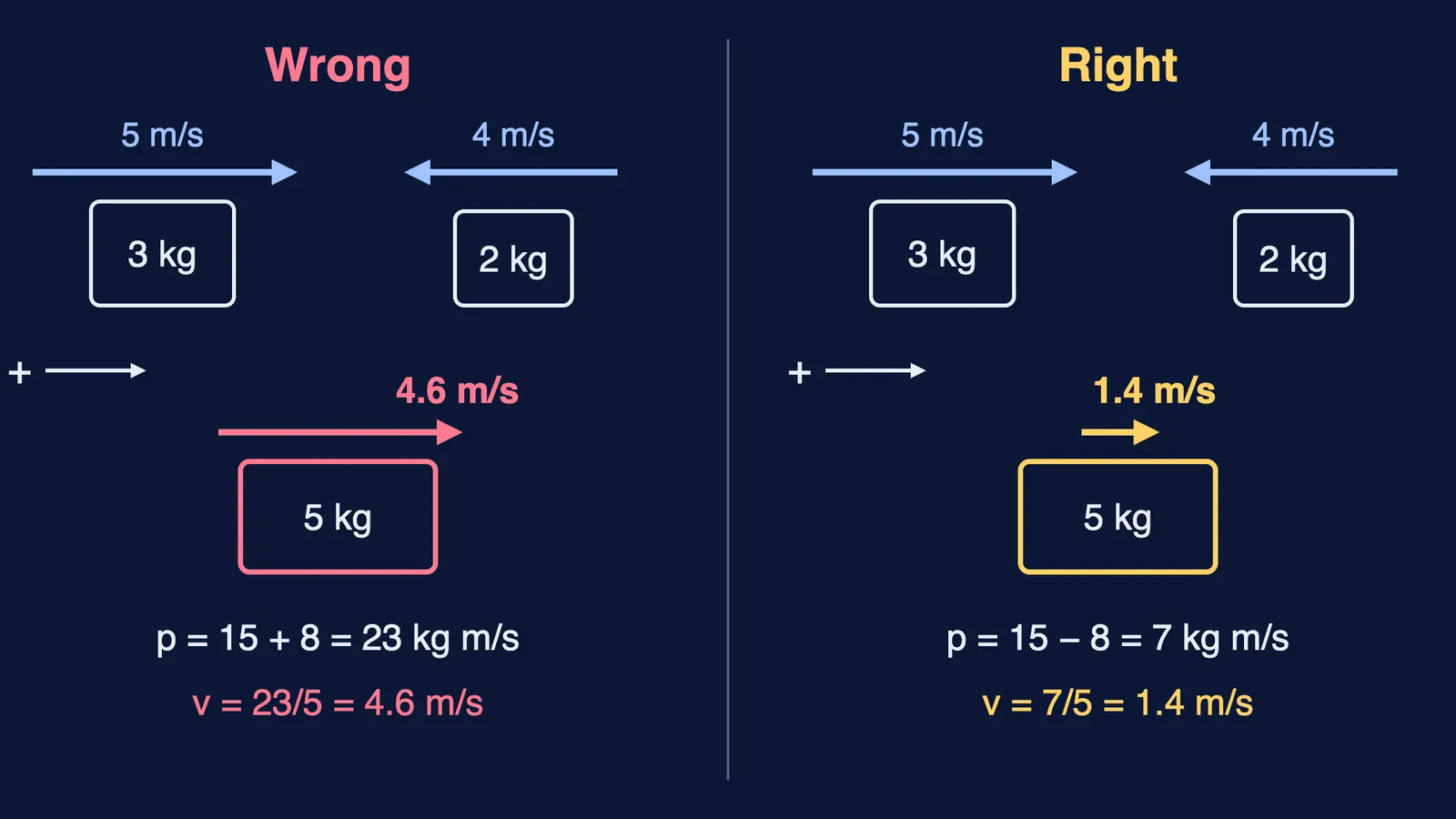
Wrong: a 3 kg trolley at 5 m/s meets a 2 kg trolley coming the other way at 4 m/s, and they stick. v = (15 + 8)/5 = 4.6 m/s.
Why: momentum is a vector, so the 2 kg trolley's momentum is −8 kg m/s.
Fix: v = (15 − 8)/5 = 1.4 m/s, in the 3 kg trolley's direction.
Habit: draw one "+" arrow first and sign every velocity from it.
Subtracting speeds when a ball rebounds.
Wrong: a 0.15 kg ball hits a wall at 12 m/s and returns at 8 m/s, so Δp = 0.15 × (12 − 8) = 0.6 kg m/s.
Why: the final velocity points the other way. Δp is final minus initial, with signs.
Fix: with "away from the wall" positive, Δp = 0.15 × (8 − (−12)) = 3.0 kg m/s, five times the wrong value.
Habit: for the size of Δp in a rebound, the two speeds add, never subtract.
Adding momenta like numbers in two dimensions.
Wrong: a 2 kg puck moving east at 3 m/s and a 3 kg puck moving north at 2 m/s stick. v = (6 + 6)/5 = 2.4 m/s.
Why: momentum is conserved separately along each axis. Perpendicular momenta add like the sides of a right triangle.
Fix: px = 6 and py = 6 kg m/s, so p = √72 = 8.49 kg m/s and v = 1.70 m/s at 45° north of east.
Habit: in 2D, write the x-equation and the y-equation on separate lines.
When is kinetic energy conserved in a collision?
Conserving kinetic energy through the moment two bodies stick.
Wrong: a 20 g bullet at 300 m/s embeds in a 1.98 kg block on a smooth floor, attached to a spring of k = 1800 N/m. ½mu² = 900 J = ½kx², so x = 1.0 m.
Why: NCERT section 5.11 states that momentum is conserved in all collisions, but kinetic energy is not when bodies deform and move together.
Fix: momentum first: V = 6/2 = 3 m/s. Then ½ × 2 × 3² = 9 J = ½kx², so x = 0.10 m. About 891 J went into the impact.
Habit: momentum across the impact, energy only before or after it.
Using the "target at rest" elastic formulas when the target moves.
Wrong: a 2 kg ball at 6 m/s catches a 1 kg ball moving the same way at 2 m/s, elastically. v1 = (1/3) × 6 = 2 m/s and v2 = (4/3) × 6 = 8 m/s. Momentum after is 12 kg m/s; before, it was 14.
Why: the NCERT results v1f = (m1 − m2)v1i/(m1 + m2) and v2f = 2m1v1i/(m1 + m2) assume the second mass starts at rest.
Fix: in an elastic head-on collision, speed of separation equals speed of approach: v2 − v1 = 4. With 2v1 + v2 = 14, v1 = 3.33 m/s and v2 = 7.33 m/s. Kinetic energy is 38 J before and after.
Habit: check a formula's conditions first. For why momentum survives a quick impact, see why momentum is conserved in collisions despite gravity.
Where is the centre of mass, and when does it stay put?
Letting the centre of mass move under internal forces.
Wrong: a 60 kg student walks 4 m along a 140 kg boat on still water, so the boat moves back 60 × 4/140 = 1.71 m.
Why: NCERT section 6.4 shows that with zero external force the centre of mass velocity is constant; starting from rest, it stays put. The 4 m is relative to the boat.
Fix: the student moves x over the water and the boat 4 − x back: 60x = 140(4 − x), so x = 2.8 m and the boat moves 1.2 m.
Habit: write every displacement relative to the ground before balancing them.
Assuming an exploding shell's pieces land where the shell would have.
Wrong: a shell that would land 300 m away splits at the top into equal halves. One drops straight down from rest, so the other lands at 300 m.
Why: explosion forces are internal, so the centre of mass keeps the original parabola, as NCERT's exploding-projectile figure shows. Both halves start with zero vertical velocity at the same height, so on level ground they land together.
Fix: m × 150 + m × x = 2m × 300, so x = 450 m.
Habit: place the centre of mass first, then share it out by mass.
Adding a hole's mass instead of subtracting it.
Wrong: a uniform 30 cm radius disc has a 10 cm radius hole centred 15 cm from its centre. Treating the hole as extra mass puts the centre of mass 1.5 cm towards the hole.
Why: the cut disc is the full disc minus the hole. For a uniform sheet mass goes with area, so the hole enters with a minus sign.
Fix: areas are 9 : 1, so X = (9 × 0 − 1 × 15)/(9 − 1) = −1.875 cm, away from the hole.
Habit: removing material pushes the centre of mass away from the gap.
What should you check in the last 60 seconds?
Stuck on why your answer is off? The Fermi Problem Library has worked problems with a step-by-step solver that explains the reasoning rather than printing an answer.
For syllabus maps and a study plan, read our Work, Energy and Power for NEET preparation guide and our Work, Energy and Power for JEE Main preparation guide.