

On this page
Many JEE students meet this puzzle. The rule says momentum is conserved only when the net external force is zero. Yet two balls colliding in mid-air are both being pulled down by gravity the whole time. So why does every solution write "momentum before = momentum after"?
Gravity does act. Over the instant of the collision, it just hardly does anything.
Why is momentum conserved in a collision even with gravity?
Start with what the law actually says. The OpenStax textbook University Physics, section 9.3 states two conditions for a closed system: the mass must stay constant, and "the net external force on the system must be zero." Gravity is an external force, so strictly the condition fails.
Now look at how a force changes momentum. Impulse is force multiplied by the time it acts, and the impulse-momentum theorem says the change in momentum equals the impulse (OpenStax, section 9.2). So gravity's impulse on a system of mass M during a collision lasting Δt is simply Mg × Δt.
The same OpenStax section says typical collision times are about a tenth of a second, "or even one thousandth of a second." Make Δt tiny and Mg × Δt shrinks with it. The collision itself does not shrink, though. The balls still need the same change in momentum, so as Δt gets shorter the contact force gets larger.
Physicists call this the impulse approximation. As the LibreTexts notes on impulse put it, the collision force is "so much larger than other forces present" that those forces can be neglected, and the collision can be treated as instantaneous.
How small is gravity's impulse? A worked example
All the numbers below are chosen for the example, and g = 9.8 m/s².
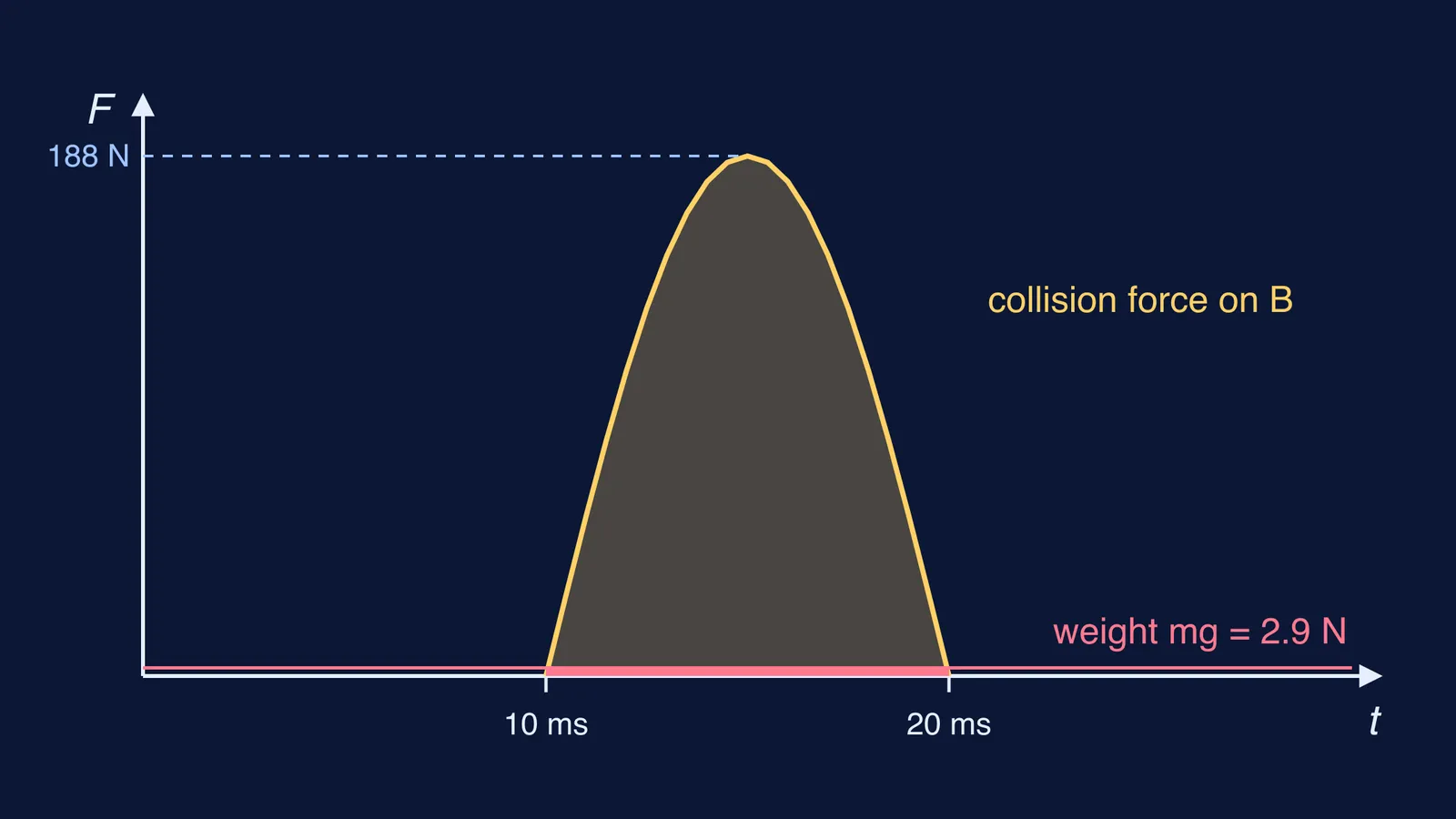
Ball A (0.20 kg) moves horizontally at 10 m/s. It hits ball B (0.30 kg), which is momentarily at rest at the top of a vertical toss. They stick together. Suppose the contact lasts 10 ms.
Horizontal momentum. Gravity has no horizontal component, so horizontal momentum is conserved exactly, with no approximation: 0.20 × 10 = 0.50 × v, so v = 4.0 m/s.
Force on B. B's momentum changes by 0.30 × 4.0 = 1.2 N s in 0.010 s, so the average contact force is 120 N. B's weight is 0.30 × 9.8 = 2.94 N. The collision force is about 41 times larger.
Gravity's impulse on the pair. 0.50 × 9.8 × 0.010 = 0.049 N s downward. That gives the pair a vertical velocity of about 0.098 m/s, roughly 2.5% of the 4.0 m/s it picks up from the collision.
Shorter contact. With a 1 ms contact the average force on B rises to 1200 N, while gravity's impulse falls to 0.0049 N s, about 0.25%.
When does the impulse approximation fail?
The argument only works when the large force is internal to your chosen system. It breaks when an external force is also impulsive.
A ball bouncing off the floor: the floor's push is the collision force, and the floor is outside the system, so the ball's momentum is not conserved. It reverses.
A bullet fired downward at an angle into a block hung on a vertical string: the string cannot pull sideways, so horizontal momentum is conserved, but it jerks tight against the downward push, so vertical momentum is not.
A rod pivoted at one end and struck: the pivot pushes back hard during the hit, so linear momentum is not conserved. Problems like this are usually solved with angular momentum about the pivot.
The Mini Physics notes on collisions put it well: a short duration can justify an approximation, but is not itself a conservation law.
How do you decide if momentum is conserved in a problem?
Run this check before you write the equation.
Choose the system so the collision forces act between its parts (internal).
List every external force acting during contact.
Drop the ones that stay ordinary in size during contact: gravity, friction, a spring at its natural length.
Keep any that become huge: floors, walls, pivots, strings that jerk tight. Momentum is not conserved along their direction.
Find a direction with no external impulsive force and conserve momentum along it.
After the collision, bring gravity back.
To practise step 4, the Fermi Problem Library has worked problems with a step-by-step solver that explains the reasoning rather than printing an answer, so you see why a force was kept or dropped. If the force-time picture feels abstract, the Fermi Simulation Lab has interactive simulations for ideas that are easier to see than to read.
Next time you write "momentum is conserved", add the reason: forces internal, collision brief, nothing external pushing hard.


