On this page
Cells, meters and electric power look like the easy end of current electricity, which is why marks slip there. Below are eight frequent slips, each with the wrong working, the physics, a fix on an original example and one habit. Everything stays inside Unit 12 (and the galvanometer part of Unit 13) of the NTA syllabus for JEE (Main), the same units of the NMC syllabus for NEET (UG)-2026, and NCERT Class 12 Physics Chapter 3 and Chapter 4. Kirchhoff loop signs are a separate topic and are not repeated here.
Which terminal voltage formula fits a cell?
Using V = E − Ir when the cell is being charged.
Wrong: a 12 V battery with internal resistance 0.5 Ω is charged at 4 A, so "V = 12 − 4 × 0.5 = 10 V".
Why it fails: NCERT's V = E − Ir holds when current leaves the positive terminal. When a charger pushes current into the positive terminal, the drop across r adds to the emf.
Fix: V = E + Ir = 12 + 2 = 14 V.
Habit: mark the current arrow at the cell first, then choose the sign of Ir.
Averaging the emfs of unequal cells in parallel.
Wrong: cells of 6 V, 1 Ω and 3 V, 2 Ω in parallel, so "E = (6 + 3)/2 = 4.5 V".
Why it fails: the plain average works only when the internal resistances are equal. NCERT's result weights each emf by the other cell's resistance: E_eq = (E₁r₂ + E₂r₁)/(r₁ + r₂) and r_eq = r₁r₂/(r₁ + r₂).
Fix: E_eq = (6 × 2 + 3 × 1)/3 = 5 V, r_eq = 2/3 Ω. Across a 4 Ω load, I = 5/(4 + 2/3) ≈ 1.07 A.
Habit: in parallel, the cell with the smaller r pulls the equivalent emf towards itself.
When does a cell deliver the most power?
Assuming the load gets most power when R is smallest.
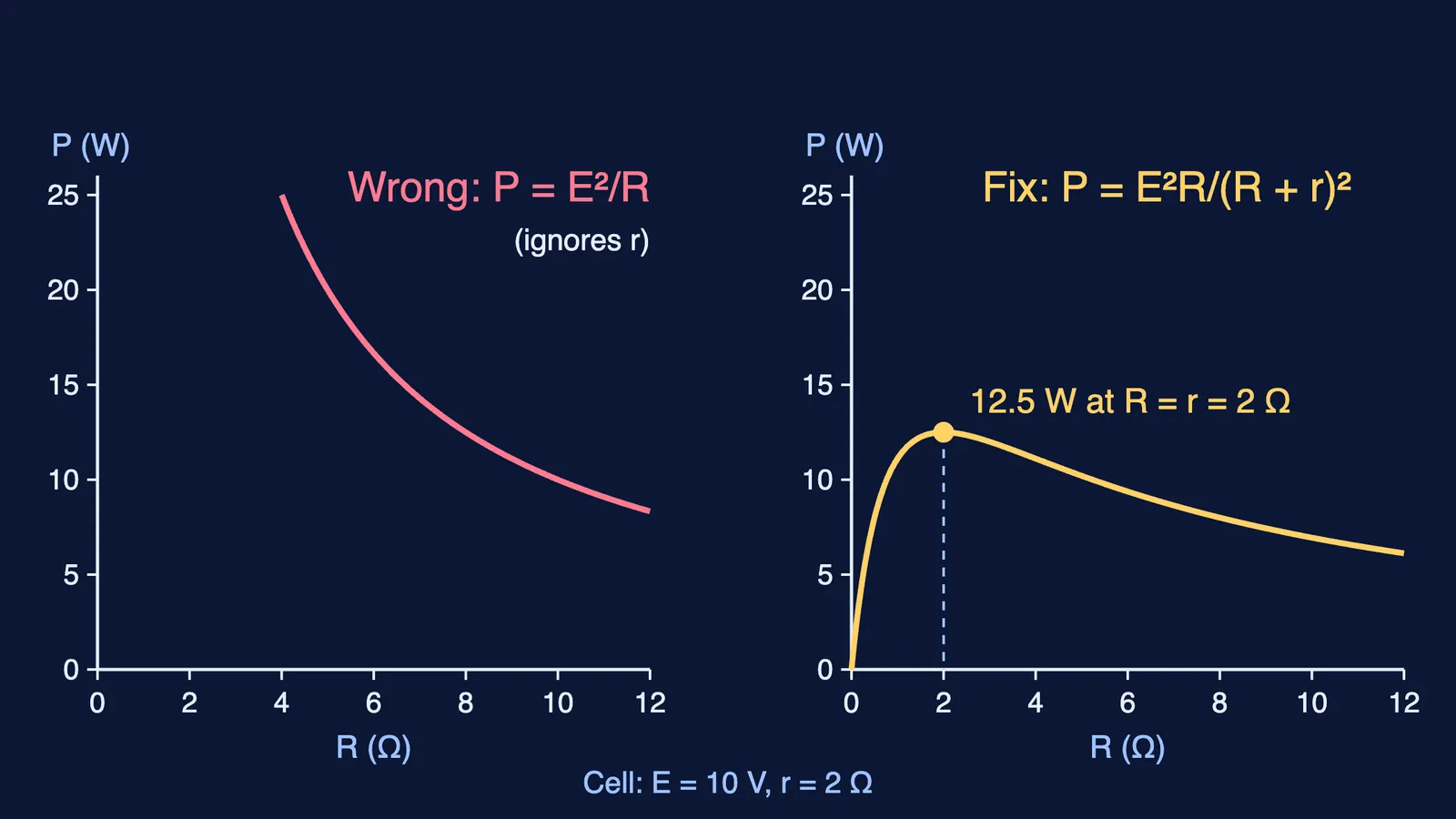
Wrong: "P = E²/R, so the smaller the load, the more power it takes; a short circuit wins."
Why it fails: E²/R ignores r. With I = E/(R + r), the load power is P = E²R/(R + r)². At R = 0 the current is largest but all the heat stays inside the cell.
Fix: for E = 10 V and r = 2 Ω, P is 11.1 W at R = 1 Ω, 12.5 W at R = 2 Ω and 11.1 W again at R = 4 Ω. The peak is at R = r, where only half the cell's power reaches the load.
Habit: whenever a cell has internal resistance, write P = I²R with I = E/(R + r), never E²/R.
Which power formula fits bulbs and loads?
Halving the voltage and halving the power.
Wrong: a 60 W, 220 V bulb on 110 V "gives 30 W".
Why it fails: the rating fixes the resistance, R = V²/P ≈ 807 Ω (taken as constant). Power then goes as V².
Fix: P = 110²/806.7 = 15 W, a quarter of the rated power.
Habit: from any rating, find R first, then use the formula for the quantity that is fixed in the new circuit.
Thinking the higher-wattage bulb glows brighter in series.
Wrong: 40 W and 60 W bulbs (both rated 220 V) in series on 220 V, "the 60 W bulb is brighter".
Why it fails: in series the current is common, so P = I²R, and the 40 W bulb has the larger resistance (1210 Ω against about 807 Ω).
Fix: I = 220/2016.7 ≈ 0.109 A, so the 40 W bulb takes about 14.4 W and the 60 W bulb about 9.6 W.
Habit: series means compare R with I²R; parallel means compare 1/R with V²/R.
How do ammeters and voltmeters change what they measure?
Dividing by the full current when choosing a shunt.
Wrong: a galvanometer of 20 Ω gives full-scale deflection at 10 mA; to read up to 50 mA, "S = I_g G/I = 0.2/0.05 = 4 Ω".
Why it fails: the shunt carries only the excess current, I − I_g, while sitting at the same voltage as the coil, as NCERT's shunt arrangement shows.
Fix: S = I_g G/(I − I_g) = (0.010 × 20)/0.040 = 5 Ω.
Habit: write "same voltage across G and S" before any shunt formula.
Treating a real voltmeter as ideal.
Wrong: two 1 kΩ resistors in series across a 12 V supply (negligible internal resistance); a 1 kΩ voltmeter across one "reads 6 V".
Why it fails: the meter sits in parallel with the resistor, making 500 Ω. NCERT notes a voltmeter must draw very little current, which is why a large resistance is added in series with the coil.
Fix: the meter reads 12 × 500/1500 = 4 V.
Habit: if a meter's resistance is given, put it in the circuit as a resistor.
How do you read a metre bridge balance?
Pairing the balance length with the wrong gap.
Wrong: a known 4 Ω in the left gap, unknown X in the right gap, balance at 40 cm from the left end, so "X = 4 × 40/60 ≈ 2.67 Ω".
Why it fails: the wire segment next to each gap pairs with that gap, so R/X = l/(100 − l), with l measured from the end beside R.
Fix: X = 4 × 60/40 = 6 Ω. Sanity check: balance falls nearer the smaller resistor, and it is near the left, so X must exceed 4 Ω.
Habit: label each gap with the length on its side before writing the ratio. Swapping the resistors to cancel end error is covered in why resistances are interchanged in the meter bridge experiment.
A 60-second self-check before you mark
Stuck on why your answer is off by a factor? The Fermi Problem Library has worked problems with a step-by-step solver that explains the reasoning rather than printing an answer.
For the full chapter plan, read Current Electricity for JEE Main: how to prepare, with solved circuits or Current Electricity for NEET: how to prepare, with worked examples. Tonight, redo one cells question you got wrong using the five checks.