On this page
The surface tension and viscosity slips below do not come from a missing formula. They happen when a correct formula gets the wrong number of surfaces, the wrong sign of cos θ, a missing buoyancy term or a thickness left in millimetres. Both the NMC NEET (UG)-2026 syllabus and the NTA Syllabus for JEE (Main) - 2027 list viscosity, Stokes' law, terminal velocity, surface energy and surface tension, angle of contact, excess pressure across a curved surface, drops, bubbles and capillary rise. The physics follows NCERT Class 11 Physics Chapter 9, Mechanical Properties of Fluids (2026-27 reprint), which writes surface tension as S. The examples use our own numbers.
How many surfaces, and which radius?
Using 4S/r for an air bubble inside water.
Wrong: an air bubble of radius 0.40 mm sits just under the surface of water (S = 0.072 N/m). "Bubble, so 4S/r = 720 Pa."
Why it fails: NCERT gives 4S/r only for a soap bubble in air, which is a film with two surfaces. An air bubble in a liquid is a cavity with one liquid-air surface, so its excess pressure is 2S/r, the same as a drop.
Fix: excess pressure = 2 × 0.072/(0.40 × 10⁻³) = 360 Pa.
Habit: count the liquid-air surfaces between inside and outside before writing 2 or 4.
Counting one surface when you blow a soap bubble.
Wrong: the work done to blow a soap bubble of radius 2.0 cm with a solution of S = 0.025 N/m is "S × 4πr² = 1.3 × 10⁻⁴ J".
Why it fails: surface tension is also surface energy per unit area, and NCERT's film derivation counts both faces (extra area 2dl). A bubble has an inner and an outer surface.
Fix: W = S × 2 × 4πr² = 0.025 × 8π × (0.020)² = 2.5 × 10⁻⁴ J.
Habit: write "area of film = 2 × geometric area" as its own line.
Why does capillary rise come out wrong?
Dropping cos θ when the contact angle is not zero.
Wrong: a liquid with S = 0.050 N/m, density 900 kg/m³ and contact angle 30° stands in a glass tube of radius 0.25 mm. "h = 2S/(ρga) = 4.5 cm."
Why it fails: the meniscus radius is a/cos θ, not a, so NCERT's result is h = 2S cos θ/(ρga). The shortcut 2S/(ρga) holds only for θ = 0.
Fix: h = 2 × 0.050 × cos 30°/(900 × 9.8 × 0.25 × 10⁻³) = 3.9 cm.
Habit: write cos θ in the formula every time, then set it to 1 only if θ = 0 is given.
Treating every capillary as a rise.
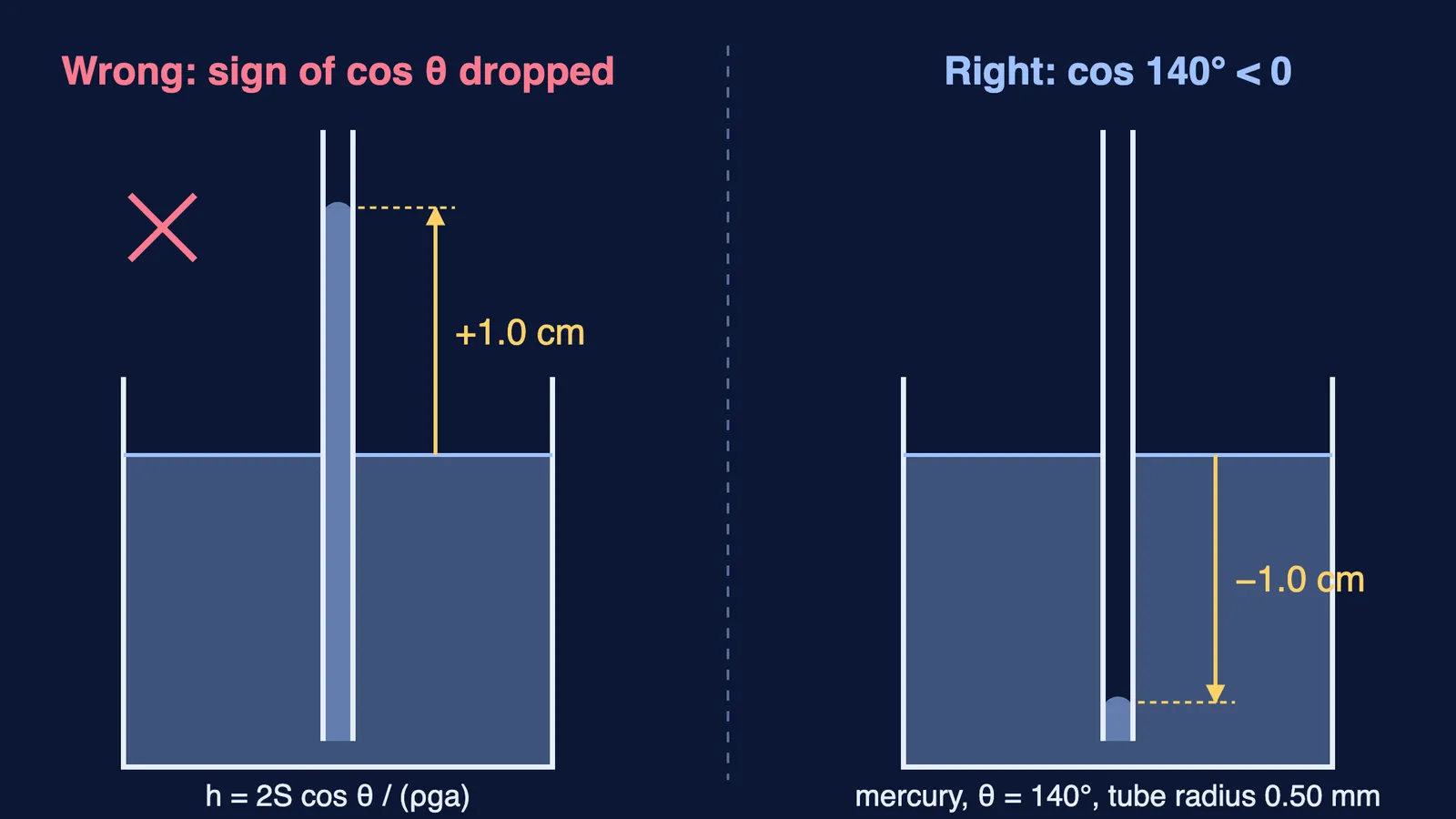
Wrong: mercury (S = 0.4355 N/m at 20 °C, NCERT Table 9.3; take ρ = 13.6 × 10³ kg/m³, contact angle 140°) in a glass tube of radius 0.50 mm. "h = 2S|cos θ|/(ρga) = 1.0 cm up."
Why it fails: for an obtuse contact angle the meniscus is convex and cos θ is negative. NCERT notes the liquid is then lower in the capillary.
Fix: h = 2 × 0.4355 × cos 140°/(13.6 × 10³ × 9.8 × 0.50 × 10⁻³) = −1.0 cm, a depression of 1.0 cm.
Habit: keep the sign of cos θ and read a negative h as "below the outside level".
Expecting water to spill from a tube that is too short.
Wrong: water (S = 0.072 N/m, θ = 0) would rise 7.3 cm in a tube of radius 0.20 mm, but only 4.0 cm of tube sticks out. "Water overflows and keeps flowing."
Why it fails: hρg = 2S/R, with R the meniscus radius. At the rim the meniscus flattens until 2S/R matches the shorter column; nothing drives a flow.
Fix: R = 2S/(ρgL) = 2 × 0.072/(1000 × 9.8 × 0.040) = 0.37 mm, about 1.8 times the tube radius. The water stops at the rim.
Habit: if the tube is shorter than h, solve for the meniscus radius, not a new height.
Where do viscosity and terminal velocity answers go wrong?
Leaving out buoyancy in terminal velocity.
Wrong: a glass bead of radius 1.2 mm and density 2600 kg/m³ sinks in a liquid of density 950 kg/m³ and viscosity 0.60 Pa s. "v = 2a²ρg/(9η) = 1.4 cm/s."
Why it fails: at terminal velocity NCERT balances weight against viscous plus buoyant force, giving v_t = 2a²(ρ − σ)g/(9η).
Fix: v_t = 2 × (1.2 × 10⁻³)² × 1650 × 9.8/(9 × 0.60) = 8.6 × 10⁻³ m/s, about 0.86 cm/s.
Habit: write weight = viscous + buoyant force first; if σ > ρ, the body rises.
Scaling terminal velocity with the number of drops.
Wrong: 125 identical mist droplets, each falling at a terminal speed of 0.40 cm/s, merge into one drop. "125 times the mass, so 125 × 0.40 = 50 cm/s."
Why it fails: volume is conserved, so the radius grows by 125^(1/3) = 5. Terminal velocity goes as a², not as mass.
Fix: v' = 5² × 0.40 = 10 cm/s.
Habit: convert "n drops merge" into R = n^(1/3) r first, then use v ∝ r².
Leaving the layer thickness in millimetres.
Wrong: a plate of area 0.20 m² slides at 0.30 m/s on an oil film 0.50 mm thick (η = 0.12 Pa s). "F = ηAv/l = 0.12 × 0.20 × 0.30/0.50 = 0.014 N."
Why it fails: η is shear stress divided by strain rate v/l, which must be in s⁻¹. With l in mm the answer is a thousand times too small.
Fix: F = 0.12 × 0.20 × 0.30/(0.50 × 10⁻³) = 14.4 N.
Habit: check units: Pa s × m² × (m/s)/m must give newtons.
Can't picture why a falling bead stops speeding up? The Fermi Simulation Lab has interactive simulations for the ideas that are easier to see than to read.
A 60-second self-check before you mark
For the whole unit, use the Properties of Solids and Liquids for NEET preparation guide or the Properties of Solids and Liquids for JEE Main preparation guide. For the elasticity half, see elasticity mistakes in JEE and NEET physics.