On this page
Prism and instrument questions in JEE Main and NEET-UG use few formulas. Errors come from using a formula outside the case it was derived for: a minimum-deviation formula fed an ordinary deviation, a near-point result used for a relaxed eye, a lens gap used as tube length. Below are nine slips, each with the wrong working, the physics, an example and a habit.
Both exams list this in Unit 16, Optics: refraction through a prism, and the microscope and astronomical telescope (reflecting and refracting) with their magnifying powers, in the NTA Syllabus for JEE (Main) 2027 and the NMC NEET (UG) 2026 syllabus. The textbook is sections 9.6 and 9.7 of NCERT Class 12 Physics Part II, Chapter 9, which takes the near point D = 25 cm.
Which prism formula fits the question?
Using the minimum-deviation formula for any deviation.
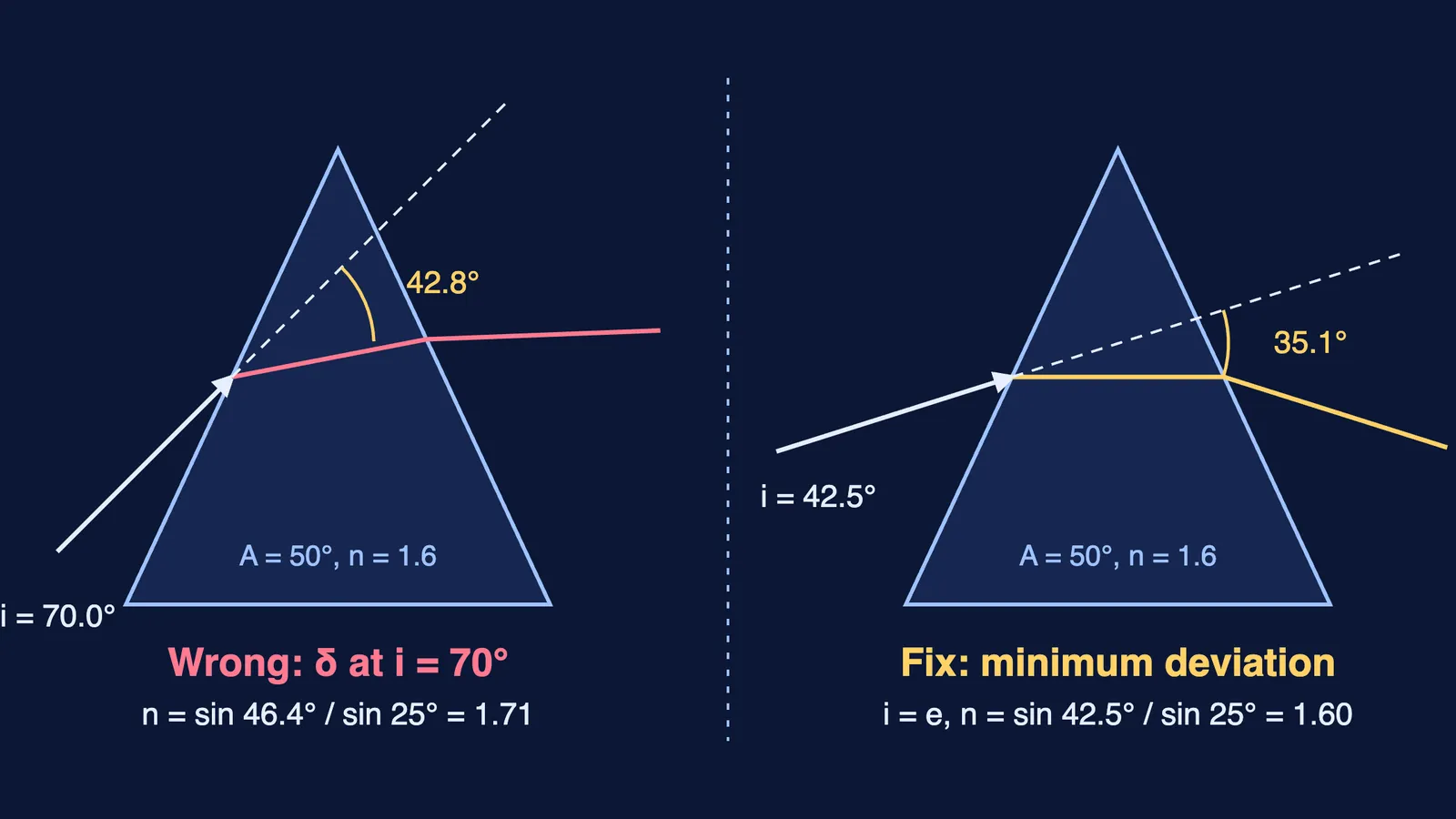
Wrong: a ray hits a prism of A = 50° at i = 70° and deviates 42.8°, so n = sin((50° + 42.8°)/2) / sin 25° = 1.71.
Why: n = sin((A + δm)/2) / sin(A/2) holds only at minimum deviation, when i = e and the ray inside runs parallel to the base. For any other ray, the NCERT section 9.6 relations are r1 + r2 = A and δ = i + e − A.
Fix: the true index is 1.60. At i = 70°, r1 = 35.97°, r2 = 14.03°, e = 22.83° and δ = 42.8°, more than the minimum of 35.1°.
Habit: use the sin formula only after reading "minimum deviation" or "i = e".
Taking i = A/2 at minimum deviation.
Wrong: for the same prism, minimum deviation happens at i = 25°.
Why: at minimum deviation it is the angle inside, r, that equals A/2. The angle outside is i = (A + δm)/2.
Fix: sin i = 1.6 × sin 25° = 0.676, so i = 42.5° and δm = 2i − A = 35.1°. A ray at 25° gives δ = 40.6°, not the minimum.
Habit: r = A/2 inside, i = (A + δm)/2 outside.
Using the thin-prism shortcut on a wide prism.
Wrong: a prism of A = 70° and n = 1.5 has δm = (n − 1)A = 35°.
Why: NCERT gets δm = (n − 1)A by replacing sines with angles, valid only for small A.
Fix: sin i = 1.5 × sin 35° = 0.860, so i = 59.4° and δm = 2i − A = 48.7°. The shortcut is about 14° short.
Habit: use (n − 1)A only for prisms of a few degrees.
How do the surrounding medium and colour change the deviation?
Using the glass index when the prism sits in a liquid.
Wrong: a thin prism of A = 8° and n = 1.56 is dipped in water, and still deviates light by 0.56 × 8° = 4.48°.
Why: NCERT writes the prism formula with n21 = n2/n1, the index of the glass relative to the medium around it.
Fix: n21 = 1.56 / (4/3) = 1.17, so δ = 0.17 × 8° = 1.36°.
Habit: write "relative to what?" next to every n.
Giving white light a single deviation.
Wrong: a thin prism of A = 4° deviates sunlight by one angle.
Why: dispersion is the splitting of light into its colours (NCERT summary); it happens because n depends on colour. Each colour obeys δ = (n − 1)A with its own n.
Fix: take n = 1.514 for red and 1.532 for violet (invented values). Red is deviated 2.056°, violet 2.128°; the colours fan out over 0.072°. Violet, with the larger n, bends more.
Habit: larger n, more deviation.
Why do microscope magnifications come out wrong?
Mixing up the two simple-microscope cases.
Wrong: a lens of f = 4 cm forms the image at the near point, so m = D/f = 6.25.
Why: NCERT gives m = 1 + D/f for an image at the near point and m = D/f for an image at infinity.
Fix: at the near point, m = 1 + 25/4 = 7.25; at infinity, 6.25.
Habit: underline where the final image is before choosing the formula.
Using the lens separation as the tube length.
Wrong: a compound microscope has fo = 0.8 cm and fe = 2.5 cm with the lenses 19.3 cm apart, so m = (19.3/0.8)(25/2.5) = 241.
Why: in m = (L/fo)(D/fe), the NCERT tube length L is the distance between the second focal point of the objective and the first focal point of the eyepiece, not between the lenses.
Fix: L = 19.3 − 0.8 − 2.5 = 16.0 cm, so m = 20 × 10 = 200 with the final image at infinity.
Habit: mark both focal points before reading off L.
What goes wrong in telescope questions?
Using the radius of the mirror as the objective's focal length.
Wrong: a reflecting telescope has a concave mirror of radius of curvature 3.0 m and an eyepiece of fe = 2.5 cm, so m = 300/2.5 = 120.
Why: m = fo/fe needs the focal length, and for a mirror f is about R/2.
Fix: fo = 150 cm, so m = 150/2.5 = 60.
Habit: when a mirror's R is given, halve it on the first line.
Treating telescope magnification as a size ratio.
Wrong: a telescope with fo = 90 cm and fe = 3 cm makes a distant tower 30 times taller, in a tube 87 cm long.
Why: a telescope multiplies the angle the object subtends, β/α = fo/fe. In normal adjustment, NCERT puts the tube length at fo + fe.
Fix: m = 90/3 = 30 and the tube is 93 cm. Two lamps 0.4° apart appear about 12° apart.
Habit: think angles, not sizes; add focal lengths for tube length.
What should you check in the last 60 seconds?
Stuck on why your answer is off? The Fermi Problem Library has worked problems with a step-by-step solver that explains the reasoning rather than printing an answer.
For syllabus maps and a study plan, read our Optics for NEET preparation guide and our Ray Optics for JEE Main preparation guide.