On this page
Dipole and Gauss's law questions in JEE Main and NEET-UG are short, so one wrong direction or a formula used outside its conditions costs the whole answer. Here are eight frequent slips, each with the wrong working, the physics, a fix on fresh numbers and a habit. Field-versus-potential, sign and conductor slips belong to electrostatics in general, so we leave them out.
Everything below sits inside the dipole, flux and Gauss's law topics listed in the NMC NEET (UG) 2026 syllabus and the NTA JEE (Main) physics syllabus. Definitions follow Chapter 1 of NCERT Class 12 Physics Part I, with k = 9 × 10⁹ N m²/C² and ε₀ = 8.85 × 10⁻¹² C²/N m².
Which way does the dipole moment point, and how big is it?
Drawing p from + to − and using half the separation.
Wrong: charges of ±5 nC sit 4 mm apart. "p points from + to −, like the field lines, and p = qa = 5 nC × 2 mm = 1 × 10⁻¹¹ C m."
Why it fails: NCERT defines p = q × 2a, where 2a is the full separation, and its direction is from −q to +q (NCERT, Section 1.10).
Fix: p = 5 × 10⁻⁹ C × 4 × 10⁻³ m = 2 × 10⁻¹¹ C m, pointing from the negative charge to the positive one.
Habit: draw p as an arrow from − to + before writing any formula.
When can you use the dipole field formulas?
Swapping the axial and equatorial results.
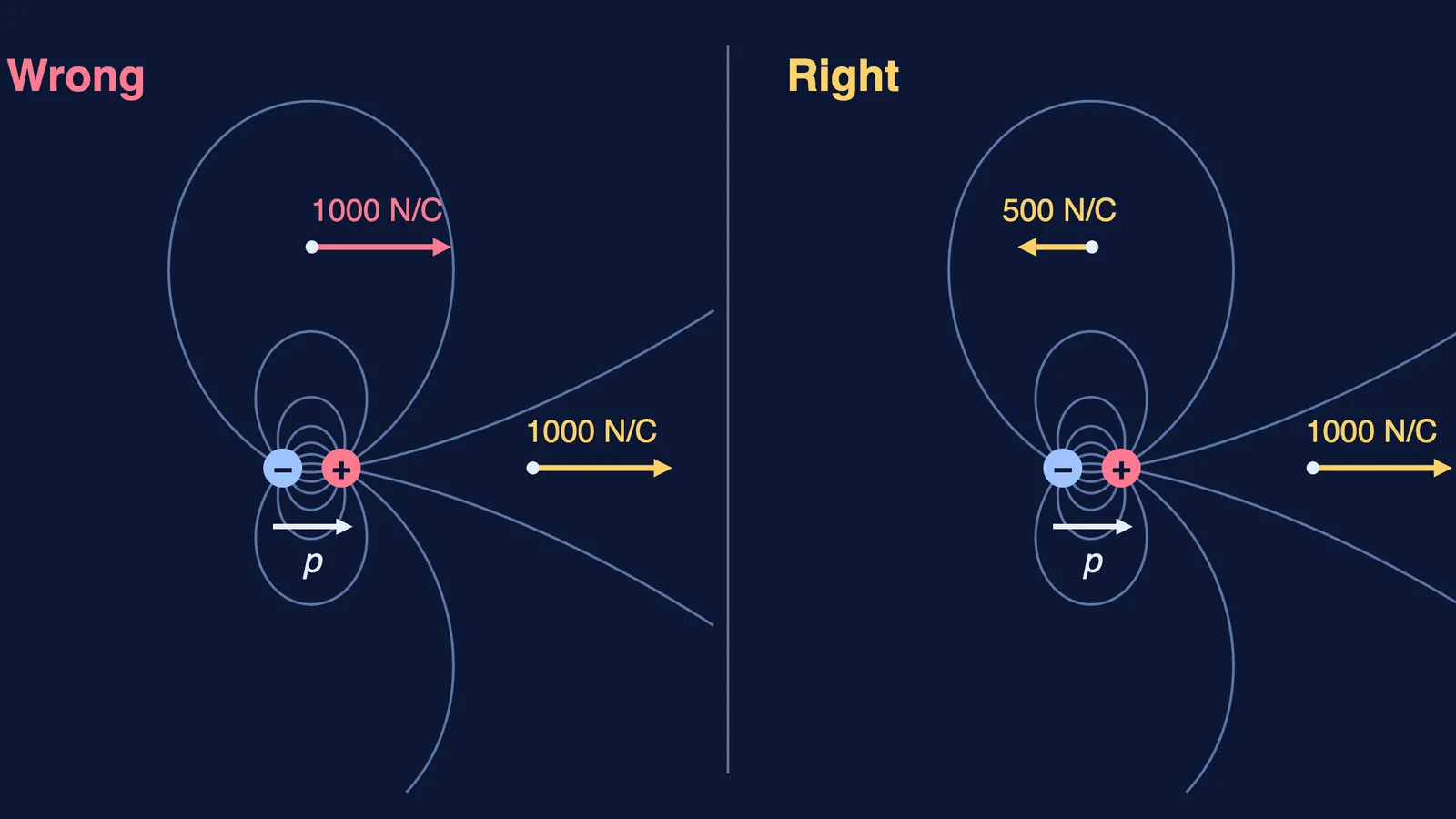
Wrong: a dipole with p = 1.5 × 10⁻⁹ C m; at 0.3 m on the equatorial line, "E = 2kp/r³ = 1000 N/C along p."
Why it fails: NCERT, Section 1.10.1 gives E = 2p/(4πε₀r³) on the axis, along p, and E = −p/(4πε₀r³) on the equatorial plane: half the size and opposite to p.
Fix: kp/r³ = (9 × 10⁹)(1.5 × 10⁻⁹)/(0.3)³ = 500 N/C. Equatorial: 500 N/C, opposite to p. Axial, at the same distance: 1000 N/C, along p.
Habit: on the equatorial line, the field always points back against p.
Using the short-dipole formula when the point is close.
Wrong: ±2 nC charges 4 cm apart (p = 8 × 10⁻¹¹ C m); on the axis 5 cm from the centre, "E = 2kp/r³ = 11 520 N/C."
Why it fails: NCERT marks both dipole formulas "r >> a". Here r is only 2.5 times a.
Fix: add the two Coulomb fields: E = kq[1/(r − a)² − 1/(r + a)²] = 18 × (1111.1 − 204.1) ≈ 16 300 N/C. The shortcut is about 30% low. At 50 cm the two methods agree to within 0.4%.
Habit: compare r with a first; if r is less than about ten times a, use the exact sum.
Torque and force on a dipole: what goes wrong?
Using cos θ for torque.
Wrong: p = 6 × 10⁻⁹ C m at 30° to E = 2.5 × 10⁴ N/C, "τ = pE cos 30° = 1.30 × 10⁻⁴ N m."
Why it fails: NCERT derives τ = p × E, with magnitude pE sin θ, where θ is the angle between p and E (NCERT, Section 1.11). Torque must vanish when p is aligned with E.
Fix: τ = (6 × 10⁻⁹)(2.5 × 10⁴)(0.5) = 7.5 × 10⁻⁵ N m.
Habit: test your formula at θ = 0; torque there must be zero.
Assuming a dipole never feels a net force.
Wrong: "the forces on +q and −q are equal and opposite, so F = 0" in a field that changes with position.
Why it fails: NCERT says the net force is zero only when E is uniform; in a non-uniform field a dipole parallel to E is pulled towards the stronger field.
Fix: a dipole of ±10 nC lies along a field that is 3000 N/C at −q and 3200 N/C at +q. Net force = (10 × 10⁻⁹)(3200 − 3000) = 2 × 10⁻⁶ N, towards the stronger field.
Habit: before writing F = 0, check the question says "uniform".
Where do flux and Gauss's law go wrong?
Measuring the flux angle from the surface.
Wrong: a uniform 400 N/C field crosses a flat 0.05 m² sheet at 30° to its plane. "φ = EA cos 30° = 17.3 N m²/C."
Why it fails: NCERT, Section 1.9 defines φ = E·ΔS = EΔS cos θ, where θ is the angle between E and the area vector, which lies along the normal.
Fix: the angle with the normal is 60°, so φ = 400 × 0.05 × 0.5 = 10 N m²/C.
Habit: draw the normal first, then measure θ from it.
Counting outside charges, or reading zero flux as zero field.
Wrong: +6 nC lies inside a closed sphere and −8 nC just outside. "Net charge is −2 nC, so φ = −226 N m²/C."
Why it fails: NCERT notes that q in Gauss's law is only the charge enclosed, while the field on the surface is due to all charges, inside and outside.
Fix: φ = 6 × 10⁻⁹/8.85 × 10⁻¹² ≈ 678 N m²/C. The converse trap: a closed surface around a whole dipole has zero flux, yet the field on that surface is not zero.
Habit: circle only the charges inside the surface before dividing by ε₀.
Using σ/ε₀ for a thin charged sheet.
Wrong: an infinite sheet carries σ = 1.77 × 10⁻⁸ C/m². "E = σ/ε₀ = 2000 N/C, and it halves if you move twice as far."
Why it fails: NCERT's Gaussian cylinder has two flat faces, so 2EA = σA/ε₀, giving E = σ/2ε₀, independent of distance.
Fix: E = 1.77 × 10⁻⁸/(2 × 8.85 × 10⁻¹²) = 1000 N/C on both sides, at any distance.
Habit: count how many faces of your Gaussian surface carry flux before dividing.
A 60-second self-check before you mark
For the wider plan, see our guides to Electrostatics for NEET and Electrostatics for JEE Main.
Finding it hard to picture which way a dipole's field points? The Fermi Simulation Lab has interactive simulations for the ideas that are easier to see than to read.