On this page
Whirl a bob on a string not quite fast enough, and somewhere in the upper half the string sags and the bob leaves the circle. JEE questions ask where, and what the bob does next.
Why does a string go slack at all?
A string can pull but it cannot push. As physicist Richard Fitzpatrick's University of Texas notes on the vertical pendulum explain, if the tension in a string ever becomes negative, the string becomes slack and collapses. So slack means the tension has fallen to zero.
The NCERT Class 11 textbook works the boundary case in Example 5.7 of the Work, Energy and Power chapter. If the string is to slacken only at the topmost point, the bob needs √(5gL) at the lowest point and has √(gL) at the top, where the tension is exactly zero. Launch it any slower and the tension reaches zero earlier, before the top.
At what angle does the string become slack?
Let a bob of mass m start at the lowest point with speed u on a string of length L, and let θ be the angle of the string from the downward vertical. Energy conservation gives the speed at θ: v² = u² − 2gL(1 − cos θ). Along the string, the net inward force supplies the centripetal force: T − mg cos θ = mv²/L.
Combining the two gives T = mu²/L + mg(3 cos θ − 2), as in the Fitzpatrick lecture notes. Set T = 0 and solve:
cos θ = (2gL − u²)/(3gL)
That is the slack angle. Two other forms are quicker in an exam. If α is the angle of the string above the horizontal at that moment, sin α = (u² − 2gL)/(3gL). At that instant the speed satisfies v² = gL sin α, and the bob is at a height L(1 + sin α) above the lowest point.
Which launch speeds make the string go slack?
u ≤ √(2gL): the bob never rises above the pivot's level. It stops with the string taut and swings back like a pendulum.
√(2gL) < u < √(5gL): the tension reaches zero above the horizontal, before the top. This is the slack case.
u ≥ √(5gL): the bob completes the loop, as in the NCERT example.
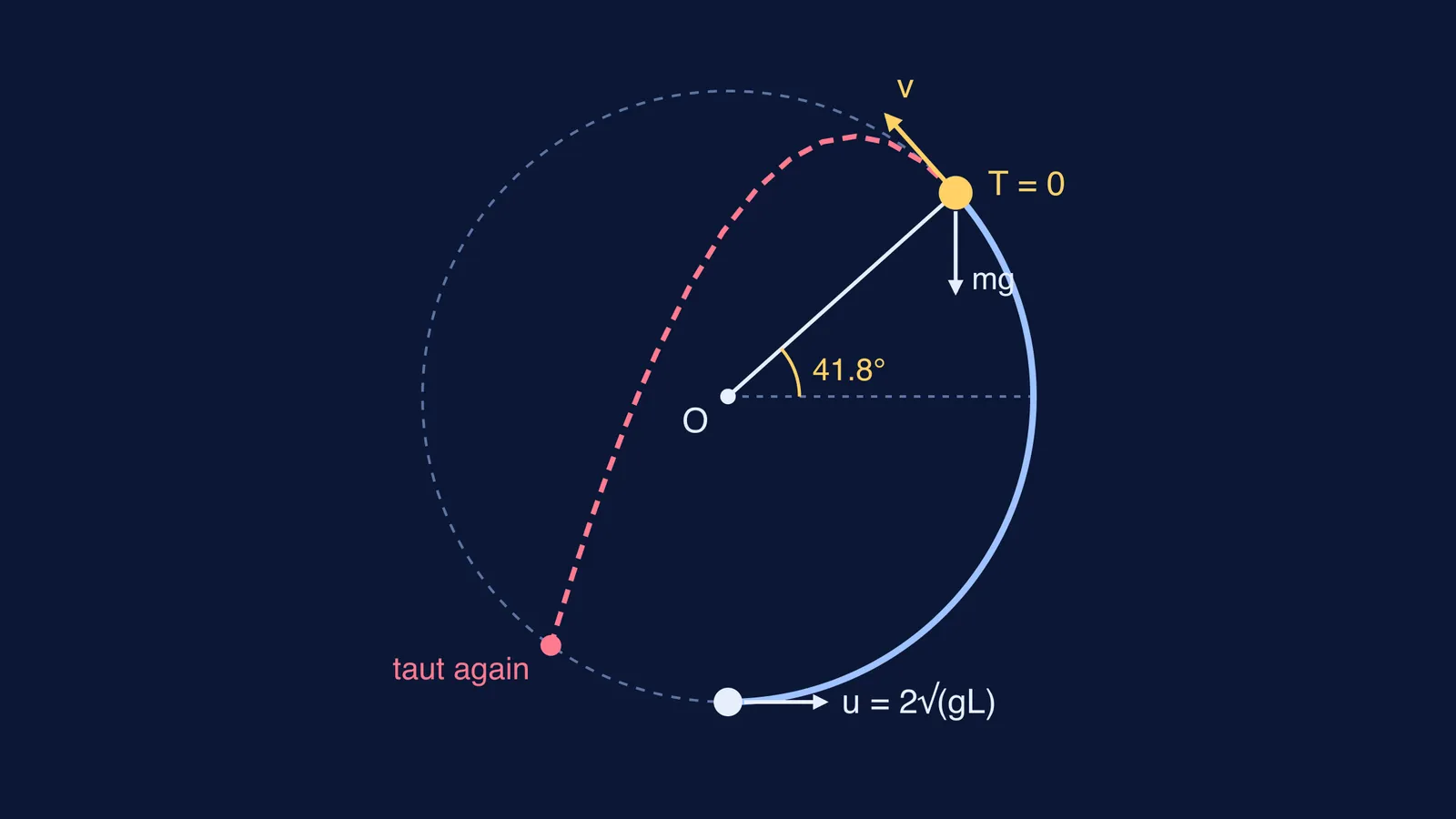
Worked example: what if u = 2√(gL)?
Here u² = 4gL lies between 2gL and 5gL, so the string goes slack.
Angle: cos θ = (2gL − 4gL)/(3gL) = −2/3, so θ ≈ 131.8° from the lowest point, or α ≈ 41.8° above the horizontal.
Speed: v² = gL × 2/3, so v = √(2gL/3), about 0.82√(gL).
Height: L(1 + 2/3) = 5L/3 above the lowest point.
Direction: the velocity is along the tangent, perpendicular to the string, so it points 90° − 41.8° = 48.2° above the horizontal, tilted back towards the centre line.
From here the bob is a projectile. Its vertical velocity is v cos α, so it rises a further v² cos² α/(2g) = (2L/3)(5/9)/2 = 5L/27. Its highest point is 2L/3 + 5L/27 = 23L/27, about 0.85L above the pivot, so it never reaches the top of the circle.
What happens after the string goes slack?
Only gravity acts, so the bob follows a parabola inside the circle while the string hangs loose. NCERT makes the same point for the top of the circle: if the string is cut there, the bob moves as a projectile launched horizontally (NCERT Class 11 Physics, Example 5.7).
The parabola later meets the circle again and the string snaps tight. Because the launch velocity is perpendicular to the string and v² = gL sin α, the algebra gives a tidy time for this: t = 4v cos α/g. In the worked example that is about 2.43√(L/g), and the bob meets the circle roughly 35° from the lowest point, on the opposite side. For the jerk that follows, see our post on impulse when a slack string becomes taut.
A checklist for slack-string questions
Compare u² with 2gL and 5gL to find your case.
State your angle: θ from the lowest point, or α above the horizontal.
Use T = 0 with energy conservation. Never set v = 0 for the slack point.
After slack, switch to projectile motion along the tangent.
On a rod, the rule changes: see why a rigid rod needs less speed than a string. For top versus bottom tension, see the 6mg tension difference, derived.
To practise with other launch speeds, the Fermi Problem Library has worked problems with a step-by-step solver that explains the reasoning, and the Fermi Simulation Lab has interactive simulations for ideas that are easier to see than to read.
Try it now with u = √(3gL): you should get cos θ = −1/3, or about 19.5° above the horizontal.