

On this page
Imagine whirling a stone tied to a thread in a vertical circle. Now imagine attaching the same stone to a stiff, lightweight stick and swinging it. Does it take the same effort to get them over the top of the loop? Physics tells us no. The minimum speed you need to impart at the bottom depends entirely on whether the object connecting them can push, or only pull. This distinction is one of the classic problems in classical mechanics.
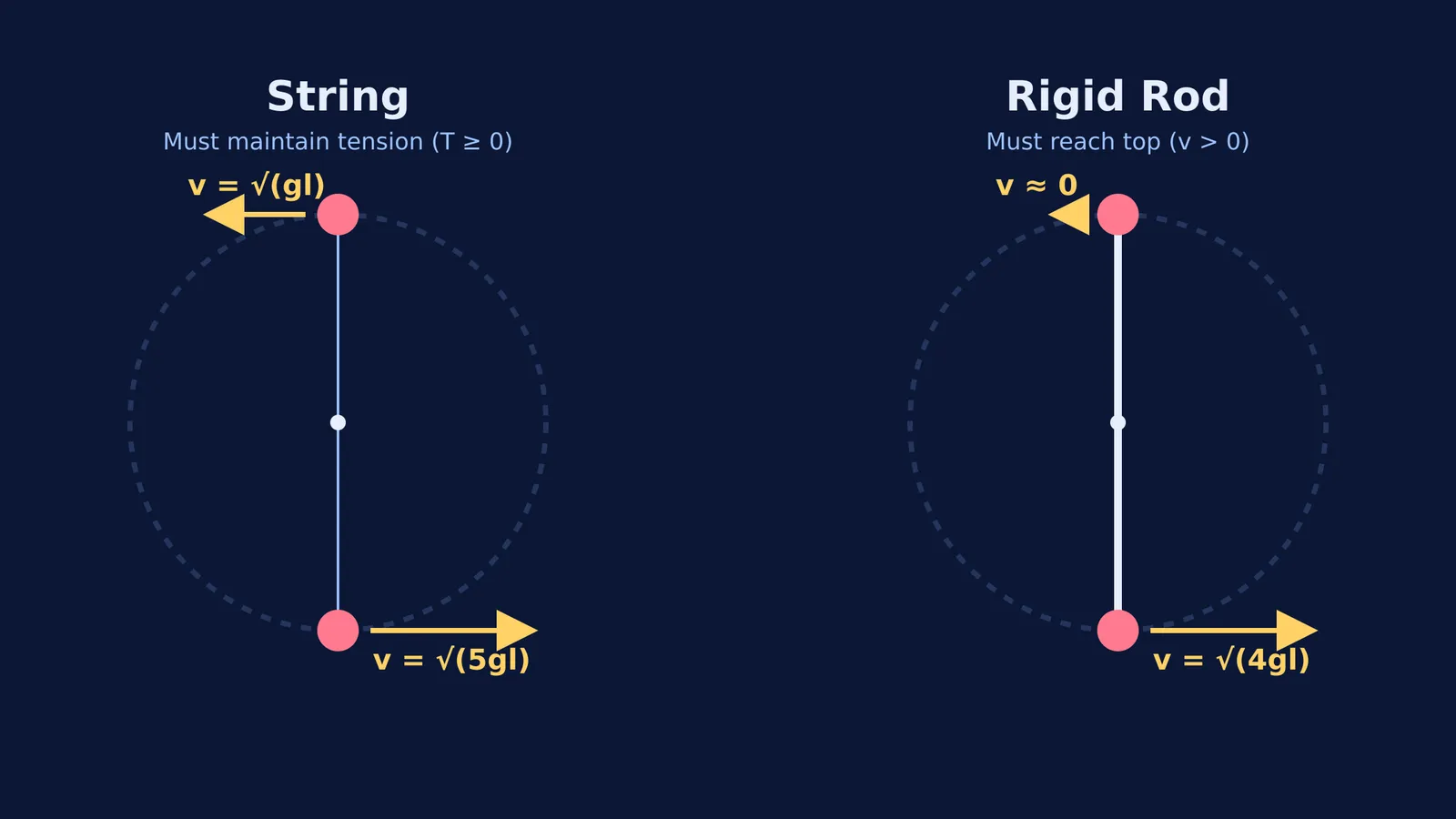
Why does a string need a minimum speed of √(gl) at the top?
The key difference lies in the nature of the connection. A string is flexible; it can only exert a pulling force (tension). It cannot push.
If the stone moves too slowly as it approaches the highest point of the circle, the string goes slack. When this happens, the stone falls out of its circular path and traces a parabolic arc downwards. To prevent this, the string must remain taut at the very top. This means the tension T must be greater than or equal to zero (T ≥ 0).
At the absolute minimum speed, the tension drops exactly to zero right at the peak. At this instant, gravity alone provides the necessary inward centripetal force to keep the mass turning in a circle of radius l. We can write this as:
`mg = mv²/l`
Cancelling the mass m and rearranging for v gives the minimum speed at the top: `v = √(gl)`.
How do you find the speed at the bottom for a string?
To find out how fast the mass must be moving at the bottom to achieve this top speed, we use the principle of conservation of mechanical energy.
As the mass swings from the lowest point to the highest point, it climbs a vertical distance equal to the diameter of the circle, which is 2l. Therefore, it gains gravitational potential energy equal to `mg(2l)`. According to the law of conservation of energy, this energy must come from the kinetic energy the mass originally had at the bottom of the path.
Equating the total energy at the bottom to the total energy at the top:
`½mv_bottom² = ½mv_top² + mg(2l)`
Substitute the minimum top speed we just found (`v_top = √(gl)`):
`½mv_bottom² = ½m(gl) + 2mgl`
Multiply the entire equation by 2/m:
`v_bottom² = gl + 4gl = 5gl`
Therefore, the minimum speed at the bottom for a string is v = √(5gl). Just as you balance forces to find the simple pendulum string tension at any angle, you must ensure the tension never drops below zero here.
Why is a rigid rod different from a string?
A rigid rod is a solid object. Unlike a flexible string, it can pull (provide tension) and it can also push (provide compression). This structural difference completely changes the boundary conditions at the top of the loop.
If a mass on a rigid rod slows down as it reaches the top, the rod will not collapse or go slack. Instead, it will simply push upward against gravity to support the weight of the mass. Because the rod physically forces the mass to stay at a constant radius no matter how slow it moves, there is no risk of the mass falling out of the circular path.
The only requirement for a rigid rod to complete the full circle is that the mass actually reaches the highest point. It just needs enough kinetic energy at the bottom to overcome the potential energy difference. Therefore, its speed at the very top can be infinitesimally close to zero:
`v_top ≈ 0`
What is the minimum speed at the bottom for a rigid rod?
We apply the same conservation of energy equation, but this time we set the kinetic energy at the top to zero.
`½mv_bottom² = 0 + mg(2l)`
Multiply by 2/m:
`v_bottom² = 4gl`
This gives a minimum speed at the bottom of `v = √(4gl)`.
By comparing the two, you can see that it takes less initial speed (and thus significantly less initial kinetic energy) to push a mass over a loop on a stick than it does to swing it on a flexible string. This fundamental shift from a tension constraint to a simple energy constraint appears often in physics problems, much like analyzing what happens when cutting a string in a spring system instantly removes a tension force while the rest of the system readjusts.
Mastering these constraints—whether it is T ≥ 0 for strings, or normal force N ≥ 0 for surfaces—is crucial for scoring well in mechanics. If you have concept gaps when applying these conditions to different scenarios, the Fermi Concept Library covers every concept in physics, chemistry, biology, mathematics and computing.


