

On this page
When a stone tied to a string is whirled in a vertical circle, the tension in the string changes constantly. For students preparing for physics exams like JEE or NEET, one of the most useful facts to know is that the difference in tension between the lowest point and the highest point is always exactly 6mg, where m is the mass and g is the acceleration due to gravity.
Understanding where this constant comes from saves you from having to derive it from scratch under exam pressure. It is a direct result of combining Newton's Second Law with the law of conservation of mechanical energy.
What are the forces at the bottom and top?
To find the tension, we must set up the force equations at the two extreme points of the circle. At any point, the net force acting towards the centre of the circle provides the centripetal force, m × v² / r, where v is the velocity and r is the radius.
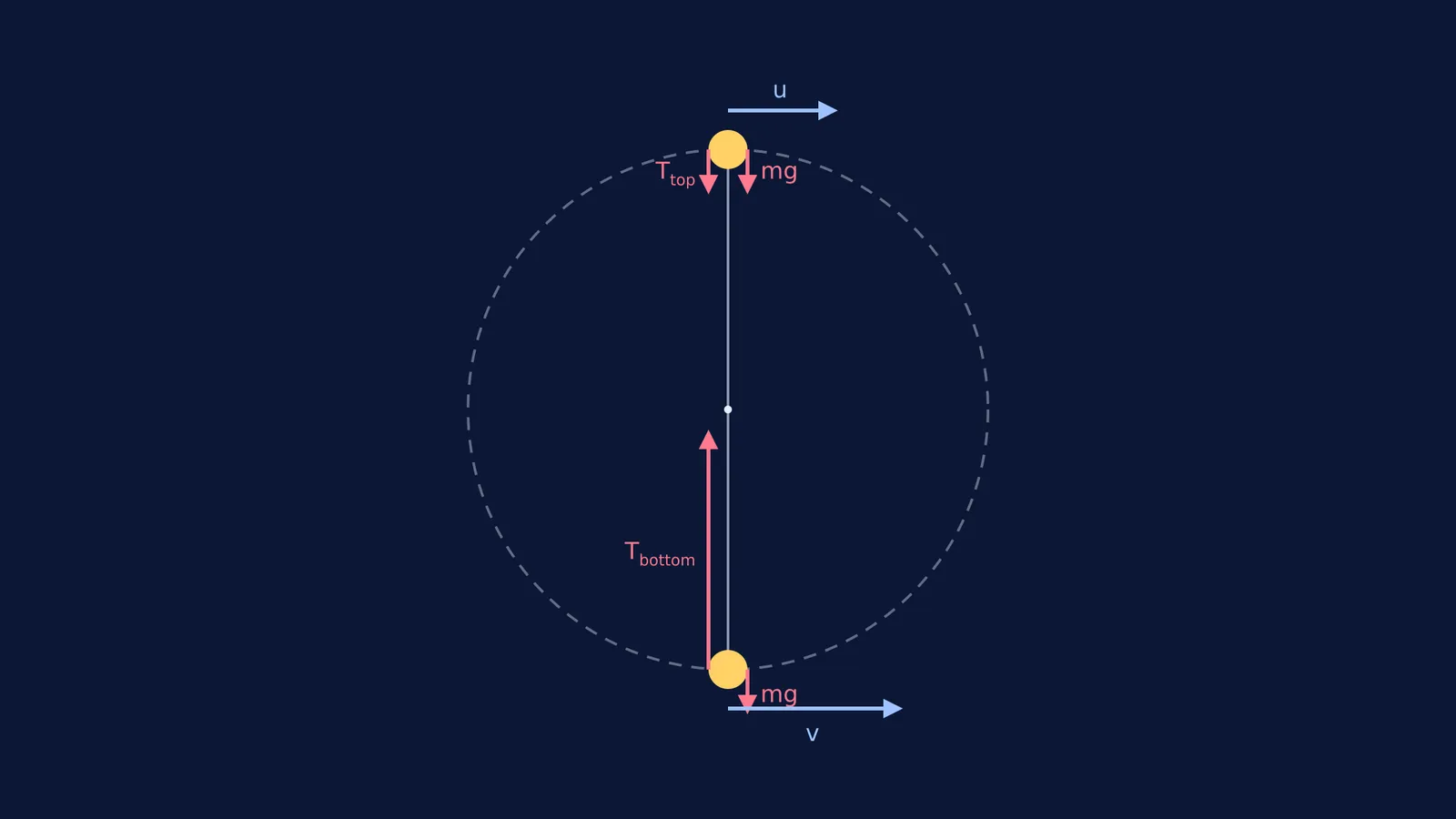
At the lowest point (the bottom), let the velocity be v. The tension T_bottom pulls upwards towards the centre, while the weight mg pulls downwards. The net force is their difference. This gives us the equation for the bottom: T_bottom - mg = m × v² / r
Rearranging this to solve for tension gives: T_bottom = m × v² / r + mg
At the highest point (the top), let the velocity be u. Both the tension T_top and the weight mg point downwards towards the centre. The net force is their sum, leading to the equation for the top: T_top + mg = m × u² / r
Solving for tension gives: T_top = m × u² / r - mg
How does conservation of energy connect them?
Because the only force doing work on the stone is gravity (tension acts perpendicular to the motion), the total mechanical energy of the system is conserved. The energy at the bottom equals the energy at the top.
Let us set the potential energy at the lowest point to zero.
Total energy at the bottom: 1/2 × m × v²
Total energy at the top: 1/2 × m × u² + mg × (2r), because the stone has risen by the diameter 2r.
Equating the two: 1/2 × m × v² = 1/2 × m × u² + 2mgr
If we multiply the entire equation by 2/r, we get: m × v² / r - m × u² / r = 4mg
This equation tells us that the difference in the centripetal force term between the bottom and the top is exactly 4mg, entirely due to the kinetic energy lost as the stone climbs against gravity.
Why is the tension difference exactly 6mg?
Now we can find the difference in tension between the lowest and highest points by subtracting our top tension equation from our bottom tension equation:
T_bottom - T_top = (m × v² / r + mg) - (m × u² / r - mg)
Grouping the terms gives: T_bottom - T_top = (m × v² / r - m × u² / r) + 2mg
From our energy conservation step, we know the term in the brackets is equal to 4mg. Substituting that value in: T_bottom - T_top = 4mg + 2mg = 6mg
This result is a mathematical constant for any complete vertical circle. The difference does not depend on the radius of the circle or the initial velocity of the stone, provided the stone is moving fast enough to keep the string taut at the top.
If you get stuck trying to set up energy equations for complex motion problems, the step-by-step solver in the Fermi Problem Library explains the reasoning behind each force and energy substitution rather than just printing an answer.
You can apply the same core principles to related setups, such as finding the simple pendulum string tension at any angle, or analysing normal forces in weighing machine readings in a lift. Mastering how to link force with energy will make you much faster at solving mechanics questions.


